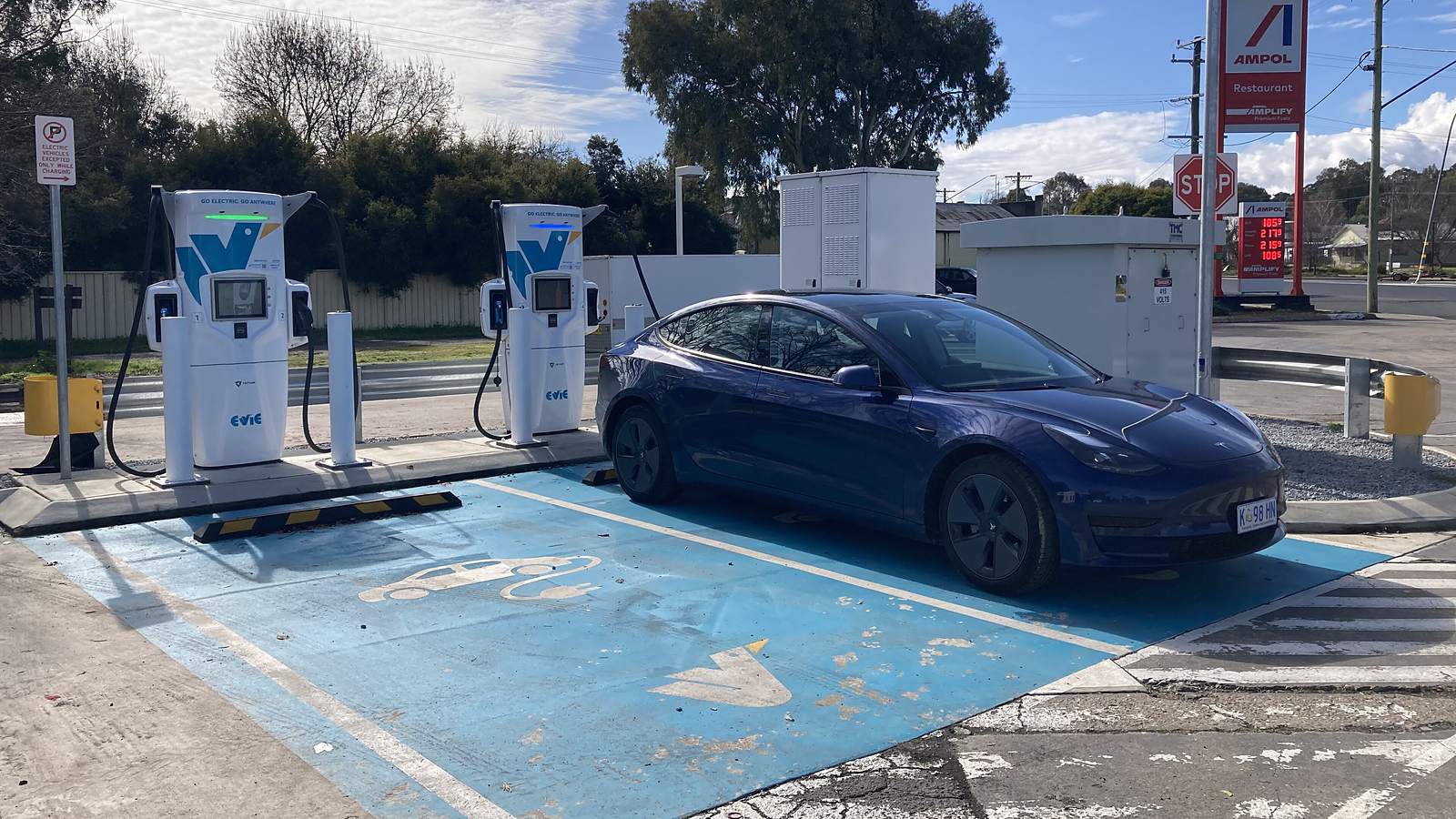

Ampol has agreed to buy Evie Networks, one of Australia's biggest public fast-charging networks, for $225 million. The deal would more than triple the number of charging bays Ampol runs, taking it to about 1,425 across more than 400 sites.
Ampol announced the purchase to the ASX on Thursday 1 October. It still needs clearance from the competition regulator, the ACCC, and Ampol expects to complete it in the first half of 2027.
What Ampol is buying
Evie Networks trades under the Evie name, but the company Ampol is actually buying is Fast Cities Australia Pty Ltd. It's been building and running chargers for nine years, according to Ampol, with fast and ultra-fast stations in cities, regional towns and along highways.
Ampol's own charging brand is AmpCharge, which runs bays at many of its service stations. Evie would add more than 1,030 bays to that network, according to Ampol's announcement. Together, the two would have about 1,425 charging bays nationally, across more than 400 sites. Those figures are as at 29 September. Ampol says Evie's network numbers came from Evie's management and it hasn't checked them independently.
Ampol's investor presentation goes further. It ranks Australia's public DC fast-charging operators by number of bays. On that measure, the combined AmpCharge and Evie network would sit at the top of Ampol's chart, with about 1,424 bays. The next biggest operator on the chart has about 1,230. In its announcement, Ampol itself calls the combined network one of Australia's largest.
Evie also brings customers. Ampol said the deal would add about 380,000 registered Evie users, meaning people who've signed up through the Evie app.
The chargers range from 50 kW units for destination charging up to 350 kW and above on key routes, according to the presentation.
Why Ampol wants Evie
Ampol is best known for petrol. It runs one of Australia's two remaining oil refineries, a national service station network and a big fuel card business for fleets. Ampol calls the Evie deal a significant step in growing its public charging network.
Chief executive Matt Halliday was clear about why the timing works. "For Ampol, EV charging is ultimately a question of disciplined investment at the right time," he said. "That means closely monitoring customer behaviour, EV uptake, site economics, grid connections and the broader charging network to ensure our capital is deployed where it can create the greatest value."
Halliday pointed to Ampol's own charging numbers. "Within the AmpCharge network, utilisation has increased year on year, with charging sessions increasing 116% and energy supplied increasing 120% in the first half of 2026," he said. "This gives us confidence in the strength of the business case that complements our traditional fuels business."
The sites themselves are a big part of what Ampol's paying for. Ampol said Evie's locations have an average lease term of about 10 years, including options, and they're already connected to the grid. Some also have spare grid capacity. Ampol says that gives it a faster, cheaper way to meet growing demand for public charging than building from scratch.
"Evie's high quality, attractive long-term tenure sites with established grid connections and some with expansion capacity, provides Ampol with an opportunity to grow its charging footprint at scale and at pace," Halliday said.
He also gave credit to the man behind Evie. "Evie's principal shareholder, Trevor St Baker AO, has been a genuine pioneer of Australia's EV charging industry and his vision and capability have helped build Evie's national platform and the foundations for broader EV adoption across Australia," Halliday said.
EVs reach a new stage in Australia
The deal comes in a strong year for electric cars here. Ampol said electric vehicles have made up more than 20% of new cars sold in Australia, on average, over the last five months.
In August, battery-electric cars outsold petrol cars for the first time, with 27,078 sales and 24.9% of the market.
Halliday argued that public charging has to keep up. "Public charging infrastructure is a precondition for broad electric vehicle adoption," he said. "That is particularly acute in a country the size of Australia, where long distances between charging locations can contribute to 'range anxiety' and deter motorists from purchasing an EV."
He also pointed out that lots of drivers can't charge at home. "A substantial portion of Australian households have no practical means of charging at home, while public infrastructure is also critical for commercial fleets, rideshare operators and customers travelling longer distances," he said.
Ampol's ASX release cited independent analysis by Rystad Energy, dated July 2026. It found public DC fast charging is the largest value pool in Australia's electric vehicle charging market. Ampol added that the segment is still under-developed compared with other countries, and is expected to grow a lot over the coming decade as more Australians switch to battery-electric cars.
Coverage on Australia's main roads has already improved. On the busy east-coast and south-eastern routes, the Hume, Pacific, Bruce and Western highways have no big fast-charger gaps. And charger spacing on the Eyre Highway means the Nullarbor gap has got smaller.
The money, and what happens next
The deal will be fully debt funded, Ampol told the ASX (release), and it said the impact on its borrowing levels would be nominal.
The company is targeting about $10 million a year in savings, mostly from cutting costs, within three years of completion. It expects the combined charging business to break even on an EBITDA basis in 2028, the first full calendar year after the deal closes. Ampol's aiming for annualised EBITDA of $30 million or more within three years. That figure includes the wider Energy Solutions unit the charging business sits in, and Ampol expects double-digit annual growth after that. These are targets, not guarantees, and Ampol's presentation says so.
For drivers, nothing changes yet. Evie and AmpCharge stay separate networks for now. Ampol and Evie will keep operating independently until the ACCC clears the deal and it completes, Ampol said. Full integration is then expected to take about three years.
If the deal goes through, a fuel company will run what Ampol's own chart shows as the country's largest public fast-charging network by bay count. With EVs passing a fifth of new car sales, it's a sign the people who sell fuel for a living now see charging as a business worth backing at scale.
The paper
Comments
No notes on this story yet.
Sign in to comment