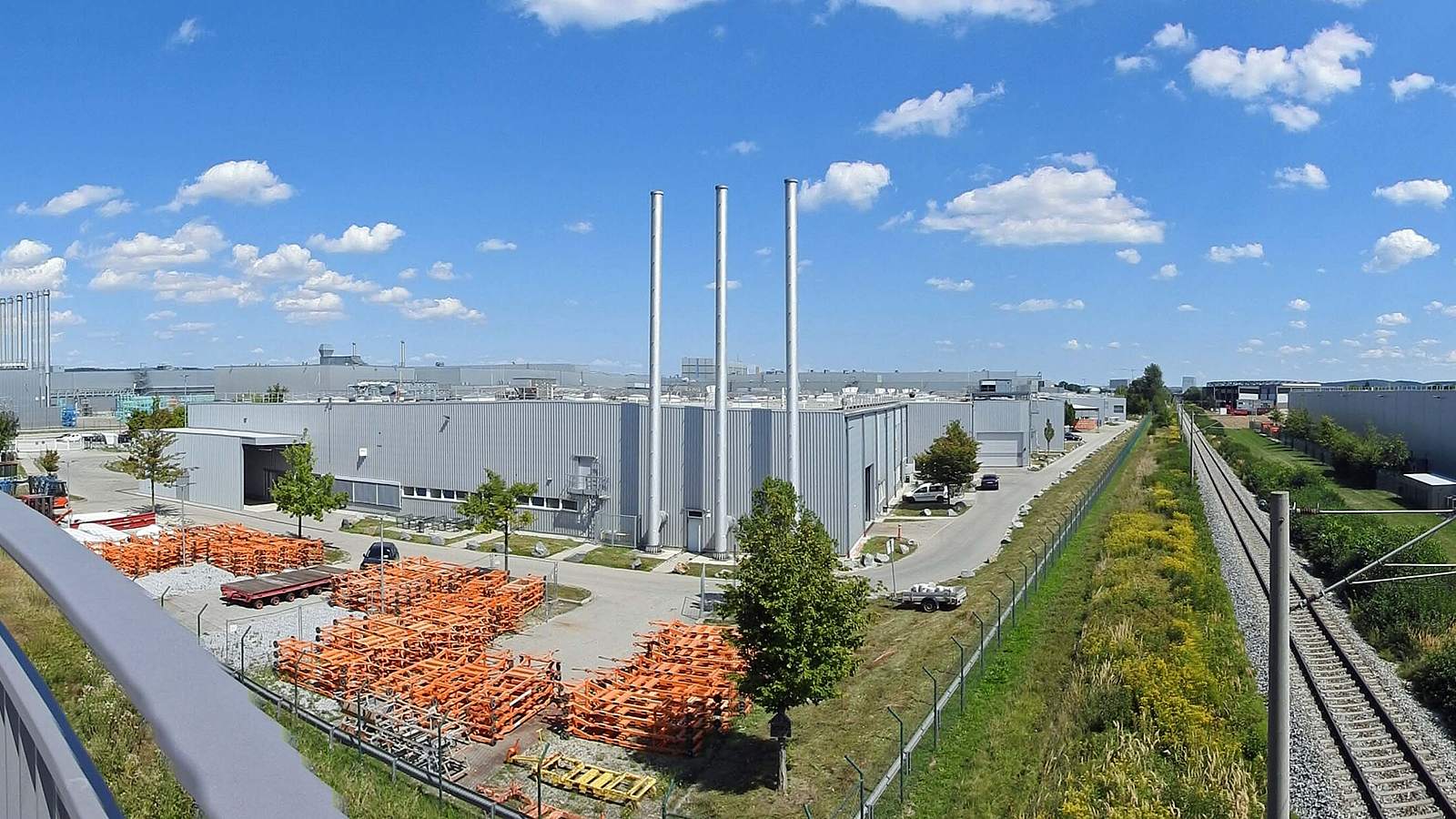

BMW has opened its new battery plant at Irlbach-Straßkirchen in Bavaria and started series production of the high-voltage batteries for its new electric i3. The carmaker officially opened the plant on Thursday 1 October, about two and a half years after construction began.
Demand for BMW's new generation of electric cars, which it calls the Neue Klasse, meant the plant started on two shifts straight away, BMW said. The ramp-up is moving faster than BMW first planned.
What BMW's new plant does
Irlbach-Straßkirchen is in Lower Bavaria, in the east of the state. BMW spent around one billion euros on it.
The plant assembles BMW's sixth-generation, or Gen6, high-voltage batteries. To start with, it's supplying BMW's Munich plant, where the new BMW i3 is built. It's set to become the central battery supplier for all of BMW's German car plants. Germany's heise news site reported that Dingolfing, Regensburg and Leipzig will follow Munich.
It's worth being clear about what happens here. Irlbach-Straßkirchen is a battery assembly plant, not a cell factory. The round battery cells come in from outside suppliers, and the plant turns them into complete battery packs. Heise reported that the cells come from CATL and EVE Energy, though BMW hasn't said which supplier's cells go to this plant.
Once it's fully up and running, about 1,600 people will work at the site, BMW said. They'll build several hundred batteries a day on two production lines, alongside about 500 robots, on a 50,000 square metre production floor.
"The new plant plays a key role in our production network: As the central platform, it will supply our German vehicle plants with sixth-generation high-voltage batteries," said Raymond Wittmann, the BMW board member in charge of production. "In this way, our high-tech plant in Irlbach-Straßkirchen is making a vital contribution to the ramp-up of the Neue Klasse."
Built at speed, with local backing
BMW made a point of how fast the site came together. Construction on the 60-hectare site started in April 2024, and the first pre-series battery came off the line in March 2026. That's less than two years.
Locals backed it from the start. In September 2023, the municipality of Straßkirchen held a referendum on the plant. More than 75% of voters said yes, on a turnout of about 77%, BMW said.
"Plant Irlbach-Straßkirchen shows what is possible in Germany when everyone involved works towards the same goal," Wittmann said. He also called the investment "a strong signal" for BMW's "technological competitiveness, for electromobility" and "for Germany as a business location."
Bavarian premier Markus Söder was at the opening. He called it "a day of celebration for Lower Bavaria, Bavaria and the whole of Germany." He said the plant was built at "Bavarian speed" and added that "the batteries produced here are high-tech 'Made in Bavaria' and are also at the forefront by international standards, for example compared with China."
Most of the building work stayed close to home, too. BMW said all directly contracted construction companies came from Germany, two-thirds of them from Bavaria. More than three-quarters of the firms supplying production equipment were German.
The plant doesn't need fossil fuels for regular operations, BMW said. Solar panels on site supply part of its electricity, and the rest comes from renewable sources. Putting the batteries together uses no water either.
Inside the Gen6 battery
The Gen6 battery is a big change from BMW's last generation. Instead of the prismatic cells BMW used before, it uses cylindrical cells 46 mm across. They slot straight into the battery pack, with no separate modules in between. BMW calls this "cell-to-pack". The pack also forms part of the car's body structure.
According to heise, BMW says the new cells hold about 20% more energy for their size. That should mean up to 30% more range and charging times up to 30% shorter than the previous generation. Those are BMW's figures. BMW said it's filed patent applications for more than 500 innovations in this generation of its electric drive technology.
Quality checks run the whole way through. BMW said it collects more than 3,500 data points on each battery during production and watches them in real time, with its own AI tools analysing the data. Every battery then gets a full end-of-line inspection.
The cells for the i3 also use some recycled cobalt, lithium and nickel, and renewable energy goes into making the anode and cathode materials and the cells themselves. BMW said emissions per watt-hour of cell capacity are about 33% lower than for the previous generation. A new cell recycling centre about 16 km away, in Salching, started operating in December 2025.
What the batteries give the new BMW i3
The first batteries from Irlbach-Straßkirchen go into the new BMW i3, a long-range electric sedan. BMW said its battery holds 108.7 kWh.
For drivers, the numbers that matter are range and charging. BMW quotes a WLTP range of up to 906 km for the First Edition of the i3 50 xDrive. It runs on an 800-volt system and can charge at up to 400 kW on a fast DC charger. That's enough to add up to 423 km of range in 10 minutes, according to BMW. The car can also charge in both directions, so it can send power back out.
To put that in Australian terms, 906 km is further than the drive from Adelaide to Melbourne along the main highway. That's BMW's lab-test figure, though, and real-world range will change with speed, weather and load.
Part of a bigger rollout
Irlbach-Straßkirchen is one of five Gen6 battery assembly plants BMW has built close to its car factories. The others are in Debrecen in Hungary, Shenyang in China, Woodruff in the US and San Luis Potosí in Mexico. BMW calls this approach "local for local", and it keeps the distance between battery plant and car plant short.
For now, the main news is simple. BMW's newest battery plant is open and building batteries for the new i3. And demand for its new electric cars was strong enough that it went straight to two shifts from day one.
The paper
Comments
No notes on this story yet.
Sign in to comment