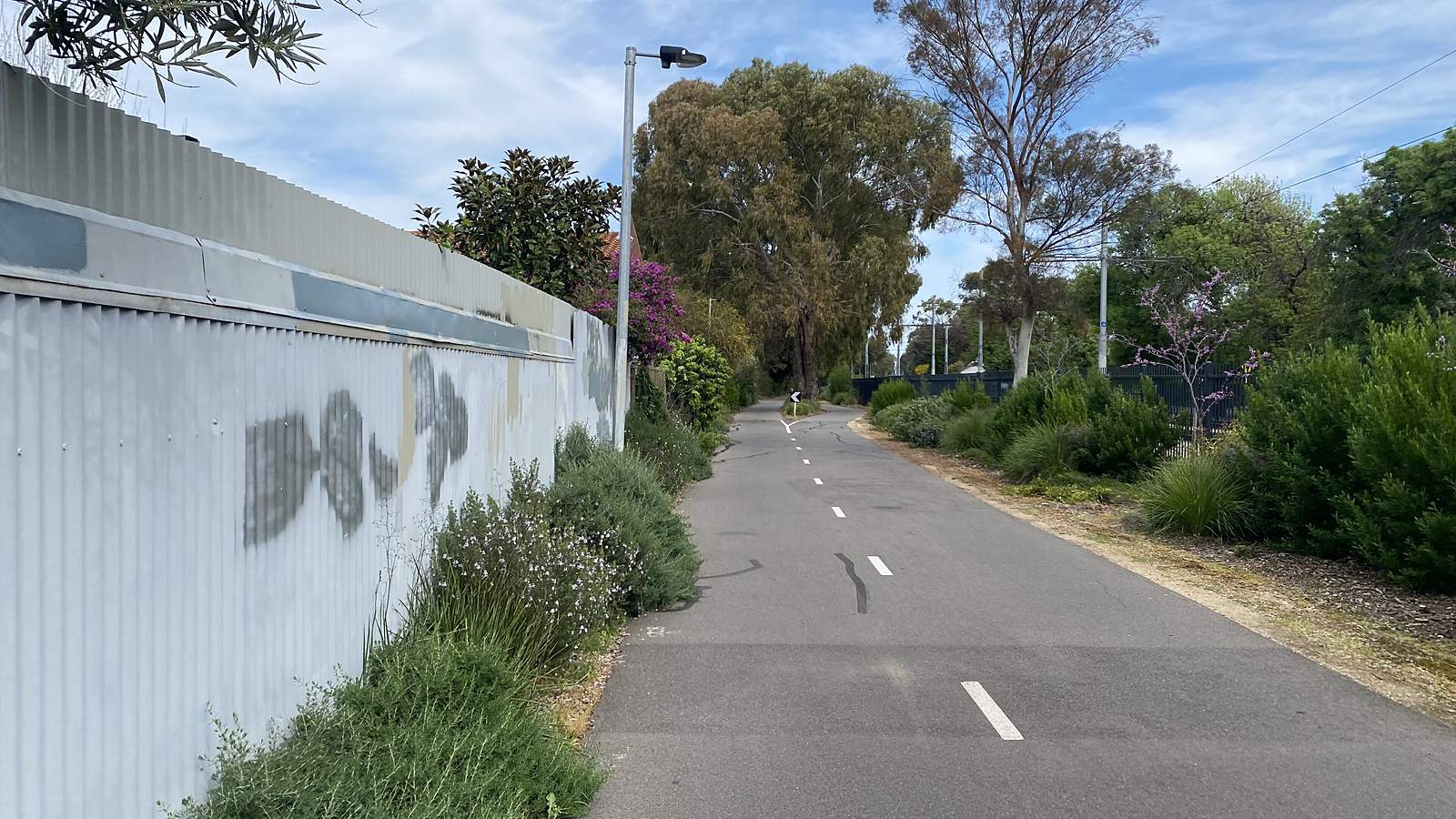

The Mike Turtur Bikeway now goes over Adelaide's traffic instead of through it. On Sunday 27 September the final elevated paths opened on the shared path beside the Glenelg tram line. Riders, runners and walkers can now cross South, Marion, Cross and Morphett roads without stopping at a single intersection.
The elevated section is nearly 1.4 kilometres long. It's the last big piece of the $870 million Tram Grade Separation Projects, which lifted the trams over those same roads earlier this year.
What opened on Sunday
The new paths run beside the tram overpasses at Plympton and Morphettville. The links over Marion Road, Cross Road and Morphett Road were the last to open. The South Road section, at the rebuilt Glandore tram overpass, opened earlier.
The joint release from federal Infrastructure Minister Catherine King and SA Infrastructure and Transport Minister Joe Szakacs says the paths were built from 80 prefabricated deck panels. They come with new lighting, anti-throw screens, handrails and bridge barriers.
The release puts the bikeway's users at more than 1,000. They share the corridor with more than 40,000 tram commuters a week on the city to Glenelg line.
The bikeway is named after Adelaide cyclist Mike Turtur. He won team pursuit gold at the 1984 Los Angeles Olympics, then set up the Tour Down Under and was its race director for two decades, according to the Australian Olympic Committee. The path follows the tram corridor from the city to the coast, Rail Trails Australia notes, which makes it one of the flattest, most direct commuter rides in Adelaide. Until this year, though, it had a weak spot. Riders still had to cross some of the busiest roads in the south-west at ground level.
While the overpasses were being built, the bikeway was cut at each site, with detours in place. The Tram Grade Separation Projects Alliance said in its project FAQ that the elevated shared paths would "progressively open across each project site in 2026." With Sunday's opening, all three are done.
Why the trams went up first
The bikeway is the tail end of a bigger fix. Before the level crossings came out, the release says, boom gates were down for up to 20 minutes an hour in peak periods. That held up about 50,000 vehicles a day at Marion Road and Cross Road, and about 25,600 a day at Morphett Road.
Major works began in August 2025, and the Glenelg trams stopped while crews built the overpasses. Services came back on Monday 26 January 2026, in time for the school year, after less than six months.
The numbers from that build are big for a few kilometres of tram line. The federal release in January said crews poured more than 15,200 cubic metres of concrete, put in more than 3,000 tonnes of steel, laid over 6,300 tonnes of asphalt, lifted 92 Super T beams into place and laid 6,540 metres of new tram rail. The project supported 1,115 jobs.
The South Road tram overpass at Glandore was rebuilt too, so it fits over the lowered motorway being dug for the $15.4 billion River Torrens to Darlington project.
The whole $870 million package is funded equally, with $435 million each from the Albanese and Malinauskas governments. It's being built by an alliance of McConnell Dowell, CPB Contractors, Arup and Mott MacDonald, with Aurecon as a sub-alliance partner, working with the state's Department for Infrastructure and Transport.
What changes for people on foot and on bikes
The obvious change is that the waiting's gone. A rider heading from the city to Glenelg doesn't have to sit at a red light at South Road, Marion Road, Cross Road or Morphett Road anymore. The path just goes over them.
Szakacs said the opening meant "safer, more reliable journeys for cyclists and pedestrians and improved road safety for everyone." He also offered a figure worth noting. "We know around one in three South Australians ride a bike each year," he said. "By providing safe, attractive cycling routes, we hope to encourage more people to get on their bikes."
King said the paths would give "active transport commuters in Adelaide's southwest suburbs a high-quality and safe connection they can rely on every day."
Jayne Stinson, the state member for Badcoe, made the point that the paths aren't only for people in lycra. "If you use a pram or have a toddler learning to ride a bike," she said, adding "like me," before going on, "if you're in a wheelchair, if you use a scooter, or you're a pedestrian or jogger, this infrastructure will make your journeys faster and safer."
Toby Priest, the state member for Morphett, singled out the Morphett Road section. "Investments like this give more people the opportunity to leave the car at home, get active and enjoy one of Adelaide's great cycling and walking corridors," he said.
What's still to come
There's one more piece for pedestrians. A new push-button crossing is going in on Morphett Road, between the new overpass and Maxwell Terrace. The release says it's a two-stage crossing, designed to keep red-light time short in each direction, and it'll be coordinated with the signals at Morphett Road and Anzac Highway so traffic keeps moving.
The intersection upgrades that came with the project have been running alongside the bikeway work. The January release listed Marion Road and Cross Road, Marion Road and Anzac Highway, and Morphett Road and Anzac Highway. That work includes new dedicated and through lanes, better lighting and drainage, fresh asphalt and new line marking.
The corridor's also getting greener. The alliance says it's planting more than 520 trees and about 39,500 shrubs and plants across the project areas, aiming for a 20 per cent increase in tree canopy. That's to make up for the vegetation that had to come out to build the overpasses.
Where it fits
The opening is part of a wider push on walking and cycling. The release points to South Australia's State Bicycle Fund, which pays for local bike lanes and crossings, and Way2Go, a statewide program aimed at road safety around schools. On the federal side, the Active Transport Fund puts $50 million a year into projects like this.
Most of our roads coverage this year has been about the long haul, from the Nullarbor to the Stuart Highway. This one's at the other end of the scale, a 1.4-kilometre run of deck panels in Adelaide's inner south-west. For the people who use it every day, though, it does something the highways can't. It takes four busy intersections out of the trip.
Stinson thanked locals for their patience through the build. "You can be sure this was worth the wait," she said. Since Sunday, the trams and the bikes both cross Marion, Cross and Morphett roads above the traffic.
The paper
Comments
No notes on this story yet.
Sign in to comment