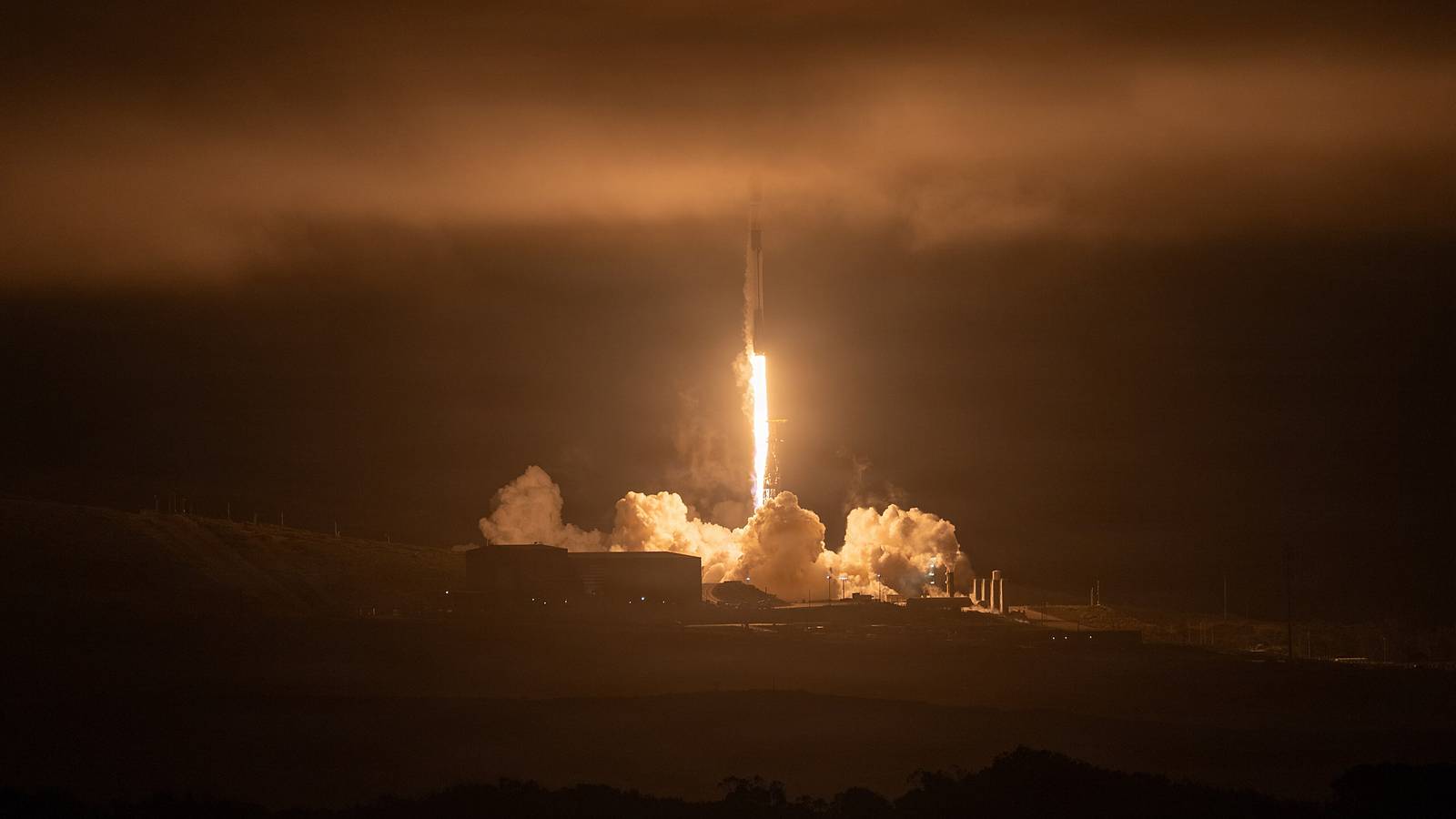
SpaceX's Transporter-18 rideshare put 130 payloads into orbit on a single Falcon 9. The rocket left Space Launch Complex 4E at Vandenberg Space Force Base in California at 11:32am Pacific time on Thursday 1 October, which was 4:02am Friday in Adelaide. Its first stage landed back at Landing Zone 4, a few kilometres from the pad.
On board were cubesats, microsats, hosted payloads, two spacecraft built to come back through the atmosphere, and four orbital transfer vehicles carrying 41 more payloads to drop off later. One of them was Google's first test satellite for putting AI chips in space.
A busy hour over the poles
Spaceflight Now said the payloads would go into a polar orbit over about 11 minutes, starting roughly 54 minutes after launch. SpaceX's own timeline shows the first one, NASA's SPRITE, leaving the upper stage at 54 minutes 22 seconds. The last, two Varda Space Industries capsules, went just after 65 minutes.
In between, the list reads like a phone book for the small-satellite industry. There were radar imaging satellites for ICEYE, Earth-imaging satellites for Satellogic and Planet, two GHGSat methane-monitoring satellites, internet-of-things satellites for Sateliot, weather satellites for Tomorrow.io, and a batch of Eaglet satellites for Italy's IRIDE Earth-observation program, manifested by OHB Italia. NASA flew a propulsion demo called ASCENT alongside SPRITE. Starfish Space, which is working on satellite servicing, had a payload aboard, and so did India's Dhruva Space.
Rideshare brokers such as Exolaunch, SEOPS and D-Orbit handled several of those spacecraft. They bundle customers together onto SpaceX's flights. D-Orbit's ION vehicles are among the transfer craft that'll carry some payloads to their own orbits before letting them go.
SpaceX says it has now launched more than 1,800 payloads across its whole Rideshare program.
Google's Suncatcher satellite is working
The best-known passenger was Project Suncatcher M1, Google's prototype satellite built with Planet. Google's Travis Beals wrote on the company blog on launch day that "our team has confirmed contact with the satellite and it is operating as expected."
Suncatcher is a research project asking whether data centres for machine learning could one day run in orbit, powered by near-constant sunlight. Beals called it "the first step in a long-term research moonshot exploring whether space could one day host scalable machine learning infrastructure." Over the coming weeks, he wrote, Google will "gather in-orbit data on how our TPUs handle the physical stress of spaceflight and the radiation and thermal extremes of space." TPUs are the custom chips Google designs to run AI models.
That's an honest way to put it. This is one test satellite, not a space data centre, and Google's clear that it's still learning what survives up there. It has also published a peer-reviewed paper in the journal Joule with the research behind the mission. Planet flew a second satellite of its own on the same rocket, Tanager-2.
Two Varda capsules at once
Varda Space Industries makes small capsules for manufacturing drugs in orbit and testing materials at hypersonic speed. This time it flew two of its W-series spacecraft together for the first time. In a launch-day release, the company said W-8 and W-9 are the first two commercial reentry vehicles sent to orbit at the same time.
W-8 carries a heat-shield monitoring payload from Canopy Aerospace & Defense, called Smart TPS-F. It uses fibre-optic sensors to measure temperature, heat flux and how much shielding burns away during reentry. Its outside surfaces carry heat-protection materials funded through a government hypersonic testing program and the Air Force Research Laboratory. W-9 carries a navigation system for collecting data during hypersonic flight, plus heat-shield samples from Syensqo.
"We talk a lot about making reentry go from novel to normal. Flying two vehicles on the same launch vehicle is exactly that kind of normalization," said Wendy Shimata, Varda's vice-president of autonomous systems, in the release. Brandi Sippel, vice-president of mission management, said: "The number of annual launches and reentries will only increase from here."
Varda says it's safely brought six capsules back since 2024. It has had two vehicles in orbit at once before, but it's never launched two together. It says both will be flown in tandem from its newly expanded mission operations centre in El Segundo, California, and that this marks a shift to running a fleet, not one capsule at a time. Each W-series capsule is built to come back through the atmosphere at hypersonic speed, which is why government programs pay to put heat-shield materials and sensors on the outside.
A 25th flight for the booster
SpaceX says this was the 25th flight for the first stage. Spaceflight Now identified it as B1082, though the earlier missions SpaceX lists for this booster don't match the ones Spaceflight Now gave for B1082. Either way, numbers like that have become routine for Falcon 9. The Gold Standard covered booster B1063's 35th flight last month, and the West Coast fleet has been flying often, as our report on the Vandenberg Starlink launch showed.
The booster came back to Landing Zone 4 about seven and a half minutes after liftoff. Spaceflight Now's preview said it would be the 36th landing at that site. SpaceX warned that people in Santa Barbara, San Luis Obispo and Ventura counties might hear one or more sonic booms as it came back.
Transporter-18 was also the middle launch of a three-launch day for SpaceX. It followed NASA's Crew-13 mission from Florida that morning and came before a Falcon Heavy launch for the National Reconnaissance Office that night. Spaceflight Now reported it was the first time SpaceX had landed four boosters in one day.
Why rideshare matters
For a small satellite company, a rideshare is often the only affordable way to orbit. Instead of buying a whole rocket, customers book a slot on a shared flight that goes to a popular orbit on a set schedule. SpaceX flies its Transporter missions to sun-synchronous polar orbits from Vandenberg, which suits Earth-imaging and climate satellites.
That's why one launch can carry a tech giant's AI experiment, a methane tracker, Italian government Earth-observation satellites and two drug-making capsules at once. It also means a lot of new spacecraft start their working lives on the same day. Over the next few weeks, the operators will be checking in on their satellites, raising orbits and, in Varda's case, planning the trips home.
The paper
Comments
No notes on this story yet.
Sign in to comment