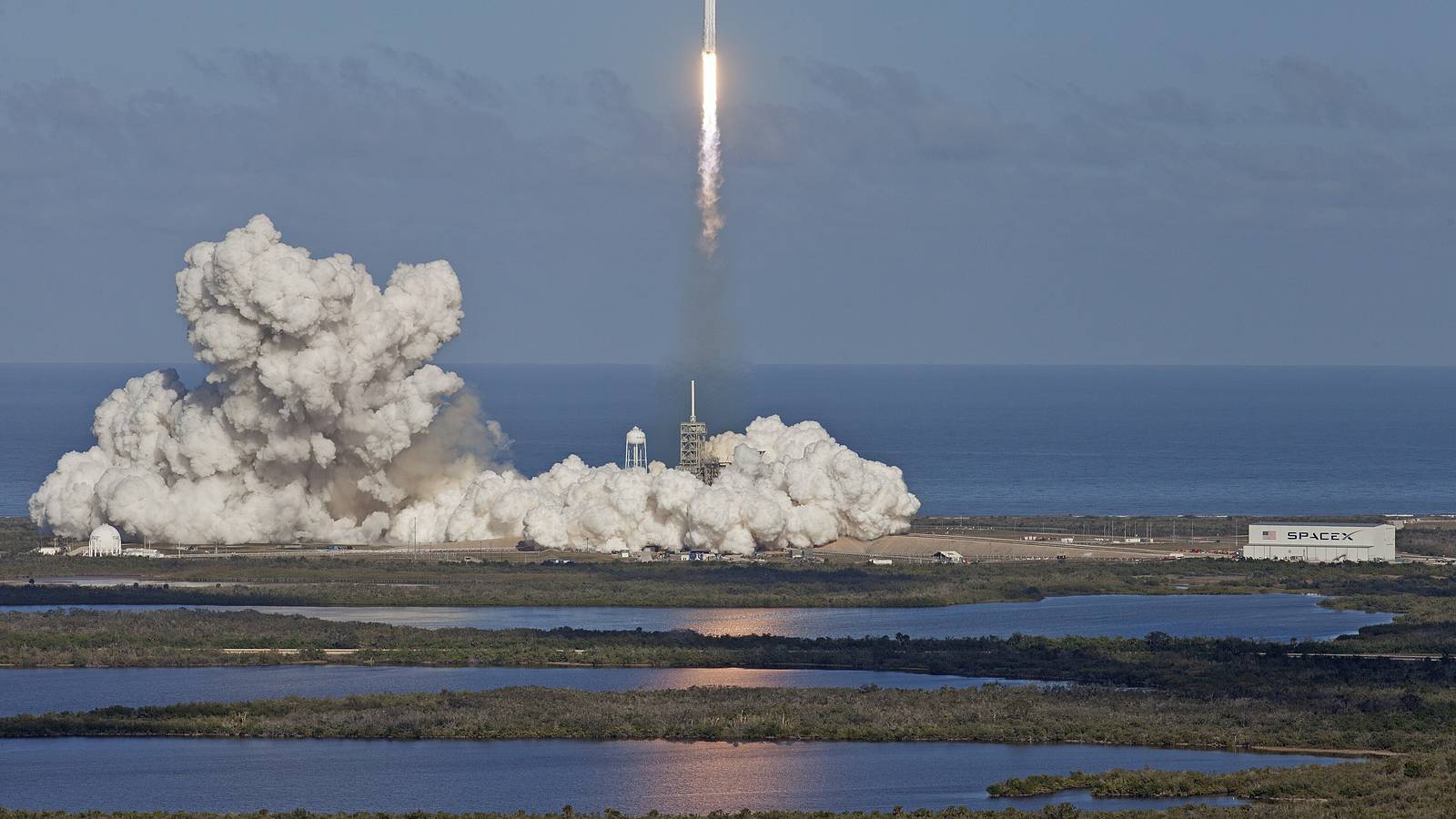

SpaceX's Falcon Heavy has flown its first mission for America's spy satellite agency. The rocket carried the classified NROL-97 payload for the National Reconnaissance Office off Launch Complex 39A at NASA's Kennedy Space Center at 11:54pm Eastern on Thursday 1 October. That was 1:24pm Friday in Adelaide.
Both side boosters flew back to Landing Zones 1 and 2 at Cape Canaveral Space Force Station. The same pair had launched NASA's Nancy Grace Roman Space Telescope only a month earlier, and the NRO says reusing them helped it avoid schedule delays.
A first for the spy satellite agency
The NRO builds and runs America's intelligence satellites, and it's leaned heavily on SpaceX for years. Spaceflight Now says the agency had flown payloads on 22 Falcon 9 rockets before Thursday, but never on a Falcon Heavy. In a press kit reported by Florida Today, the NRO called it "a significant expansion in NRO's heavy-lift capability following 22 successful Falcon 9 launches."
As with almost every NRO flight, there's very little public detail about what actually went up. The rocket flew a north-easterly path out of Florida, and that's about as far as the official story goes.
What is on the record is the contract. The NRO said NROL-97 was the first national security payload launched under the National Security Space Launch Phase 3 Lane 2 contract. That's the part of the Pentagon's launch program meant for the most demanding missions, with full government mission assurance. Spaceflight Now says the mission was bought through that contract in 2025. Florida Today said the press kit lists it as the NRO's fifth launch of 2026, after NRO-105, NROL-172, NROL-179 and NROL-95.
Boosters back in about a month
The reuse is what stands out. SpaceX says this was the second flight for one side booster and the fourth for the other, and that between them they'd already flown the GOES-U weather satellite, Viasat-3 F3 and the Roman Space Telescope. Spaceflight Now reported that they were B1104 and B1072.
The Gold Standard covered the Roman launch, which went up nine months ahead of schedule on 30 August Eastern time. Landing the same two boosters, refurbishing them, stacking them on a new core and flying again by 1 October is fast work for a three-core rocket.
Col. Ryan Hiserote, who commands Space Systems Command's System Delta 80 and runs the launch program, said in the NRO's statement, which Intelligence Community News republished, that the teams "enabled the recovery, maintenance, and reuse of SpaceX's flight-proven side boosters that previously supported a NASA mission only a month earlier." He called that "a 30 percent faster improvement over the previous record."
The payload fairing was reused too. The NRO said the fairing halves came from the NROL-95 launch on 30 July. Only the centre core was thrown away, and Spaceflight Now reported it was a brand-new booster, B1106. Centre cores on missions like this usually don't have the fuel left to come home.
What the NRO says it gets
Col. Kathryn Cantu, director of the NRO's Office of Space Launch and the NROL-97 mission director, put it plainly in the agency's statement: "While the NRO and SSC have partnered on countless critical missions, NROL-97 stands as a historic milestone in our shared history."
She tied the speed straight to the reused hardware: "Additionally, reusing the side boosters from NASA's successful Nancy Grace Roman Space Telescope launch enabled us to eliminate schedule delays and share mission assurance practices for a rapid turn-around of the Falcon Heavy capability."
Hiserote said the mission showed "the effective collaboration between the SYD 80 NSSL One Falcon Team, the NRO, SpaceX, and NASA."
That's an unusual line-up for one launch. A civilian science telescope's boosters and a spy satellite's fairing ended up on the same rocket, and both agencies are calling it a win. It also shows two government agencies treating flight-proven boosters as a way to save time on a national security mission, not as a risk to work around.
The 14th Heavy, and a busy Thursday
Spaceflight Now reported that this was Falcon Heavy's 14th flight since its debut in 2018. The rocket is three Falcon 9 first stages strapped together, with 27 Merlin engines firing at liftoff, and it doesn't fly often. So a month between two Heavy missions from the same pad is a notable stretch.
The side boosters' landings also brought Landing Zone 1 back into use. Spaceflight Now reported that SpaceX had replaced LZ-1 with a new pad, LZ-40, at Space Launch Complex 40. But LZ-40 had already been used earlier that day by the booster from the Crew-13 launch, so LZ-1 went back into service for this mission.
The weather helped. Florida Today reported that the Space Force's 45th Weather Squadron had put the odds of acceptable launch weather at 60%, worried about thick cloud from a stalled front over south Florida. By the evening SpaceX said that had risen to 80%, and its webcast shortly before liftoff put it at 90%. SpaceX had also warned people across nine Central Florida counties, from Brevard to Okeechobee, that they might hear sonic booms as the two side boosters came home a little after midnight. Florida Today said both landed, with the rumbling booms to prove it.
NROL-97 was the last of three Falcon launches SpaceX flew that Thursday, after Crew-13 from Cape Canaveral and the Transporter-18 rideshare from California. Spaceflight Now reported it was the first time SpaceX had landed four boosters in a single day. Space Launch Delta 45 counted the Heavy as the 58th orbital launch of 2026 from Cape Canaveral and Kennedy, Florida Today said.
More Heavy work ahead
Falcon Heavy's schedule is filling up. NASA has already booked the rocket for Europe's Rosalind Franklin Mars rover. National security customers are a regular part of SpaceX's launch business too, as the 27th flight of a Falcon 9 booster on USSF-153 showed last month.
The bigger point from Thursday night is about pace. The NRO said it reused the side boosters specifically to avoid schedule delays, and it worked. If hardware from one mission can be cleared for an intelligence launch about a month later, the Heavy starts to look less like a special event and more like a rocket you can call on when you need it.
The paper
Comments
No notes on this story yet.
Sign in to comment