
One Nation put a three-year stock cut on the board this morning. More than seven hundred and fifty thousand temporary visa holders and unlawful non-citizens would leave the temporary migrant count if the party ever governed on the numbers it published on Monday.
Here's what landed. On Monday, 14 September 2026, Pauline Hanson’s party unveiled a migration plan to slash temporary visa holders and unlawful non-citizens by more than 750,000 over three years. The party says net overseas migration would run net-negative across those three years. After that reset, a permanent net overseas migration ceiling of 130,000 a year would stay in place. The ABC’s Courtney Gould carried the politics live. Nine, the Daily Mail, and an AFR advance carried the same core figures and party lines.
That's the short version. The longer fight is the category list, the student cap, the skilled secondary cut, the bridging and overstayer rules, and a wall of Labor, Coalition, business, and farm pushback that arrived before lunch.
You should hear the numbers before the slogans.
Hanson framed the goal as a stock reset, not a weekend slogan. She put it this way: “One Nation's plan will return the temporary migrant population to around 2017 levels and the international student population to 2015 levels.”
On the three-year path: “Over the three years net overseas migration will be net-negative.”
On what stays after that: “Following this, One Nation's net overseas migration ceiling of 130,000 per year would remain in place.”
Those three lines are the architecture. Everything else in Monday’s paper is plumbing.
Party and AFR framing put the temporary migrant stock at about three million now, against a bit over two million when Anthony Albanese took office in 2022. Mail reporting used the same surge. That stock number is the political fuel. The cut targets are how One Nation says it would drain it.
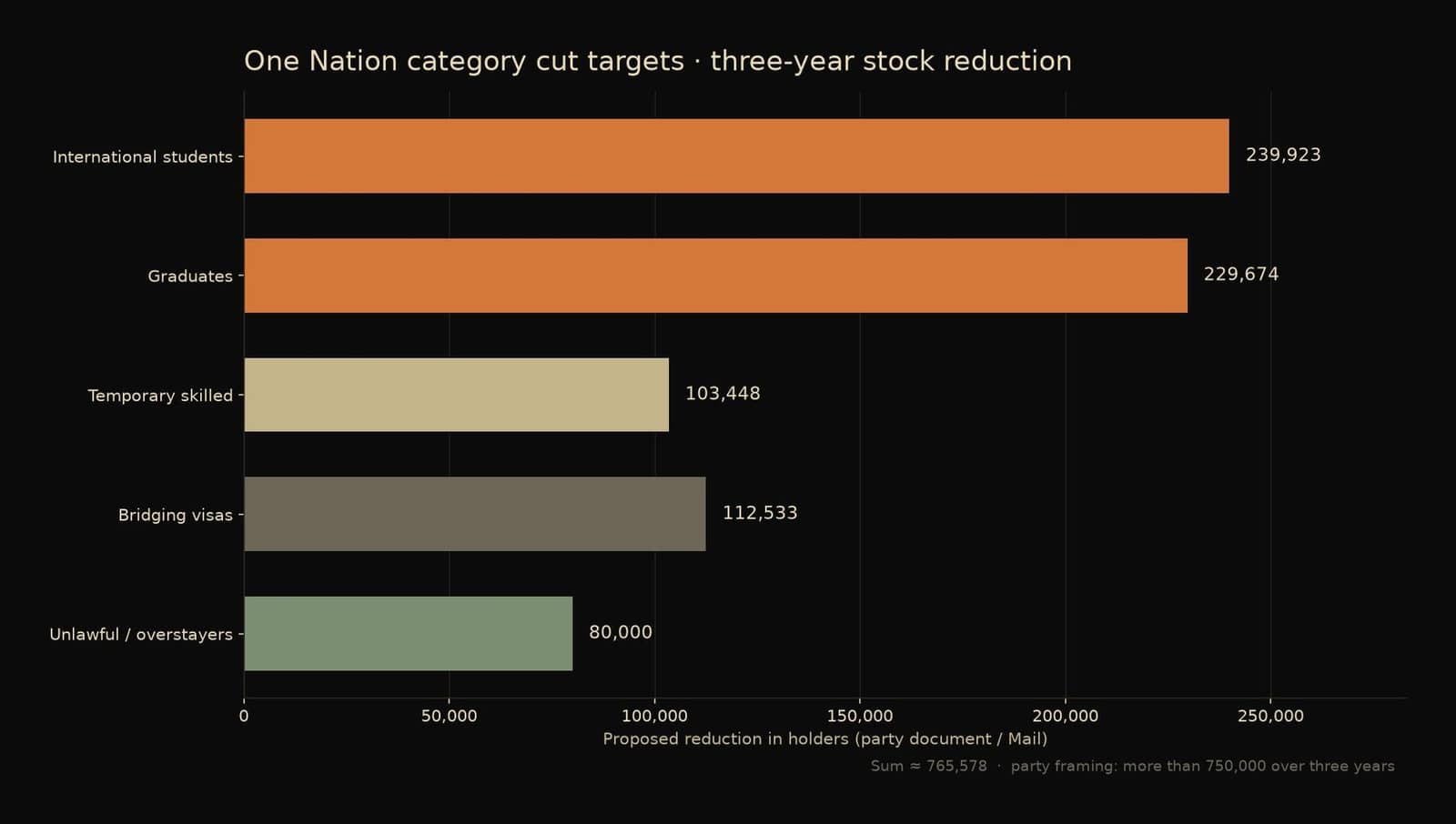
The Mail published the five category bars from the party proposal document. International students: 239,923. Graduates: 229,674. Temporary skilled: 103,448. Bridging: 112,533. Unlawful non-citizens and overstayers: 80,000. Add those and you get about 765,578. That is how the party gets to “more than 750,000” without rounding tricks.
Read the labels carefully. These are stock reductions over three years in named temporary categories, not a single annual visa intake number. Net overseas migration is a different meter. One Nation says the stock cut is large enough that NOM runs negative for three years, then locks at 130,000. Labor’s cited path in the same reporting sits far higher. Mail: Labor forecast NOM of 245,000 this financial year and 225,000 after. Other Budget and Population Statement paths in the same debate sit around 260,000 then 225,000. The Australian Bureau of Statistics has already recorded the recent fall from the post-pandemic peak. More on that below. First, the visa mechanics.
Start with students. International student visas would be capped at 100,000 a year. Priority would go to universities that provide accommodation. Hanson and Nine’s reporting also left room for universities to enrol more than 100,000 under that priority framing. The hard annual visa cap is the headline. Accommodation priority is the gate the party wants on the queue.
Beside that cap sits a new uncapped pathway for postgraduate and high-value STEM and medical research students. The Mail put the expected take-up at about 15,000 foreigners plus dependants. Uncapped in the sense of no fixed place limit in the party’s description. Still a targeted lane, not a second mass student program.
Graduate visas get tightened. Course-hopping and bridging pathways that keep people onshore while they shop for the next status get cracked. That is One Nation language. The party wants the student-to-graduate-to-bridge chain shortened and policed.
Temporary skilled primary visas stay demand-driven and uncapped. Hanson was blunt: “The temporary skilled migration program will remain available and be driven by employer demand.”
The cut lands on secondaries. About 70,000 secondary family visas would come off. Mail reporting said the temporary skilled program would fall from around 263,000 to around 160,000 in three years under that design. Primary sponsorship survives. Family tagging as a soft permanent pathway does not, on the party’s account.
Hanson put the family point this way: “Employers will still be able to sponsor skilled migrants, but temporary skilled migration will no longer operate as a sham family migration pathway.”
Seasonal programs stay. She said: “One Nation will maintain the existing seasonal worker programs, such as PALM and the working holiday maker program.”
You'll hear the farm reaction in a moment. One Nation says PALM and Working Holiday Maker are untouched. The National Farmers’ Federation still warned of harvest damage. The clash is real. It belongs in one plain sentence when the reactions arrive, not in a fog of process talk.
Bridging visas are a named cut target of 112,533. The party treats bridging as part of the stock problem, not a neutral holding pattern. Overstayers and unlawful non-citizens are the enforcement chapter. Target: 80,000. Rule: three months to leave. If you comply, you may re-apply later. If you do not, enforcement plus a lifetime ban.
Hanson’s own words on that clock: “We will crack down on illegal migrant employment, cutting off illicit income and encouraging departures. Illegal migrants will be given three months to leave Australia.”
And: “Those who depart will be allowed to apply for a visa in the future. Those who remain unlawfully after this period will face immigration enforcement and a lifetime ban from re-entering Australia.”
Two older planks rode with the new numbers. Pause migration from countries on DFAT travel warnings for terrorism or extreme security risks. Cut tax-funded legal aid for visa appeals. Both showed up in Monday’s reporting as part of the package, not as footnotes.
Why do this, on Hanson’s account? Housing pressure, hospital pressure, and a claim that per-person living standards are the right scoreboard.
“I know Australians are doing it tough. Families are competing with hundreds of people for rental accommodation.”
“The Labor-Liberal political cartel has sacrificed Australian living standards to serve vested interests demanding continued mass migration.”
“A larger economy on paper means nothing if Australians are poorer per person and cannot afford a home, find a hospital bed, or get ahead.”
“A larger economic pie doesn't mean anything if individual Australians' slice of it is getting smaller.”
She expected the shriek: “Vested interests and elite economists will shriek at the prospect of these cuts.”
Then the Canada claim, which this paper records as her claim, not as a verified thesis: “But Canada has shown you can cut migrant numbers, take pressure off rents, and still grow the economy.”
Breathing-space line, also verbatim: “This is about giving Australians breathing space by drastically cutting the stock of temporary migrants, restoring control and making sure migration serves Australia.”
That is the party case as published Monday. Now the other desks.
Labor’s Mark Butler dismissed the plan as a “tabloid headline.” He said it would “smash” construction, health, aged care, and disability workforces, especially in rural Australia where Australian doctors and care workers are already hard to find. Butler also put the government’s own cut on the record: migration down about 50 per cent since the pandemic peak, on Labor’s telling. Labor’s longer migration plan is still delayed after Home Affairs Minister Tony Burke’s National Press Club speech was cancelled. Asked whether One Nation had beaten Labor to the punch, Butler did not concede the race and did not set a firm release date.
Environment Minister Murray Watt went further on the economic risk. He said the plan would “destroy” regional economies and send Australia into recession. He said industries would be “decimated.” Watt also tied in the National Farmers’ Federation warning and said One Nation owed an apology for Hanson’s comments on the Prime Minister’s late mother. That mother row is side context. Keep it short. A podcast remark on Albanese’s late mother and public housing resurfaced over the weekend. Albanese said he was “stunned.” Barnaby Joyce stood by related remarks on Sunrise. It is not Monday’s migration story. One short graph is enough, and that was it.
Liberal deputy Jane Hume called the package “poorly thought through.” She said One Nation had put headline numbers without modelling. Economists, she said, warn of recession risk. She wants the modelling released. The Coalition’s own migration policy is “very soon,” on her account, and she wants migration linked to housing supply. On the mother remarks, Hume called them “gratuitous and unnecessary” and “distasteful.” She is fighting One Nation on process and evidence while promising a Coalition paper that ties arrivals to dwellings built.
Business did not give Hanson a clean win. ACCI chief executive Andrew McKellar supports action so the system is not gamed. He does not support wholesale cuts to meet an arbitrary net overseas migration number. Pubs, cafes, and hotels still need chefs. Aged care and hospitals are short. Farmers and resources face shortages. Housing projects are held up when labour is missing. That is the chamber line in Monday’s coverage: integrity yes, arbitrary NOM smash no.
Farm politics is the sharpest clash line in the package. NFF figure Hamish McIntyre warned of a “terrible impact.” About one in seven farm workers are working holiday makers, on that warning. Planting and harvest risk rises. Food prices follow. But One Nation’s own document says Working Holiday Maker and PALM stay. One Nation says those programs are maintained. The NFF still warns the broader cut lands on agriculture. Readers can hold both sentences without a seminar.
Put the official NOM history next to the party ceiling so the scale is visible.
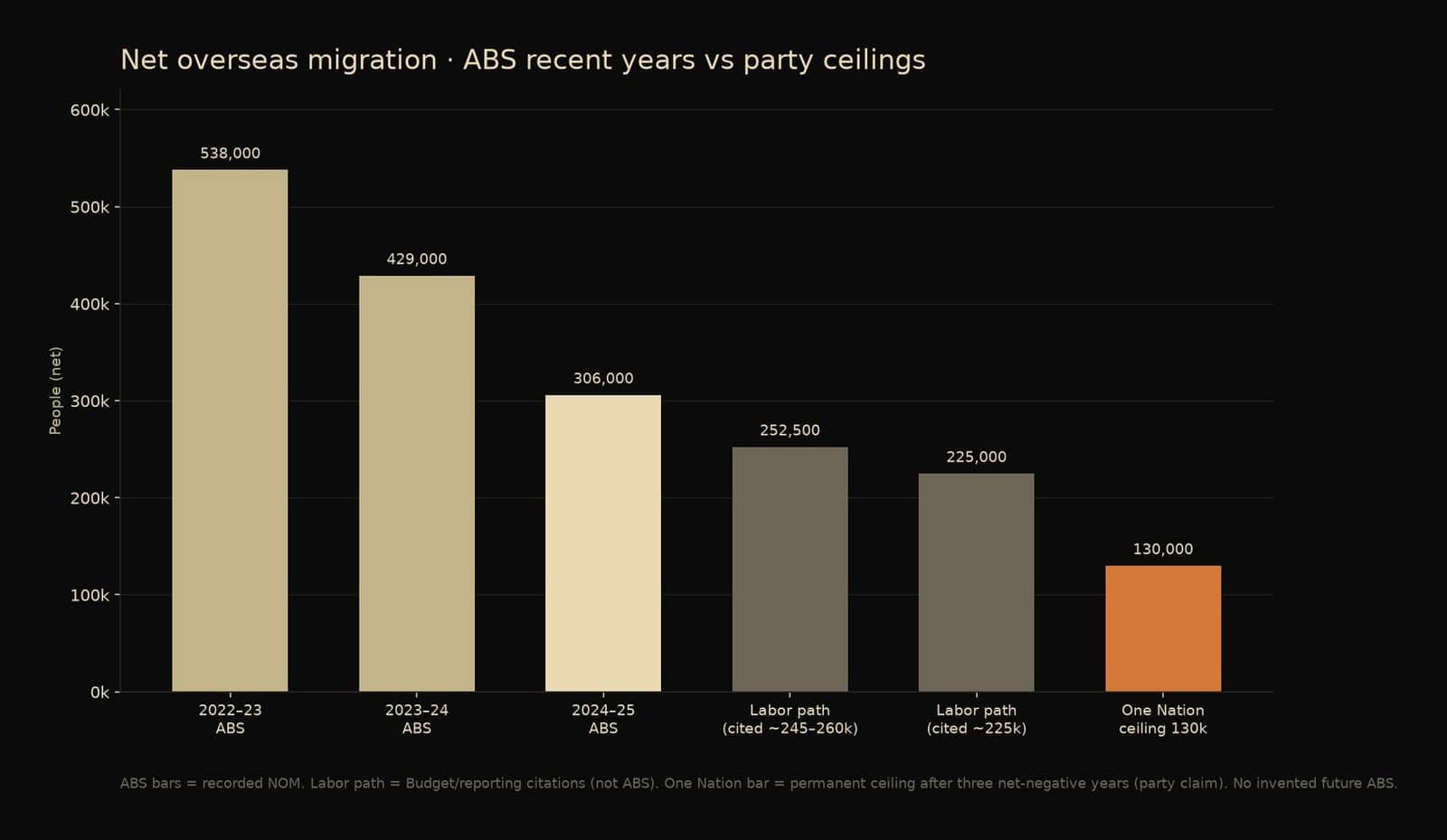
ABS financial-year NOM: 538,000 in 2022–23, the recent peak. 429,000 in 2023–24. 306,000 in 2024–25. The year to September 2025 sits around 311,000 on Centre for Population and related reporting. Labor’s Budget and Population Statement path cited in Monday’s coverage sits near 245,000 to 260,000, then 225,000. One Nation wants three net-negative years, then 130,000. That is less than half the Labor path number the Mail used for the out-year. It is also far below the ABS peak two years ago.
Do not confuse stock cuts with the NOM meter. Stock is how many temporary holders and unlawful non-citizens are in the country at a point in time. NOM is arrivals minus departures over a year for people who stay twelve months or more in an Australian sense of the residency test. You can cut temporary stock hard and still see NOM move on a different path if permanent places, New Zealand flows, or other categories shift. One Nation’s claim is that its temporary stock cut is large enough to drive NOM negative for three years. That claim is the party’s. The ABS bars above are history. The 130,000 line is policy, not a forecast the Bureau has published.
Walk the student lane again, because universities will feel it first if the cap ever becomes law. One hundred thousand international student visas a year is a hard ceiling in the party text. Priority to campuses that house students is the rationing tool. A separate uncapped high-value postgraduate STEM and medical research visa is the prestige escape hatch, sized by the Mail at about 15,000 foreigners and dependants. Graduate visas tighten. Course-hopping and bridging get policed. The 239,923 student stock cut and the 229,674 graduate stock cut are the two largest bars on Monday’s chart. Together they are about 469,597 of the ~765,000 total. That is more than sixty per cent of the named reduction sitting in education pathways.
Skilled primary stays open. Secondary family visas of about 70,000 come off. Program size, Mail: from about 263,000 to about 160,000 in three years. Hanson’s “sham family migration pathway” line is the political charge under that cut. Employers who need a welder, nurse, or engineer can still sponsor on the party’s design. Bringing the household on a secondary temporary ticket is what shrinks.
Bridging at 112,533 is the onshore status pile. Overstayers at 80,000 are the enforcement pile. Three months. Re-apply if you leave. Lifetime ban if you stay unlawful past the clock. Legal aid for visa appeals loses tax funding under the same package. DFAT terrorism and extreme security warning countries see a pause on migration. Those enforcement pieces sit around the five bars.
What does “return to 2017 temporary levels” and “2015 student levels” mean in practice? The paper does not invent a full ABS time series One Nation did not table on Monday. The party’s claim is directional: temporary migrant population back to around 2017, international students back to around 2015, from a stock near three million now and a bit over two million in 2022. Readers should treat those year anchors as party framing until a full statistical annex lands.
Labor’s counter is workforce. Butler’s smash list is construction, health, aged care, disability, with rural stress named. Watt’s destroy list is regional economies and recession risk, with an apology demand attached to the mother row. The government’s own story is that it already cut migration about fifty per cent from the pandemic surge and still has a plan waiting after Burke’s cancelled NPC slot. That delay is a political fact. It does not prove One Nation’s numbers. It does explain why Monday’s vacuum filled with Hanson copy.
The Coalition’s counter is modelling and housing linkage. Hume’s “poorly thought through” line is about missing annexes, not about defending today’s intake. She wants migration tied to houses built. She says the Coalition paper is coming “very soon.” She also separated herself from Hanson’s mother remarks as gratuitous, unnecessary, and distasteful. That is a Liberal deputy trying to fight One Nation on migration seriousness without adopting One Nation’s family attack lines.
ACCI’s McKellar splits the difference business usually wants. Stop gaming. Do not smash NOM to hit a round number. Chefs, aged care, hospitals, farms, resources, and housing builds all show up in that shortage list. NFF’s McIntyre puts harvest and food prices on the table while One Nation insists WHM and PALM survive. If you are a regional reader, that clash is the one that matters on Monday more than a Canberra process fight.
Canada appears once in Hanson’s quote and stays there. She says Canada cut migrant numbers, eased rent pressure, and still grew. This paper is not verifying Canadian housing or GDP outcomes in this filing. It is reporting what she claimed on the day she published Australian category cuts.
Scale check against official history again. ABS NOM fell from 538,000 to 429,000 to 306,000 across three financial years. That is already a large descent from the peak. One Nation wants to go through zero for three years, then sit at 130,000. Labor’s cited path sits near a quarter of a million then 225,000. The political argument is whether the next step after 306,000 is another managed step down, a housing-linked Coalition rule, or a three-year stock purge of the size One Nation printed.
Nobody serious on Monday disputed that temporary numbers rose after the border reopened. The fight is over how far and how fast to cut, which categories carry the weight, and whether a 130,000 NOM ceiling after a negative stretch is governing policy or a tabloid shock. Butler chose “tabloid headline.” Hume chose “poorly thought through.” McKellar chose integrity without wholesale arbitrary cuts. McIntyre chose harvest risk. Hanson chose 750,000-plus, five bars, three months for overstayers, and a 130,000 ceiling.
If you rent in a tight market, the party wants you to hear the breathing-space line and the rental competition line. If you run a hospital ward or a fit-out crew, Labor wants you to hear smash and destroy. If you farm, you get One Nation’s maintain-PALM-and-WHM promise in one ear and the NFF’s terrible-impact warning in the other. If you watch budgets, you get ABS history on one chart and party ceilings on the other. That is the honest spread of Monday’s record.
A few mechanics still need annexes the party did not drop with the headline. How does a university over-enrol against a 100,000 visa cap if accommodation priority is the only softener? What exact courses sit inside the uncapped STEM and medical research lane? How is the ~15,000 Mail estimate derived? Which bridging subclasses make up 112,533? How is the 80,000 overstayer enforcement sequenced across states and territories? What happens to people already mid-appeal when tax-funded legal aid is cut? Monday’s coverage gave the targets and the quotes. It did not give a full implementation timetable with departmental costings. Hume’s modelling demand sits on that gap. Hanson’s answer, for now, is the published bars and the stock story.
Election timing sits in the background. Mail copy floated an election-in-2028 frame for returning temporary levels to 2017 and students to 2015. That is political calendar talk, not a Bureau release. The policy as stated Monday is what a One Nation government would do: three-year stock cut above 750,000, net-negative NOM through that window, then 130,000. Whether that ever becomes legislation depends on seats, partners, and Senate numbers this paper will not invent.
Side noise stays side noise. Hanson’s resurfaced podcast remarks about the Prime Minister’s late mother and public housing produced an Albanese “stunned” line and a Joyce defence on Sunrise. Watt wanted an apology. Hume called the mother remarks gratuitous and distasteful. None of that changes the five category bars or the 130,000 ceiling. It is context for the temperature of the week, not the lead.
What should a reader take from the charts? The cuts chart shows education pathways carrying most of the named stock reduction. Students and graduates alone are nearly 470,000 of ~765,000. Temporary skilled, bridging, and unlawful make up the rest. The NOM chart shows ABS already cutting the annual flow from half a million-plus toward about 300,000, with Labor’s cited path still well above One Nation’s permanent ceiling. One Nation’s distinctive claim is not only 130,000. It is the three-year net-negative stretch built from temporary stock destruction.
Repeat the verbatim spine so nobody can say the paper paraphrased the load-bearing lines.
On levels: “One Nation's plan will return the temporary migrant population to around 2017 levels and the international student population to 2015 levels.”
On the three-year NOM path: “Over the three years net overseas migration will be net-negative.”
On the ceiling: “Following this, One Nation's net overseas migration ceiling of 130,000 per year would remain in place.”
On skilled demand: “The temporary skilled migration program will remain available and be driven by employer demand.”
On seasonal programs: “One Nation will maintain the existing seasonal worker programs, such as PALM and the working holiday maker program.”
On family secondaries: “Employers will still be able to sponsor skilled migrants, but temporary skilled migration will no longer operate as a sham family migration pathway.”
On purpose: “This is about giving Australians breathing space by drastically cutting the stock of temporary migrants, restoring control and making sure migration serves Australia.”
On overstayers: “We will crack down on illegal migrant employment, cutting off illicit income and encouraging departures. Illegal migrants will be given three months to leave Australia.”
On the ban: “Those who depart will be allowed to apply for a visa in the future. Those who remain unlawfully after this period will face immigration enforcement and a lifetime ban from re-entering Australia.”
On rents: “I know Australians are doing it tough. Families are competing with hundreds of people for rental accommodation.”
On the major parties: “The Labor-Liberal political cartel has sacrificed Australian living standards to serve vested interests demanding continued mass migration.”
On per-person living standards: “A larger economy on paper means nothing if Australians are poorer per person and cannot afford a home, find a hospital bed, or get ahead.”
And: “A larger economic pie doesn't mean anything if individual Australians' slice of it is getting smaller.”
On critics: “Vested interests and elite economists will shriek at the prospect of these cuts.”
On Canada, as claim not proof: “But Canada has shown you can cut migrant numbers, take pressure off rents, and still grow the economy.”
Monday’s announcement was quote-heavy. The words stay intact. The numbers sit beside them.
Compare this filing with older One Nation border rhetoric already on the shelf. The desk already carries a generic borders argument under the slug for borders that mean something. Monday’s piece is different. It is the concrete policy with category bars, a student cap, a skilled secondary cut, an overstayer clock, and a 130,000 ceiling after three net-negative years. Do not confuse a values essay with a Monday numbers drop.
This filing is the Monday migration stock and NOM drop. It is not Secret Harbour, not a Hastie row, and not the super diversion from the week before.
Where are the soft spots in the public record as of Monday night? Full Treasury-style modelling of recession risk is not in the party release the outlets summarised. University enrolment maths under a 100,000 visa cap with accommodation priority is incomplete. The 15,000 high-value postgraduate estimate is Mail reporting of expected use, not an ABS series. NFF impact modelling against a package that claims to spare WHM and PALM is asserted as warning, not tabled as a joint spreadsheet. Canada’s rent and growth outcomes are asserted by Hanson, not audited here. Those are fact gaps. They are flagged, not filled with invented annexes.
Where is the hard ground? The five category numbers sum to about 765,000. The student cap is 100,000. Secondary skilled family visas of about 70,000 are removed. Temporary skilled primary stays demand-driven. PALM and WHM are maintained on the party document. Overstayers get three months, then enforcement and a lifetime ban if they stay. NOM is claimed net-negative for three years, then capped at 130,000. ABS NOM history is 538,000, then 429,000, then 306,000. Labor’s cited path sits near 245,000–260,000 then 225,000. Butler, Watt, Hume, McKellar, and McIntyre all spoke on the day. Those points are solid enough to print.
For a reader who only keeps three facts: more than 750,000 temporary stock cut over three years across five named categories. Net-negative NOM for those three years on the party’s claim, then 130,000. Biggest bars are students and graduates, with skilled secondaries, bridging, and overstayers making up the rest while primary skilled, PALM, and WHM are said to survive.
For a reader who keeps the political map: Labor says smash and destroy and points to its own post-pandemic cut and a delayed plan. The Coalition says poorly thought through, wants modelling, wants housing linkage, and is writing its own paper. Business wants integrity without arbitrary wholesale NOM cuts. Farming warns of harvest damage even as One Nation says seasonal programs stay. Hanson says breathing space, rental competition, and per-person living standards beat a larger economic pie.
Metric where it matters. The cuts are counted in people. NOM is counted in people per year. The temporary stock is counted in people onshore. Rents and hospital beds are the pressure points Hanson named. Food prices are the pressure point the NFF named. Recession is the risk Watt and Hume named. None of those pressures get a false precision number from this paper beyond what sources published.
Will the 100,000 student visa cap survive contact with university balance sheets and state education ministers? Monday does not answer. Will removing ~70,000 secondary skilled visas change employer sponsorship behaviour, or simply shift family reunions into other queues? Monday does not answer. Will an 80,000 overstayer enforcement surge clear, or clog courts after legal aid is cut? Monday does not answer. The announcement is a governing prospectus. Treat it as one.
Net overseas migration at 130,000 after a negative stretch would be a sharp regime change from the ABS peak of 538,000 and from Labor’s cited mid-200,000s path. Whether that regime change is affordable for construction and care is exactly the Butler-Watt argument. Whether it is modelled is exactly the Hume argument. Whether it is gamed-system reform or blunt stock destruction is exactly the McKellar split. Whether farms still get backpackers is exactly the One Nation document versus NFF warning clash.
You do not need a seminar to see the shape. Education pathways carry most of the named cut. Skilled primary stays. Family secondaries go. Bridging and unlawful get enforcement weight. Seasonal programs are promised intact. NOM goes negative, then sits at 130,000. Opponents say recession and smashed workforces. Hanson says smaller per-person slices of a larger pie are the real failure.
Walk through the arithmetic once more without the charts. Students 239,923 plus graduates 229,674 equals 469,597. Add temporary skilled 103,448 and you are at 573,045. Add bridging 112,533 and you are at 685,578. Add unlawful and overstayers 80,000 and you land at 765,578. That is the party document’s five-bar sum as the Mail printed it. “More than 750,000” is not a vibe. It is that sum with a round-number floor.
Now put the skilled program size beside that. Mail: temporary skilled falls from about 263,000 to about 160,000 in three years. The gap is about 103,000, which lines up with the temporary skilled bar of 103,448 and with the ~70,000 secondary family visas Hanson wants removed, plus related stock movement in that lane. Primary visas stay demand-driven. The household tickets are what shrink. If you are an employer reading this on a phone between shifts, that is the practical split Monday offered you.
Student maths is harsher on volume. A 100,000 annual visa cap is a flow control. A 239,923 stock cut is a stock purge. They work together only if departures and non-renewals outpace new grants for three years. The accommodation-priority rule is One Nation’s way of saying some campuses keep more places if they house students. Nine’s reporting of Hanson’s framing still allowed universities to enrol above 100,000 under that priority story. The visa ceiling is the federal lever. Enrolment behaviour is the campus response. Do not blur them.
The uncapped postgraduate STEM and medical research visa is the prestige offset. Mail expectation: about 15,000 foreigners and dependants. That lane is meant to answer the charge that a student cut kills high-value research. It does not restore a mass low-level course pathway. It is a narrow door next to a wide closed one.
Graduate tightening and anti-course-hopping rules are how the party tries to stop the student cut leaking into a graduate pile. The graduate bar at 229,674 is almost as large as the student bar. If graduates are not tightened, the student stock cut simply relocates. That is why Monday’s package treats graduates as a first-order target, not a footnote.
Bridging at 112,533 is the onshore waiting room. People on bridging visas are not all the same case. Some are mid-application. Some are mid-appeal. Some are mid-protection claim. One Nation’s document treats the stock as too large and cuts it as a category. The legal-aid cut for visa appeals is the paired move. Fewer funded appeals, fewer long holds, on the party’s theory. Critics will call that due-process damage. Monday’s release still pairs the two.
Overstayers are the cleanest political sentence in the package. Three months to leave. Re-apply if you go. Lifetime ban if you stay. Hanson said both halves on the record. Enforcement capacity is the open question. An 80,000 target needs officers, removals logistics, and state cooperation. The paper will not invent a Department of Home Affairs staffing plan One Nation did not publish.
DFAT travel-warning pauses are a prior One Nation plank riding again. Countries on terrorism or extreme security warning lists see migration paused. That is nationality-and-risk screening layered on top of the category bars. It is not the same as the student or skilled cuts. It is an entry pause by risk list.
ABS context deserves one more plain pass because people mix NOM with permanent migration and with temporary stock. NOM counts net long-term overseas migration. It rose hard after the border reopened, hit 538,000 in 2022–23, then fell to 429,000 and 306,000. The year to September 2025 around 311,000 shows the descent continuing off the peak. Labor says it already cut about half from the pandemic surge. One Nation says that is not enough and wants a negative stretch. Both can cite a falling ABS series and still disagree about the destination.
Labor’s cited NOM path near 245,000 to 260,000 then 225,000 is still a further step down from 306,000, but it stays positive and large by One Nation’s standard. One Nation’s 130,000 ceiling after three negative years is a different regime. Readers should keep the ABS bars as history, the Labor path as Budget-era citation, and the One Nation ceiling as party policy. Do not paste them into one fake continuous ABS forecast.
Butler’s workforce smash list is not abstract. Construction, health, aged care, and disability are migrant-heavy in many regions. Rural doctor and care shortages are the concrete tip he named on Nine. Watt’s regional destroy line points at farms, clinics, pubs, and builds. Those arguments stand or fall on labour-market evidence, not on whether Hanson’s rental line sounds true to a renter. Both kinds of evidence matter. Monday gave rhetoric from all sides and category bars from One Nation. It did not give a joint impact table everyone signed.
Hume’s modelling demand is the Coalition’s attempt to own seriousness. Link migration to housing. Publish the mix. Avoid a slogan that tips the country into recession. “Very soon” for the Coalition’s own policy is a promise with a clock. Until that paper lands, One Nation owns the sharpest published number on the opposition-adjacent side of politics, and Labor owns the delayed plan after Burke’s cancelled Press Club slot.
McKellar’s ACCI line is the business median. Stop the gaming. Keep the chefs. Keep the aged-care workers. Keep the project labour. Refuse an arbitrary NOM target as the master switch. That is not a love letter to current settings. It is a refusal of One Nation’s stock purge as the instrument.
McIntyre’s NFF warning collides with Hanson’s PALM and WHM maintain line. One in seven farm workers as working holiday makers is a large dependence. If WHM truly stays untouched, the farm hit has to come through other channels: graduates, bridging, skilled secondaries, or general labour tightness from the wider cut. If WHM is politically promised but administratively squeezed later, the NFF warning becomes prophecy. Monday’s text says maintain. Monday’s farm lobby says terrible impact. Print both.
Hanson’s per-person living standards argument is the ideological core under the bars. A larger economy on paper means nothing if the individual slice shrinks. Hospital beds, home ownership, and rent competition are the examples she chose. Canada is the overseas exhibit she chose. This paper reports the claim. It does not certify Canadian rents.
What would success look like on One Nation’s own terms after three years? Temporary migrant population around 2017 levels. International students around 2015 levels. NOM having run negative across the three years. Then a 130,000 ceiling holding. Overstayer stock down by about 80,000 through departures or removals. Bridging stock down by about 112,533. Skilled program near 160,000 with secondaries largely gone. Student flow capped at 100,000 visas a year with accommodation priority. High-value postgraduate STEM and medical research lane running near the Mail’s 15,000 expectation. That is the scoreboard implied by Monday’s release. It is ambitious. It is also unmodelled in public.
What would failure look like on the opponents’ terms? Construction delays. Care roster gaps. Regional recession. Food price spikes. University revenue holes without a research-lane offset large enough to matter. A lifetime-ban regime that fills detention and court lists after legal aid is cut. Those failure modes are why Butler said smash, Watt said destroy, Hume said poorly thought through, McKellar refused wholesale cuts, and the NFF said terrible impact.
The desk’s job on a day like this is narrow. Carry the numbers. Carry the quotes. Carry the clashes in plain English. Do not invent scenes of cabinet panic. Do not invent a Treasury spreadsheet. Do not turn Canada into a proved template. Do not bury the PALM and WHM maintain line under the farm warning, or the farm warning under the maintain line. Put them in one clash and move.
Monday’s package also sits inside a longer polling and minority-parliament argument this paper will not overclaim. One Nation wants to set the migration terms other parties answer. Labor answers with workforce risk and its own cut narrative. The Coalition answers with housing linkage and modelling homework. Business answers with skills. Farms answer with harvests. The category bars are how Hanson tried to make the argument numeric instead of purely atmospheric.
If you only screenshot one figure, take the cuts chart. It shows where the 750,000-plus comes from. If you only screenshot one comparison, take the NOM chart. It shows ABS history against Labor path citations and the 130,000 ceiling. Together they are the Monday record without the slogans.
That is Monday, 14 September 2026, as filed. One Nation published a concrete temporary stock cut above 750,000 over three years, with category bars, a student cap, a skilled secondary haircut, an overstayer clock, and a 130,000 NOM ceiling after net-negative years. Labor called it a tabloid headline that would smash care and construction. Watt said destroy and recession. Hume said poorly thought through and asked for modelling. ACCI backed integrity and rejected wholesale arbitrary cuts. The NFF warned of terrible farm impact while One Nation said PALM and Working Holiday Maker remain. ABS history shows NOM already falling from 538,000 toward about 300,000. The next argument is whether the country steps from there toward Labor’s mid-200,000s path, a Coalition housing link, or One Nation’s three-year purge and 130,000 lock. The numbers are on the table. The modelling fight is the next room.

The paper
Comments
No notes on this story yet.
Sign in to comment