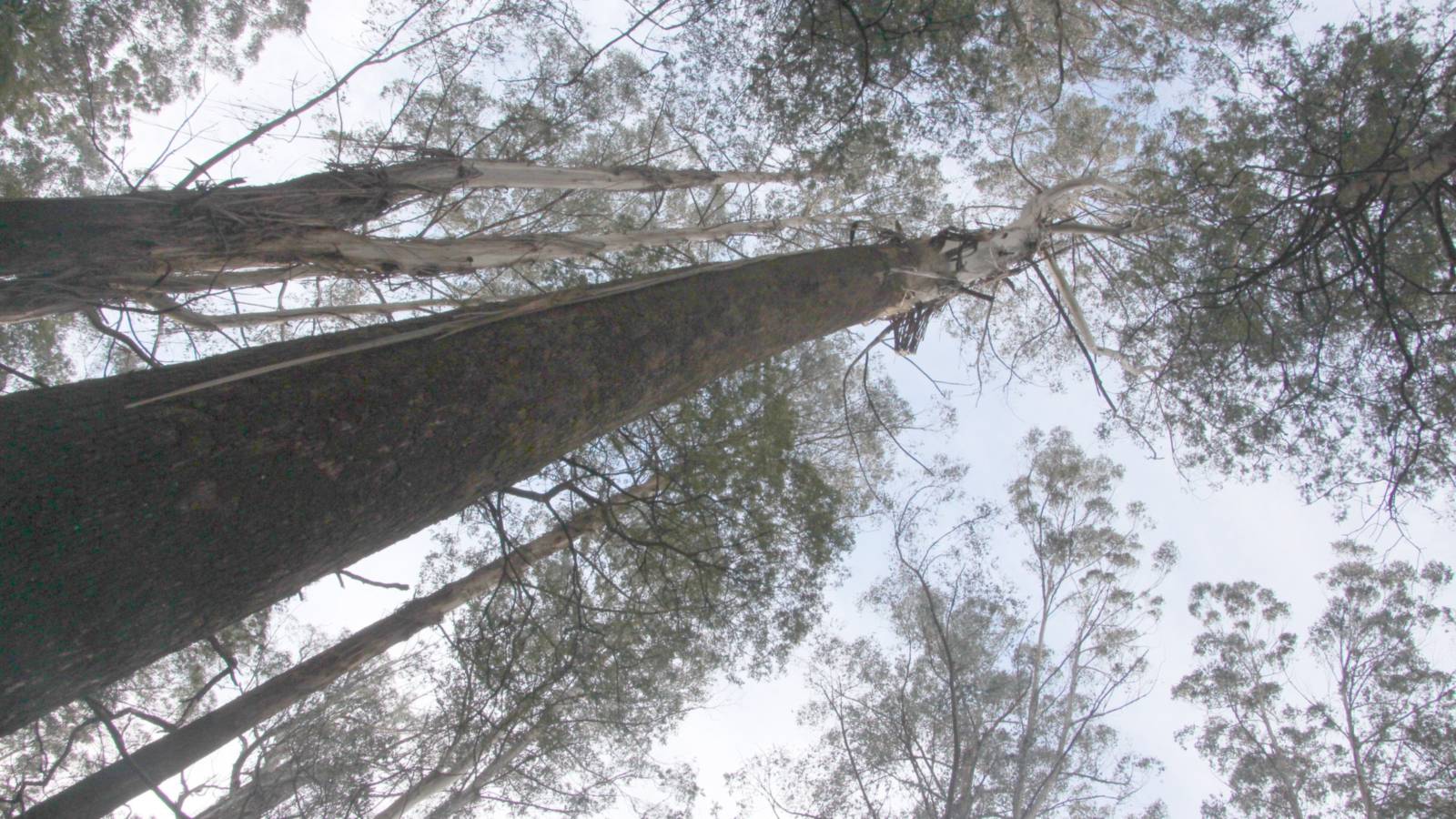

One Nation’s Victorian leader Warren Pickering says a One Nation government would bring native timber harvesting back to Victoria. The state stopped logging native forests on public land at the start of 2024, six years ahead of its original plan, and Pickering says that decision has failed.
He told the Herald Sun this week that native forestry would return under a Tasmanian-style model if One Nation wins in November, according to the industry outlet Wood Central. Old-growth forest and sensitive habitat would be “strictly protected”, he said, and the industry would pay for its own forest management out of harvest revenue. The party also wants a “local wood first” rule for state government purchasing and country-of-origin labels on timber.
Labor’s Agriculture Minister Michaela Settle says One Nation hasn’t explained how the problems that ended the industry have gone away. Those problems were court cases, timber shortages and bushfires. The state’s Auditor-General found the same three things behind the shutdown, and the fight over them is now one more line between Labor and One Nation with eight weeks to go before Victorians vote on 28 November.
What Pickering said
Pickering’s argument is that Victoria didn’t stop using native hardwood when it stopped cutting it. It just started buying it from somewhere else. Wood Central summed up his case this way: Victorians are now “simply buying their timber from countries with weaker environmental standards”.
His plan has three parts. The first is reopening native forests to harvesting. “Environmentally sensitive old-growth forest and native habitats will be strictly protected, and the model will be self-sustaining by funding management operations through harvest revenue,” he said, as reported by Wood Central. He said the forests would open under “detailed forest practice plans based on sustainable selective harvesting models successfully used interstate and overseas”.
Selective harvesting means taking some trees from an area and leaving others standing, rather than clear-felling a whole coupe. A coupe is the patch of forest marked out for a harvest. Pickering didn’t say how much timber a reopened industry would take, which forests it’d cover, or who’d run it. Victoria’s state-owned logging business, VicForests, managed harvesting on public land before the ban.
The second part is a buy-local rule. A One Nation government would favour Victorian and Australian wood in state government purchasing. The third is labelling, so you’d know where the timber in a product came from.
Wood Central says Pickering made those last two pledges before, when he ran as One Nation’s lead Senate candidate for Victoria at last year’s federal election, and named a bigger plantation estate as the party’s main priority back then. They line up with One Nation’s national forestry policy, which already lists a local wood first rule for government purchasing and country-of-origin labelling.
What’s new is the first part. Reopening Victoria’s native forests is a big step beyond buying local, and it’s the part most likely to be fought over.
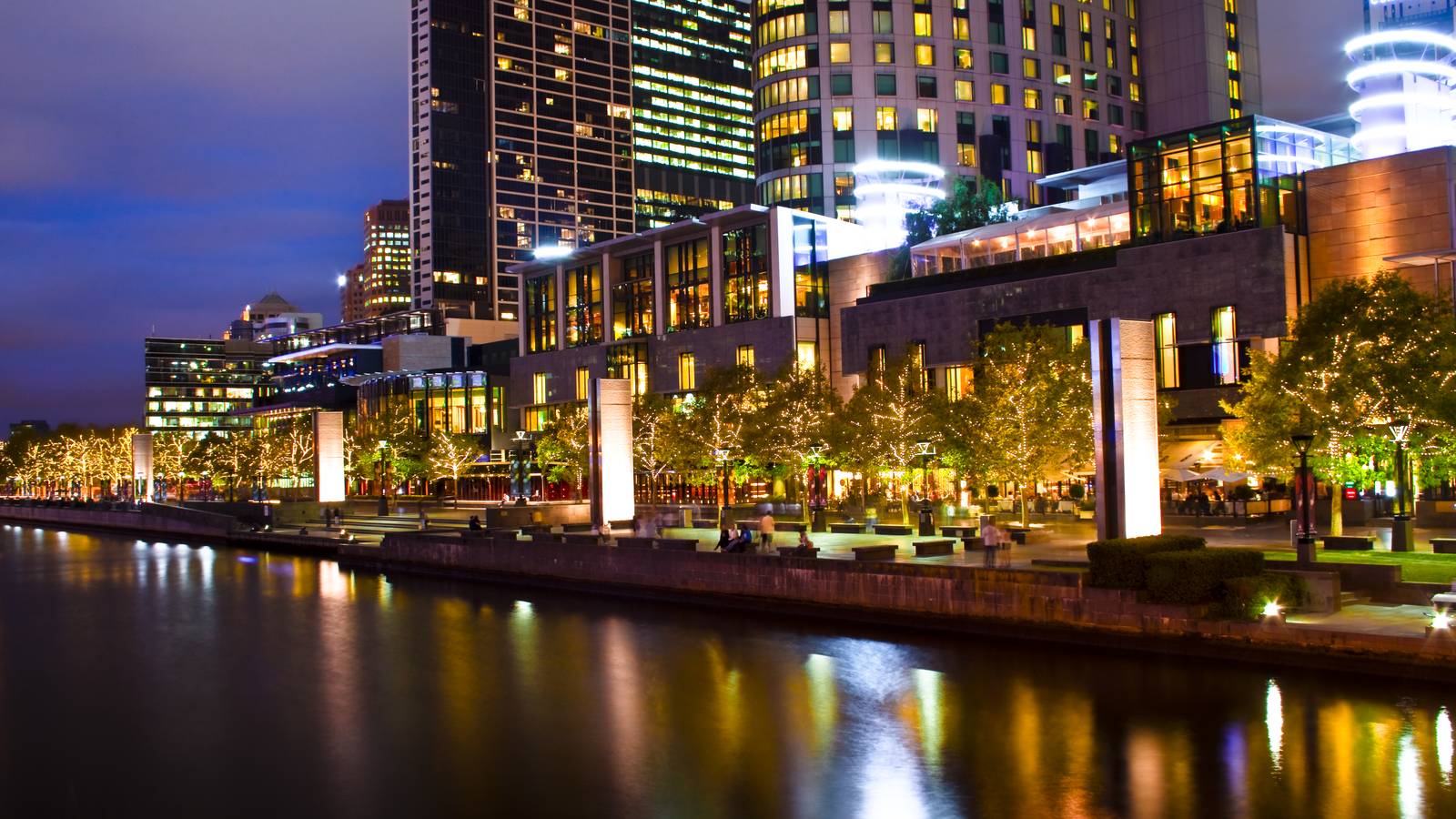
One Nation hasn’t put the full policy on its Victorian website yet. As of Friday night its policy page listed health, education, farming, firearms, cost of living and energy, with nothing on forestry. Wood Central reported that the full timber policy was due this week. The party’s campaign and policy launch is at the Crown Conference Centre in Melbourne at midday on Saturday 3 October, where it says the full Victorian platform will be released for the first time. If there’s more detail on timber, that’s where it’s likely to come.
Why Victoria stopped
To weigh Pickering’s plan you need to know why the industry ended. Victoria first planned to phase out native harvesting by 2030. That was the Andrews government’s 2019 decision. Then in May 2023 it pulled the end date forward to 1 January 2024.
The Victorian Auditor-General’s Office, which tabled an audit of the transition on 1 April this year, put the reason plainly. The decision was “due to the inability to access harvestable timber caused by ongoing litigation processes and increasingly severe bushfires”.
In practice, that meant two things. Court cases brought by community and environmental groups over threatened species, such as the Leadbeater’s possum and the greater glider, had tied up large parts of the harvest schedule. And the Black Summer fires of 2019-20, along with earlier fires, had burned through forests the industry relied on. By 2023, mills weren’t getting the timber they’d been promised.
That’s the point Settle came back to on Tuesday. “One Nation needs to explain how the litigation, timber shortages and bushfire risks that forced the transition have suddenly vanished,” she said. She also said Labor was “backing forestry workers into new jobs, growing local plantation timber and keeping forestry skills and experience in our forests”.
That question goes to the heart of Pickering’s plan. Reopening the forests by law wouldn’t by itself stop people suing over threatened species. It wouldn’t bring back forest that’s burned. A One Nation government would need either a lot of timber that isn’t tied up in court and wasn’t burned, or changes to environmental law that would themselves be fought in court. Pickering hasn’t said which.
What the shutdown cost, and who it hit
The Victorian government has committed $1.5 billion to the transition. That includes $320 million for the Forestry Transition Program, the package of grants and payments for workers, businesses and towns.
The Auditor-General said the decision directly affected around 1,000 workers and 200 businesses that relied on forestry, mostly in Gippsland and the state’s north-east. As of 30 June 2025, 565 workers had been made redundant and were eligible for help.
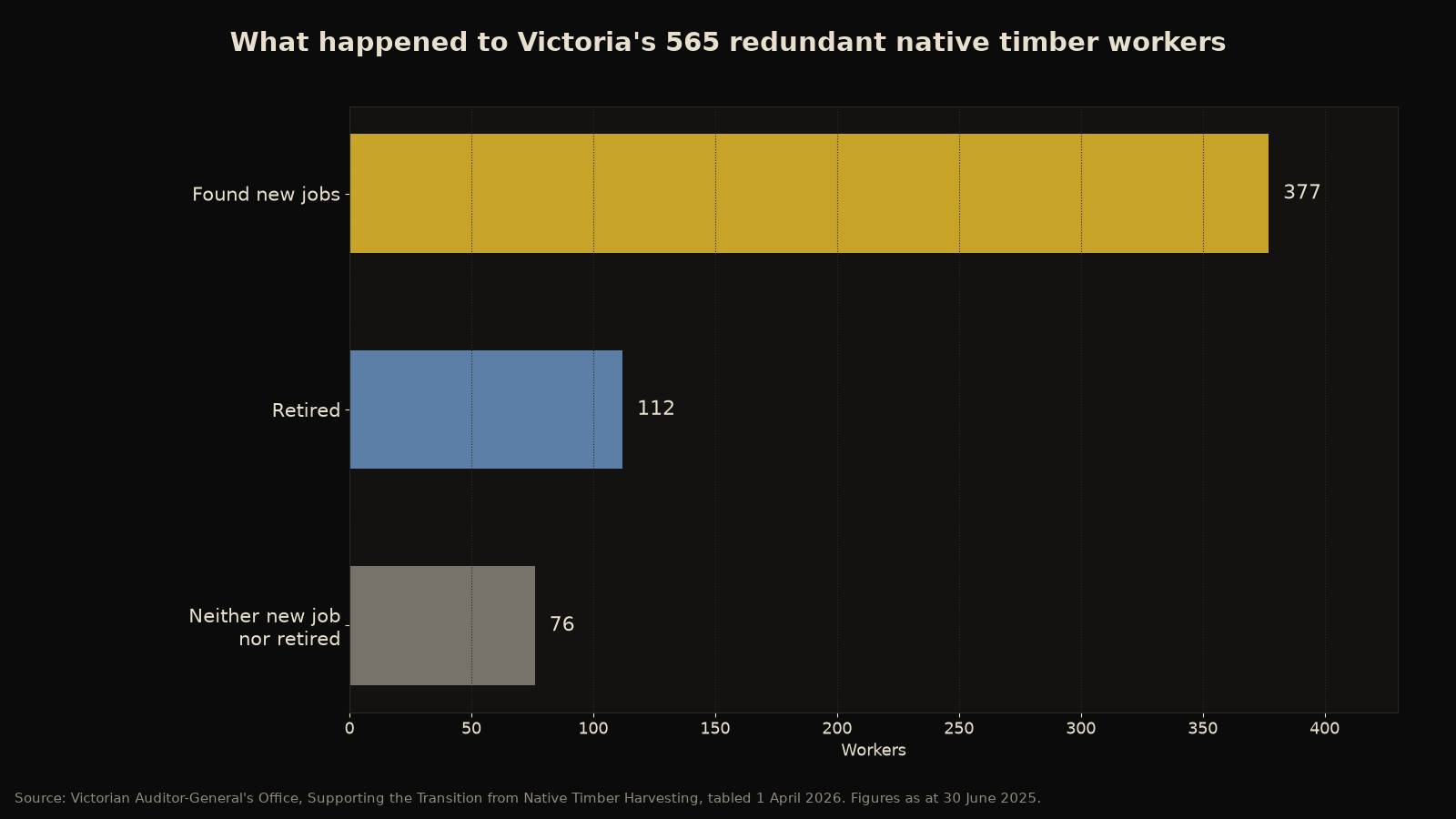
Here’s how they’ve fared. The program had helped 377 of them into new jobs and 112 into retirement, so 87 per cent were either working again or retired. That’s the headline number. But the Auditor-General found the new jobs were less secure. Full-time roles fell from around 80 per cent to around 60 per cent, with more part-time, contract and casual work. And about three quarters of the new jobs were in other industries. “Most workers left the native timber supply chain,” the report said.
The department running the program couldn’t say whether people were earning more or less than before. It doesn’t collect salary data. So nobody can tell you yet whether a timber worker who’s now driving trucks or working in construction is better or worse off.
The audit also found gaps in the record-keeping. The department couldn’t show it had properly checked eligibility in any of the 50 worker case files the auditors sampled. About a third of hardship payments, $102,000 across 34 payments, may have gone to people who weren’t eligible. Ten site rehabilitation payments worth $1.35 million had no evidence the work had been done. In total, the auditors said the department couldn’t give enough assurance for more than $1.61 million in payments, about 2 per cent of the sample. The department accepted all four of the audit’s recommendations.
None of that settles whether ending the industry was right. But it gives One Nation material. A party that says the transition was a mistake can now point to an official report showing people moved into less secure work and that the money wasn’t always tracked.
The import argument
Pickering’s central claim is that the ban shifted logging overseas rather than ending it. That’s hard to measure precisely, but the trade numbers give a sense of the scale.
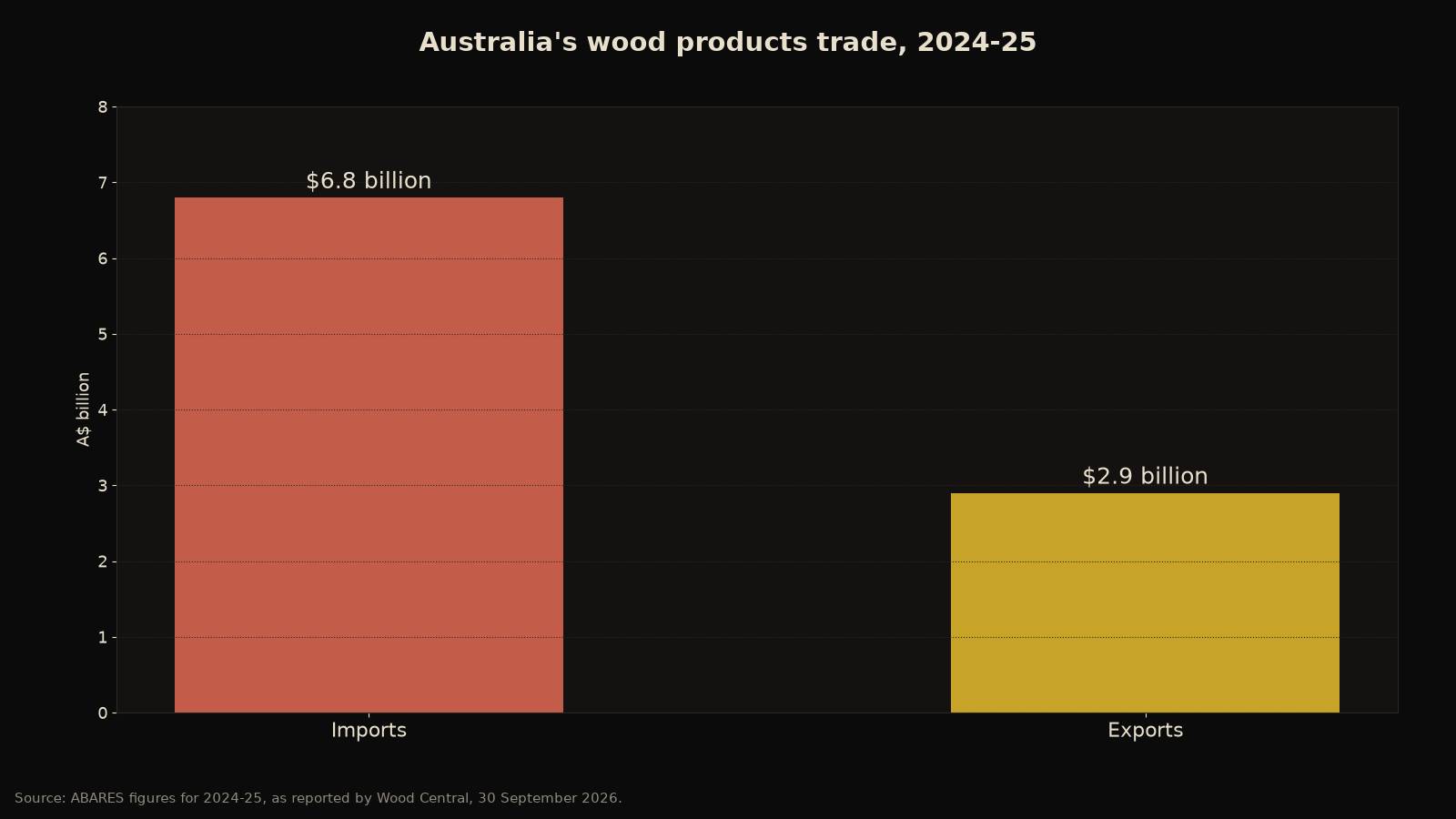
Australia imported $6.8 billion worth of wood products in 2024-25 and exported $2.9 billion, according to figures from the Australian Bureau of Agricultural and Resource Economics and Sciences cited by Wood Central. That’s a national figure covering everything from sawn timber to paper, not just hardwood that used to come from Victorian forests. It doesn’t prove the Victorian ban drove imports up. But it does show Australia’s a big net importer of wood.
Andrew White, chief executive of the Victorian Forest Products Association, welcomed the buy-local and labelling pledges. He said mills were fighting a “flood of cheap imports” and that those measures were long overdue. “We also desperately need a new government-backed Timber Strategy that sets out a vision and action plan for the entire industry,” he said. The association’s members are mostly plantation growers and timber processors. White said the association was “keen to work with One Nation on a new strategy for the industry”.
White’s support had limits, going by Wood Central’s report. He backed local wood first and origin labels. He didn’t, in the quotes published, say the industry wanted native harvesting back. That’s a live split in the timber world. Plantation growers and processors have built businesses since the ban that don’t depend on native logs, and some of them would rather see public money go to plantations than to restarting a native industry.
Victoria’s forests aren’t untouched now
There’s a twist in all this. Native timber is still coming out of Victoria’s state forests, just not through a logging industry.
In April the Department of Energy, Environment and Climate Action released a State Forest Timber By-Products Framework. It lets the department remove and sometimes sell native timber taken out during fire and forest management work, such as clearing fuel breaks or cleaning up after storms. About 7,000 tonnes of timber by-product was auctioned in May after a storm near Daylesford, the ABC reported in July. Revenue from sales goes to traditional owners under the framework.
Environmental groups call it logging by stealth. Jordan Crook from the Victorian National Parks Association told the ABC he’d seen an “intensification” in timber removal. The government rejects that. “Forest and fire management work is never conducted for a commercial purpose and is not logging,” a spokesperson said.
Scientists are split too. ANU forestry academic David Lindenmayer called the push to manage every patch of forest for fire “madness”. Former CSIRO chief research scientist John Raison took the opposite view. “The reality is that our national, protected forest area is not in good shape,” he told the ABC. “We want a good, well-managed forest. It’s not simply a matter of just saying we’ll no longer take timber out, we’ll put it all into a big protected area. How are you going to manage it? How are you going to finance it? I think that’s the big issue.”
Raison’s last question is the one Pickering’s plan tries to answer. One Nation says harvest revenue would fund forest management. Whether a reopened industry could actually make enough money to do that, after years of shrinking supply and with the fire and court risks still there, is something the party hasn’t put numbers on.
The Greens want to go the other way
The Victorian Greens have gone in the opposite direction. In June, state Greens leader Ellen Sandell announced a bill to ban Victorian mills from processing native forest timber from anywhere in Australia, Wood Central reported. It followed a Four Corners investigation that traced Tasmanian native timber to Victorian operations.
Sandell’s bill would also ban harvesting on private land, stop companies selling timber from bushfire and storm clean-ups, and repeal the laws a future government could use to restart native harvesting on public land. She said Powelltown Sawmills had used a $9 million transition payment to help bring Tasmanian native timber into Victoria.
So Victorian voters have three positions in front of them. Labor says the ban stays and it’ll back plantations and retrained workers. The Greens want to close what they see as loopholes. One Nation wants the forests reopened.
The Greens’ bill also exposes something Pickering’s plan relies on. Wood Central noted that Labor hasn’t repealed two laws that a future government could use to restore commercial harvesting. If those laws are still on the books in December, a One Nation-influenced government wouldn’t necessarily need new legislation to restart harvesting, though it would face the same court challenges that helped end the industry.
One Nation’s federal record on timber
This isn’t new ground for the party nationally. One Nation’s federal forestry policy says it “supports current levels of native forestry” and opposes “any moves to lock away more areas of native forest that is available for commercial harvesting”. It claims only six out of every 10,000 native trees in Australia are harvested each year, a figure the party doesn’t source on its page. It also wants to establish an extra 18,000 hectares of plantation forests a year and cut timber mills’ power bills by changing electricity market rules to favour coal and gas.
In the Senate last month, One Nation backed a Nationals motion to knock out a carbon credit method that pays state governments for taking native forest out of the harvest schedule. The motion lost 34 votes to 27 on 10 September. One Nation’s Senate whip Sean Bell warned that “perhaps the future of Australian hardwood will be made in Malaysia”, Wood Central reported.
Pickering’s pledge is a state version of the same idea, and it sits beside the party’s other Victorian energy and resources promises. He and Pauline Hanson have pledged to keep Loy Yang A open past 2035, and Pickering has vowed to repeal Victoria’s 1983 nuclear ban. Put together, it’s a pitch aimed squarely at Gippsland and regional Victoria, where coal, timber and farming jobs are concentrated.
Where it could matter
Native timber jobs were concentrated in a handful of places. The Auditor-General’s report lists towns and shires across Gippsland and the north-east as directly affected. Wood Central singled out Noojee in West Gippsland, one of 11 towns the government identified as vulnerable to the end of native harvesting, where the local mill has since closed.
Those are areas where One Nation is chasing votes hard. The party has promised to run candidates in every Victorian seat and is announcing them in batches. Polling has it competitive statewide, and Premier Ben Carroll has made the prospect of a Liberal-One Nation government a central attack line, as reported in his “One Nation terrifies me” comments. The Coalition is led by Jess Wilson. One Nation is unlikely to govern alone, which means a forestry pledge would most likely end up as a bargaining chip with the Coalition rather than a policy One Nation could deliver by itself.
That raises the obvious question for the Liberals and Nationals: where do they stand on reopening native forests? The Coalition hasn’t made it a centrepiece of its campaign so far, and no Coalition response to Pickering’s plan had been reported this week.
What isn’t known yet
A lot. One Nation hasn’t said how much timber it thinks the forests could supply, or where. It hasn’t said whether it’d recreate a state-owned harvester like VicForests or open forests to private contractors. It’s not clear what a Tasmanian-style model would mean in Victorian law. In Tasmania a state-owned business, Sustainable Timber Tasmania, manages harvesting on public production forest. There’s no word on what One Nation would do about the threatened species cases that helped shut the industry, or how it’d handle fire risk in forests that have burned repeatedly.
And there’s no cost attached. The transition has already been funded to $1.5 billion. Reopening would mean new roads, new contracts and possibly new compensation for businesses that took transition money and moved on.
Some of those answers may come on Saturday. One Nation says its Crown launch will put its full Victorian platform on the table, and Hanson and Pickering are both due to speak. Until then, what’s on the record is a pledge to reopen the forests, a promise to protect old growth, a buy-local rule, and a minister asking how One Nation thinks the problems that ended the industry have disappeared.
The paper
Comments
No notes on this story yet.
Sign in to comment