
Pauline Hanson didn’t wait long. The Reserve Bank lifted the cash rate to 4.60 per cent on Tuesday 29 September 2026. Within hours the One Nation leader had gone after the Treasurer, and by the next morning she was saying Jim Chalmers should resign.
Here’s what happened. The Reserve Bank of Australia’s Monetary Policy Board voted unanimously to raise the cash rate target by 25 basis points. The cash rate is the interest rate banks charge each other for overnight loans, and it’s the lever the RBA pulls to push every other rate in the economy up or down, including your mortgage. A basis point is one hundredth of a percentage point, so 25 basis points is a quarter of a percentage point. The new target took effect on Wednesday 30 September. It’s the fourth hike of 2026, and it puts the official rate at its highest level since 2011.
Hanson called it a Labor failure. Chalmers said Australians were under pressure, blamed a war on the other side of the world for turbocharging inflation, and said the government takes responsibility for its part of the fight. Governor Michele Bullock said inflation was too high, driven first by pressure on the economy’s capacity at home, with the Middle East shock on top.
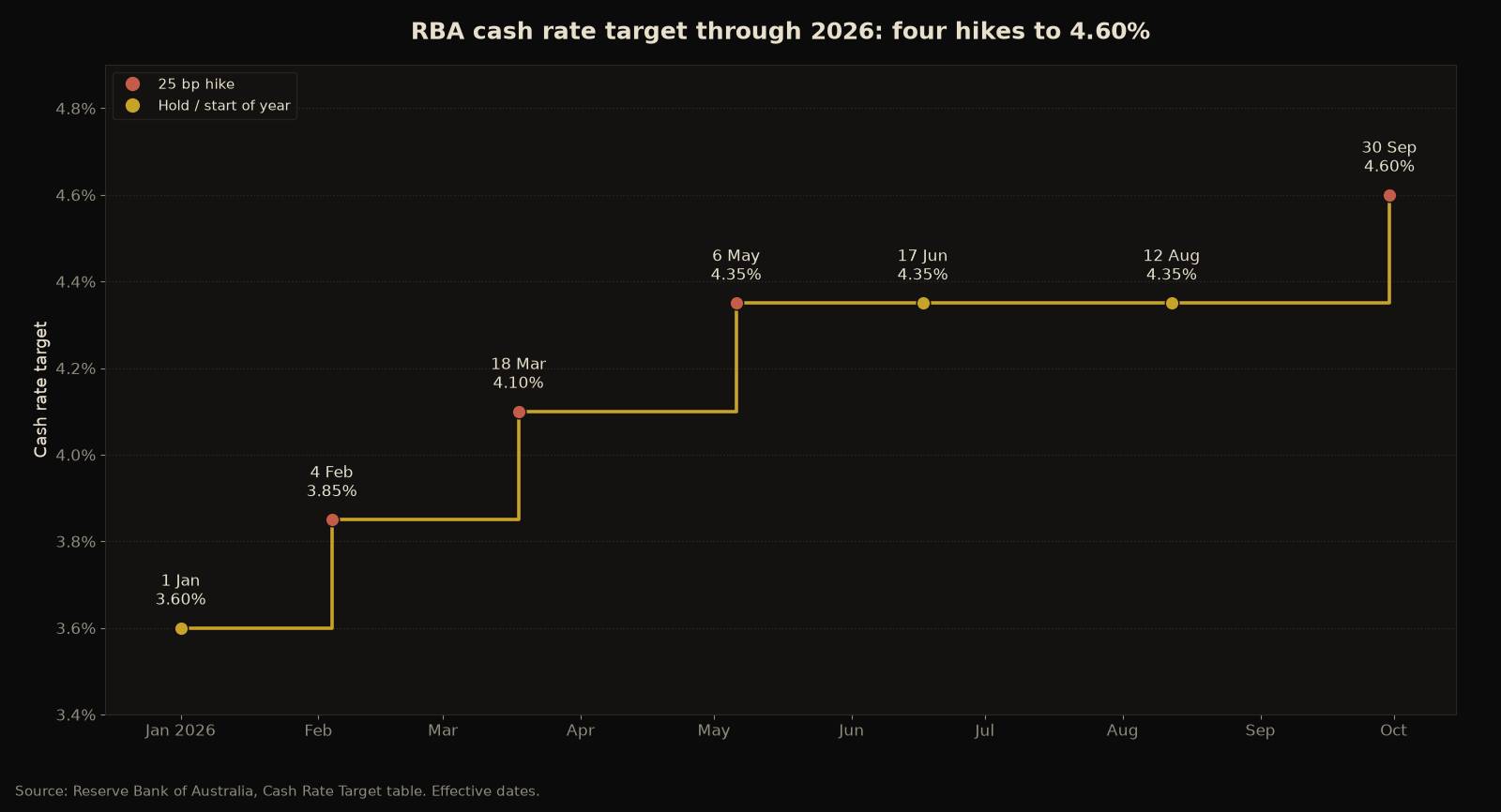
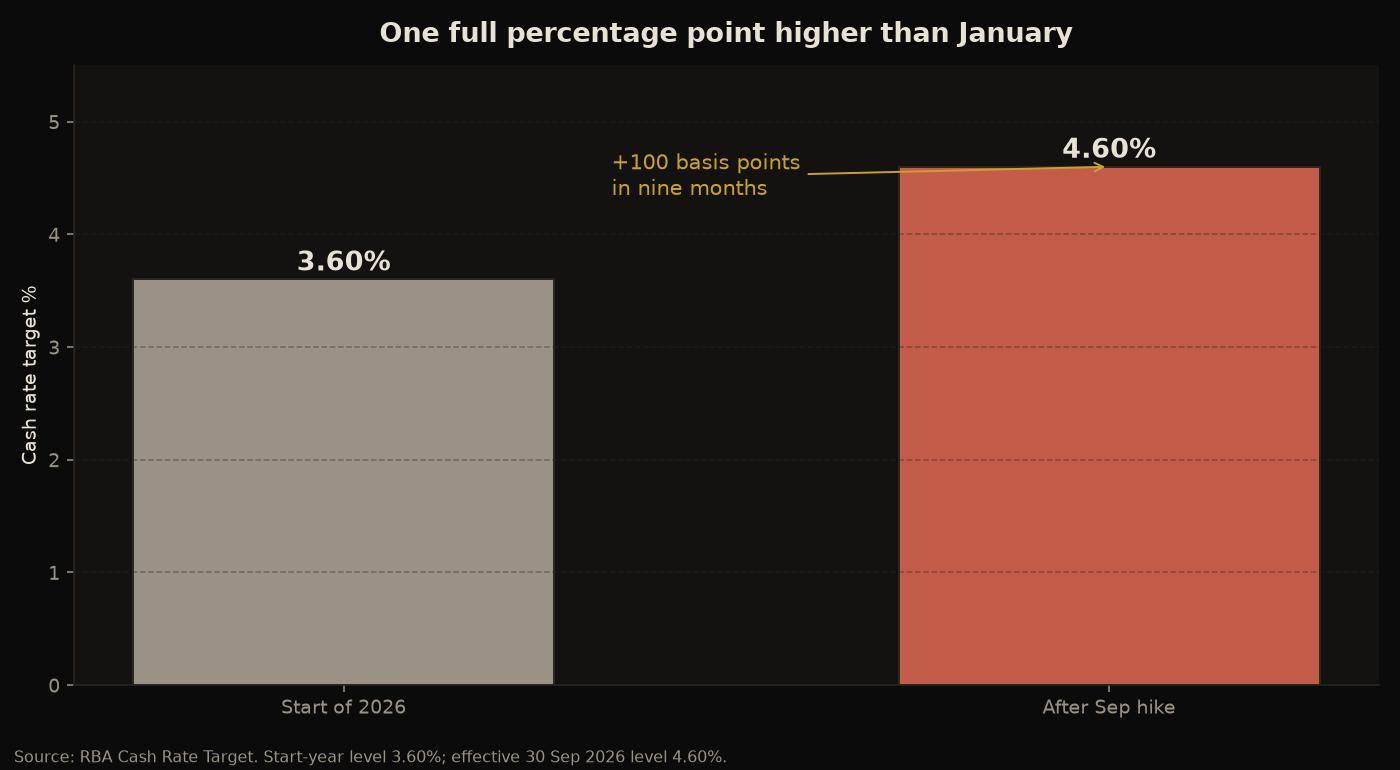
The RBA’s own numbers tell a clean story. The cash rate started 2026 at 3.60 per cent. It rose to 3.85 per cent from 4 February, 4.10 per cent from 18 March and 4.35 per cent from 6 May. The Board held at its June and August meetings. Then came 29 September. That’s one full percentage point higher than in January, in nine months. And that path isn’t a pundit’s sketch. It’s straight from the RBA’s published Cash Rate Target table.
Hanson’s opening shot came in a video statement on the day of the decision. Daily Mail Australia’s Nicholas Comino reported the One Nation leader saying Labor had wrecked the economy and needed to fix it. Her words were: “Labor has wrecked our economy and it needs to be fixed.”
Then came the promise she says was broken. “Jim Chalmers said rates were coming down, but today Australians have been hit with another interest rate rise.”
And the blame line that ran under the whole clip: “Another Labor lie. And yet again, Jim Chalmers blames everyone but himself.”
On the morning of Wednesday 30 September, Daily Mail Australia reported, she went further. On social media she wrote the two sentences that now sit over this story:
“Treasurer Jim Chalmers has failed Australians. He should resign.”
The Australia Today’s copy of that post is dated 29 September.
So that’s the story. A resignation demand that landed less than a day after the cash rate hit a 15-year high, and the answers that came back from the Treasurer and the Governor.
The Board’s media release, number 2026-27, is short and blunt. Inflation remains elevated. Some of the upside risks the Bank flagged in August are now happening. The Middle East conflict has broadened. Global energy prices are much higher than the August forecasts assumed. Demand linked to the global tech boom is driving rapid growth in world prices for technology goods. There’s still pressure on the economy’s capacity at home. Firms are telling the Bank about cost pressures, and they’re either raising prices or looking to do so. Short-term inflation expectations remain elevated. And recent inflation results in Australia were stronger than the Board expected at its previous meeting.
Growth in output has slowed, the Board said, but it was a bit stronger than expected in the June quarter. Consumer spending looks to be easing gradually. Housing prices have fallen in most capital cities. New housing loans have dropped noticeably. The job market has eased broadly as expected. Business investment and debt growth are strong.
The Board also flagged a lot of uncertainty. The Middle East conflict remains unresolved. There are scenarios where inflation is higher and activity lower than forecast. Global oil supply disruptions are keeping upward pressure on energy prices. A long stretch of uncertainty could also drag growth lower overseas and in Australia. So far, though, growth in Australia’s major trading partners has been stronger than expected, because the boost from tech investment has outweighed the damage from the conflict. At home, weak productivity growth is still holding back how fast the economy can grow without pushing up prices, and there are questions about what the housing downturn will do.
Then there’s the decision paragraph, the one that matters for anyone with a variable mortgage:
“Since the previous meeting, some of the upside risks to inflation are materialising. There have been further disruptions to global oil supply and recent data suggest that growth and inflation in Australia have been higher than expected. Higher fuel prices have partially been passed through to prices of other goods and services. This inflation impulse is in addition to the effect of capacity pressures in the economy.”
The Board said it’s focused on stopping high inflation from getting stuck. To do that, growth in total spending across the economy needs to stay subdued for a while. The three earlier increases this year tightened financial conditions, and the economy looks to be slowing. But inflation is still too high, and the Board judged a further tightening was warranted. It left the door open:
“The Board will continue to do what it considers necessary to bring inflation sustainably back to target, including increasing the cash rate target further if needed.”
“Today’s policy decision was unanimous,” the release said.
Bullock’s media conference in Sydney that afternoon filled in the reasoning. She opened with the decision, then the why. Higher interest rates are needed to make sure inflation gets back to target. Inflation is too high and has been driven by pressure on the economy’s capacity at home. The inflation hit from the Middle East conflict comes on top of that. Spending and investment at home have been stronger than expected, despite weak sentiment and a softer housing market. Productivity growth is still weak. The job market is still a little tight. And outside Australia, the global economy has held up better than many expected.
She said the upside risks to inflation are now showing up. The Middle East conflict has escalated again in recent weeks. Oil prices have risen significantly. Disruptions to oil supply could last longer than expected. Separately, the global boom in tech investment has driven big price rises for some inputs in that supply chain, including software costs and some commodity prices. Those costs are starting to flow through to businesses and consumers. That boom is also adding to demand in Australia at a time when the economy is already running near its limits.
She didn’t soften the message for households.
“Now, I know this decision is difficult for households with a mortgage and businesses with loans, but high inflation hurts all Australians, especially the most vulnerable. Every household has seen how the price of everything has gone up in recent years. Pay packets don’t go as far as they used to, and that’s why we need to stop this high inflation.”
And she kept more hikes on the table. “The Board will increase interest rates again if that’s what’s needed to get inflation down.”
Matt Wade of the Sydney Morning Herald asked whether this was an unusual time to hike, with unemployment at a five-year high, house prices falling for five months and weak growth in GDP per person. Bullock said the unemployment rate is still quite low by historical standards, and the job market is still a little tight. She compared Australia with New Zealand and Canada, which raised rates much higher and now have much higher unemployment. The Board’s strategy, she said, is still to bring inflation back to target in a reasonable time while keeping as many of the job market’s gains as possible. Productivity, she said, is doing nothing. With too much demand in the economy, demand has to grow more slowly than supply for a while. Recession, she said, is not the Bank’s central case at the moment.
Michael Read of the Australian Financial Review asked about markets expecting underlying inflation of about 3.6 per cent in the August figures due the next day. Would that be enough to avoid a hike in November? Bullock said underlying inflation had been about 3.5 per cent for the past six months. That’s the past. The Board is trying to set financial conditions tight enough for what’s coming. The three earlier rises still have effects to flow through. This is one more. Will four be enough? She doesn’t know. And she wasn’t giving any forward guidance.
Matt Cranston of The Australian asked about money supply, real interest rates, and whether the super guarantee might be a finer tool than the cash rate. On super, Bullock shut the door. That’s not within the Bank’s gift, she said, and she had no comment. On the comparison with the 1990s and its double-digit rates, she said inflation was in double digits back then too. Inflation now is about 3.5 per cent. That’s a percentage point above target, she said, but nowhere near the 1990s. The Bank thinks financial conditions are restrictive, meaning rates are high enough to slow things down. How restrictive is the key question. As she put it later, the proof of the pudding will be in the eating.
Nasteho Said of Bloomberg asked whether the economy could handle a cash rate above 5 per cent by May, which is what traders were pricing in. Bullock again wouldn’t forecast. Markets are reading the data. The Bank raised early, waited, and found underlying inflation a bit higher than expected in things like market services, groceries and consumer durables. If the tightening already done turns out to be enough, maybe there won’t need to be more rises. Markets will adjust as the data come out.
John Rolfe of the Telegraph and Herald Sun pressed her on the line that productivity is doing nothing. Who’s responsible? Bullock said she’s not the productivity tsar. That’s Danielle Wood. Individual productivity policies aren’t the RBA’s bailiwick, she said. Governments could look at regulations. Businesses need to step up too. If some things are in the government’s gift, like regulation, then yes, it can act. The best thing monetary policy can do for productivity, she said, is get inflation low and stable, so businesses and households can spend and invest without worrying about the cost of living.
Patrick Commins of Guardian Australia asked how much the Middle East conflict drove the decision. Bullock said the conflict has been a big shock and has made Australia poorer. Early hopes that it would be short-lived haven’t held up. Fuel, fertiliser and transport prices are now permanently higher. The longer it lasts, the more likely businesses will try to pass costs on. “I want to make that clear,” she said, before laying it out:
“This isn’t all about the Middle East conflict. It is making things much worse, but we did start from a position of excess demand anyway, and that’s why we started raising interest rates even before the conflict started.”
That’s the sentence political opponents will keep quoting. The ABC’s Clare Armstrong noted that Bullock’s diagnosis was broader than Chalmers’ repeated emphasis on the war.
Stella of Reuters asked whether the Board considered a pause or a 50-basis-point move. Bullock said the Board weighed holding against a 25-basis-point rise. There was a case for holding because of downside risks, including housing. Against that sat the three upside risks flagged earlier: the Middle East conflict dragging on with fuel prices rising again, the tech boom, and pressure on capacity being higher than thought. The first risk, she said, has more or less happened. The tech boom is having an impact on demand. Capacity pressures are harder to measure, but early warning signs in the job market have largely steadied.
Chalmers didn’t resign. He defended the government’s record. Speaking on Tuesday 29 September, Daily Mail Australia reported, he said the government had been fighting inflation through disciplined budget management and slower growth in public spending.
“We take responsibility for our part of the fight against inflation. That’s why we’ve been managing the budget responsibly. It’s why we’ve been delivering a couple of surpluses and then much smaller deficits. It’s why we’ve made sure that public demand in our economy has slowed rather than gathered pace.”
He argued the private sector is now doing most of the spending.
“If you look at public demand in our economy versus private demand, over the last year or so, for every five dollars of demand in our economy, four of those have been private demand and one has been public demand. And we saw public demand growth halve compared to the year before.”
And on the shock from overseas:
“As I said, we do have serious challenges in our economy. Our inflation challenge is being turbocharged by a war on the other side of the world. Australians are paying a very hefty price for that war in the Middle East. And today that price became a bit steeper with this decision from the independent Reserve Bank.”
Al Jazeera’s John Power quoted Chalmers’ post on X the same day: “We know a lot of Australians are under pressure and this will make things harder. Inflation and interest rates are going up around the world but we know that doesn’t take the sting out of today’s decision.” Chalmers said the government would take responsibility for “our part of the fight against inflation”. That meant, he said, continuing to manage the budget responsibly, rolling out tax cuts and cost-of-living help, and tackling longer-term challenges in an uncertain world.
Writing on 30 September, the ABC’s Clare Armstrong reported Chalmers accepting “responsibility for my part in the fight against inflation” while arguing the US war with Iran had “turbocharged” fuel costs and that Australians were paying a “very hefty price” for it. The ABC also reported the Coalition seizing on the hike. Opposition Leader Angus Taylor said the government was spending “too much” and the economy was “not working”. “Households, families are having to tighten their belts, but the government hasn’t tightened its belt,” Taylor said.
The Australia Today’s Jitarth Jai Bharadwaj reported more of what Chalmers said after the decision. “Australian workers didn’t choose this war, but they are paying a hefty price for it,” the Treasurer said. And: “Inflation is much lower than its peak, but it is higher than we would like and the conflict in the Middle East is making inflation linger for longer.” He pointed to cost-of-living help, like cheaper medicines, more bulk billing, wage increases and tax cuts. He said the 2025–26 budget outcome was $6 billion better than forecast in May, and the deficit was almost half the level Labor inherited when it came to office. “Responsible economic management is a defining feature of this Government,” he said.
At the media conference, Daily Mail Australia’s Nicholas Comino asked Bullock whether public sector spending was adding to total demand and making the Bank’s job harder. She didn’t take the bait:
“So I’ve made the point a number of times before that aggregate demand is made up of public demand and private demand. They are both adding to aggregate demand. And so I wouldn’t say any particular items are making our job harder. Our job is to focus on what we can do to bring inflation down.”
Asked about Chalmers saying the inflation environment was beyond his control, she said: “Look, I’m not here to play a blame game.” Demand is growing faster than supply. Add the Middle East conflict and you’ve got a very difficult situation. The tool the Bank has is the interest rate.
On productivity she was blunt. “The bottom line is that productivity is doing nothing.” The ABC’s Armstrong put that line next to the spending debate. Figures released that week, the ABC said, showed government spending at 26.9 per cent of GDP last financial year, the highest level in four decades outside the pandemic. The total tax take climbed to 24.1 per cent, just shy of the Howard-era record. Chalmers argued the headline spending figure hid a slowdown in public demand. Bullock wouldn’t name a culprit.
Hanson didn’t stop at resign. She also pushed One Nation’s “super pay boost” again. Daily Mail Australia reported her saying the plan would let Australians take up to 25 per cent of their future compulsory super contributions as take-home pay for up to three years, to help with mortgage repayments or rent. And she put a household number on it:
“It won’t fix Labor’s mess, but it could give a working family about $82 more a week after tax.”
Then the double demand:
“Labor is running this country into the ground. The best thing Jim Chalmers could do today is implement One Nation’s super pay boost, then he should resign.”
So where does $82 come from? It’s One Nation’s own example, from when the party launched the policy in early September. Daily Mail Australia reported at the time that, under the plan, a couple earning $168,000 a year between them would take home about $4,300 a year extra after tax. Divide that by 52 weeks and you get about $82. By the party’s own numbers, a single worker on $90,500 would get about $44 a week. That’s Hanson’s estimate, for one example household. It isn’t an RBA or ABS figure.
We covered the policy in detail in Three per cent off the guarantee. The short version: One Nation’s plan would let eligible renters and mortgage holders take three percentage points of the 12 per cent Superannuation Guarantee as take-home pay for up to three years. Hanson is using rate-rise day to sell that as immediate relief. Chalmers has criticised the proposal, arguing it risks weakening retirement savings. When the plan was launched, Social Services Minister Tanya Plibersek told Sunrise, “It’s obvious that One Nation wants you to raid your super instead of getting a pay increase.”
So what can we say about the hit to households without making up mortgage maths? We can stick to what named outlets reported.
The ABC’s Gareth Hutchens reported that the decision lifts the cash rate to 4.6 per cent from 4.35 per cent, the highest since late 2011, and that it’ll be a blow to home owners with big mortgages. He also noted that savers with high-interest accounts could earn more interest if their bank passes the rise on. Clare Armstrong’s follow-up said the hike, the fourth this year, will add about $91 to the monthly repayments of a typical home owner with a 25-year $600,000 mortgage. That’s the ABC’s figure. Cotality, cited by Hutchens, said the RBA’s four rate rises this year have cut Australians’ borrowing capacity by almost $90,000 on average. Macquarie Bank said it would lift its variable home loan reference rates by 0.25 per cent a year from 15 October, and would also lift variable rates on some transaction and savings accounts.
Al Jazeera cited a Roy Morgan research report from earlier in September. It said nearly one-third of Australian mortgage holders, nearly 1.8 million people, were at risk of “mortgage stress” as of July. Al Jazeera described that as households spending 25 to 45 per cent of their after-tax income on repayments. That’s Roy Morgan’s measure, as reported by Al Jazeera, not an RBA figure.
Bullock, asked about households being squeezed, said people are feeling, quite rightly, very annoyed and upset. They’re seeing real wage cuts. Then there’s a Middle East shock that has nothing to do with them but has made everyone poorer. The best thing the Bank can do, she said, is get inflation back to 2.5 per cent, where it sits in the background. Lin Lin of the ABC asked about household mortgage debt being much bigger than in 2011. Bullock said that at an overall level, debt and stress measures aren’t pointing to massive stress across the household sector, though she acknowledged individual households are hurting. She said the RBA’s Financial Stability Review, due out on Thursday 1 October, would cover where households stand.
Economists quoted on the day weren’t cheerful. EY Oceania chief economist Cherelle Murphy told the ABC it wasn’t a happy time for households. Consumer sentiment was extremely low. People had jobs but didn’t feel like they were getting ahead. The recent fall in house prices was making many families feel less wealthy. “It’s certainly going to hurt many households, this fourth interest rate hike,” she said. From the Bank’s point of view, she added, what hurts more is inflation staying too high after a long time above the target band.
BetaShares chief economist David Bassanese said he thought the RBA would lift again in coming months. The Bank had noted local firms facing higher costs and either raising prices or looking to do so. “Sadly, Australia looks set for a period of stagflationary conditions, with weak growth alongside stubbornly high inflation,” he said. His base case, he told the ABC, was another 25 basis points on Melbourne Cup Day, taking the cash rate to 4.85 per cent.
Hutchens also noted Australia isn’t alone. In recent weeks the European Central Bank, the US Federal Reserve, the Bank of Japan and the Reserve Bank of New Zealand have all lifted rates. Fighting in the Middle East has sent crude oil prices higher and pushed more inflation around the world through fuel.
Bullock was asked about bond markets pushing rates higher around the world. She said she wasn’t worried at that point about being forced further than she’d be comfortable with. Bond markets are adjusting to higher inflation overseas and to more demand for long-term funding, from governments and from the giant tech companies building data centres. So far the moves have been orderly. The Financial Stability Review, she said, would talk about high prices for some tech assets and the risks if they fell in a disorderly way.
Is recession more likely after the hike? It’s not the central case, she told Wade. Could the Bank ever need to push the economy into recession to get inflation to 2.5 per cent? She hoped not. The scenario that would force a dramatic slowdown, she told David Taylor of ABC News, is if inflation expectations get away, if people start treating three-point-something or four as fine. That’s the worry behind the household pain.
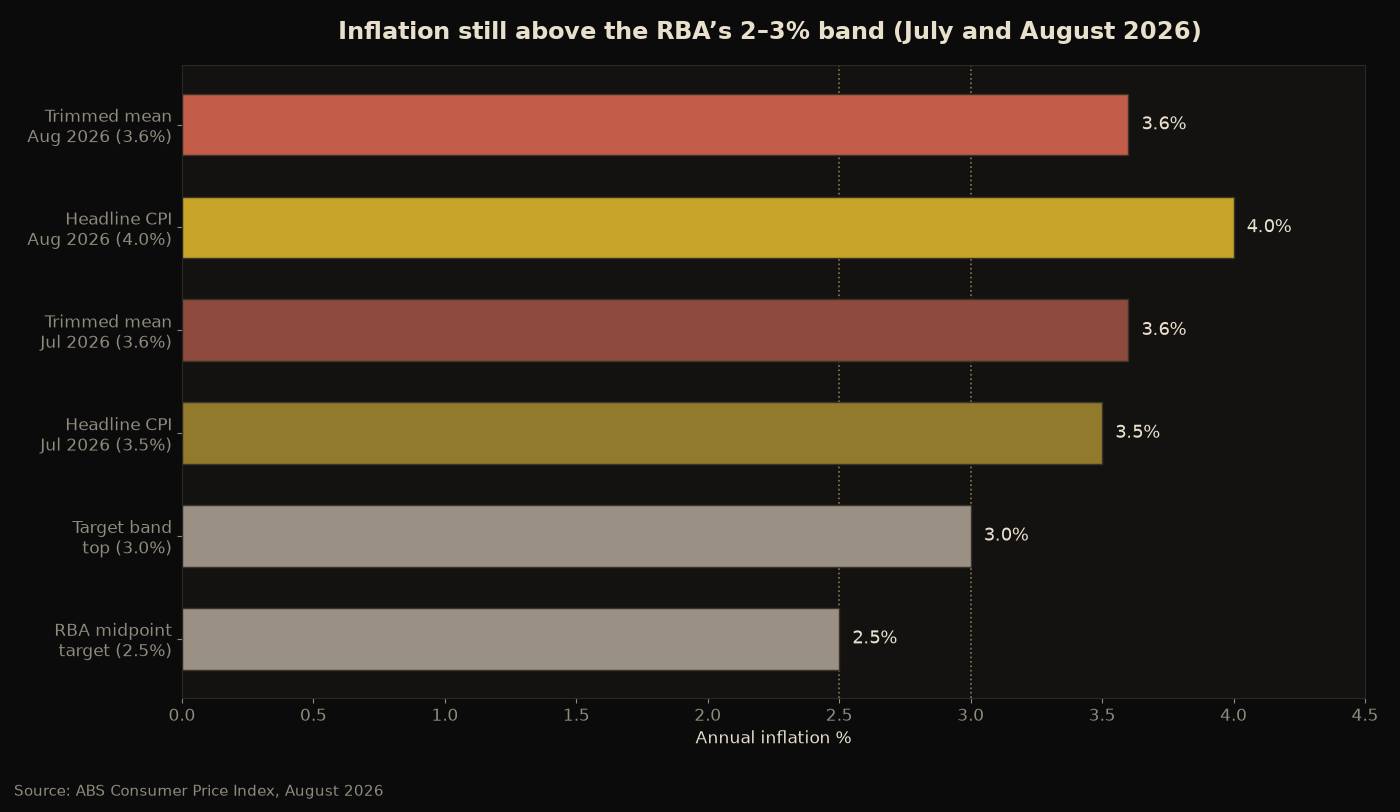
Before the August figures landed, the latest official numbers showed consumer prices up 3.5 per cent over the year to July. That’s the Consumer Price Index, or CPI, the ABS measure of how much the prices of everyday things households buy are changing. The Australia Today summed up the rest: housing costs up 5 per cent over the year, food and non-alcoholic drinks up 3.2 per cent, and the ABS trimmed mean at 3.6 per cent. The trimmed mean is a measure of underlying inflation. It cuts out the biggest price jumps and falls each month so you can see the trend. Both numbers were above the RBA’s 2 to 3 per cent target band. Bullock told the media conference that if the next figure came in around market expectations, near 3.6 per cent underlying, it would confirm inflation in the first half of the year was unacceptably high. That number looks backwards, she said. The Board is trying to look forward. The full effect of a rate change can take 12, perhaps even 18 months to come through.
The ABS released the August figures on Wednesday 30 September, the day after the decision. Headline CPI inflation jumped to 4.0 per cent over the year, up from 3.5 per cent in July. The trimmed mean held at 3.6 per cent.
Bullock also rejected the stagflation label at today’s levels. She wouldn’t call inflation of 3.5 per cent and unemployment of 4.6 per cent stagflation. Stagflation, she said, usually means very high inflation and very high unemployment, and she doesn’t think Australia has very high unemployment. The full employment goal, as she frames it, is the level of employment that fits with low and stable inflation, and she thinks the job market is still a bit too tight for that. A rise in the unemployment rate, she told Hannah Kwon of SBS, doesn’t necessarily mean job losses. Unemployment has risen from 3.5 per cent to 4.6 per cent over a couple of years, while more than a million jobs were created. Often it means people take longer to find work, or more people start looking.
On wages, she agreed with Board member Iain Ross that there’s no wage-price spiral. Labour costs per unit of output are rising faster than fits with the inflation target, she said, but that’s because productivity is doing nothing, not because wages are spiralling. Real wages are under pressure for the same reason.
So how does Hanson turn a central bank decision into a resignation demand? The cash rate is set by an independent board, but the political fight is over who created the inflation problem that board is trying to crush. Hanson blames Labor spending and broken promises. Chalmers says a war turbocharged an already hard fight, and that public demand has slowed. Bullock says pressure on capacity at home came first, the oil shock made it worse, productivity is doing nothing, and both public and private demand add to the total. She won’t pick a villain for the cameras.
One Nation has put cost of living and economic management at the centre of its pitch. The Australia Today noted the party has been polling much more strongly than at the 2025 federal election. Hanson is trying to turn mortgage stress into ministerial accountability. Chalmers is arguing Australians are being hit by global shocks the government can’t control and problems at home it’s working on. And the Reserve Bank is warning inflation is still serious enough to keep more increases on the table.
Comino’s Daily Mail piece also reported Bullock confirming that both government and private spending feed into inflation, while declining to blame any one source. Her words, from the RBA’s transcript: “The fact is we’re observing that demand is increasing a bit too quickly. Well, it’s slowed now, but it’s still above supply, and that’s what we’re trying to do here.”
Daily Mail Australia’s version of that answer is worded a little differently from the RBA transcript.
Chris Kohler of 9News put a question to Bullock that plenty of readers will recognise. Too much demand, permanently higher prices from the Middle East, data-centre spending, and households footing the bill through the cash rate. Is another hike detached from the problem?
Bullock’s answer walked through the different ways rate rises work. It isn’t only the cash-flow hit to people with mortgages, though that’s real and it hurts. Higher rates also encourage saving over spending. They work through asset prices, including housing. And according to the Bank’s research, she said, the most important channel is the exchange rate. Raising rates affects import prices and shifts spending. Other countries without Australia’s heavy reliance on variable-rate mortgages still see rate rises work through those other channels.
Patrick Morrow of 2SM asked for a message to mortgage holders who feel they can only do so much. Bullock said there’s nothing she can say to make households feel better. The Board didn’t take the decision lightly. “We know this, but we have to do it if we are to bring inflation back down. We need to do it if we are to bring inflation back down. That’s our mandate, and ultimately, in the long run, hopefully in the next couple of years when we get inflation back down, this will all have been worth it.”
Cameron Micallef of NewsWire asked whether higher fuel costs, which also take money out of people’s pockets, made a case for holding. Bullock said there was a case for holding, but not for that one-for-one reason. Petrol prices don’t stand in for the interest rate. Luca Ittimani of The Guardian asked whether people need to get used to rates at this level. Bullock said she doesn’t know if this particular level is the new normal, but the country isn’t going back to policy rates near zero. The lows before and during COVID look like the exception.
Hanson’s video and follow-up posts did a simple political job. They named a person. Not “the Board”. Not “the cycle”. Jim Chalmers. They tied the hike to a broken-promise claim, that he said rates were coming down. They offered a cash-in-hand policy as the thing he should do before he goes. And they used the word resign twice, once in the social post and once in the super pay boost closer.
Walk the rate path one more time, because the politics only make sense if the arithmetic holds up. The cash rate target had been 3.60 per cent since a cut that took effect on 13 August 2025, and it held there into the new year. From 4 February 2026 it was 3.85 per cent. From 18 March, 4.10 per cent. From 6 May, 4.35 per cent. Then holds in June and August. From 30 September, 4.60 per cent. Four hikes. One hundred basis points. The highest since 2011, when the target sat at 4.75 per cent for most of the year before cuts in November and December.
Bullock reminded reporters that in 2011 inflation was also around 3.5 to 4.5 per cent. What households remember, she said, is the very low rates before and during COVID. She knows the country isn’t going back to rates near zero. Neutral rates, the level that neither speeds the economy up nor slows it down, are moving up a little, she said, because global tech investment is putting heavy demand on the world’s pool of savings.
On the super pay boost, keep the facts straight. The Superannuation Guarantee is 12 per cent. One Nation wants eligible workers to be able to take three percentage points of that as pay for up to three years. On rate-rise day Hanson repeated her pitch of $82 a week after tax. That’s her claim, built on her party’s example of one couple on $168,000. Our earlier piece, Three per cent off the guarantee, has the longer walk-through of how the policy would work.
Sophia Rodrigues of Central Bank Intel asked whether the Bank was looking at tools beyond the cash rate for a world of repeated supply shocks. Bullock said she’s not aware of an alternative tool within the Bank’s control for this. It’s lopsided, she said. At zero you run out of room, while rates can keep rising. She said she’s confident inflation will come down, and that means using the interest rate as needed.
So where does that leave you? The Reserve Bank raised rates. It said it might do it again. Hanson says the Treasurer has failed and should resign, and she held up the super pay boost as the thing he should do first. Chalmers says the government takes responsibility for its part, pointed to budget discipline and private-led demand, and said a war overseas made the inflation fight harder. Bullock says the fight started with too much demand at home, the oil shock made it worse, productivity is flat, and she won’t play a blame game on camera.
The cash rate is 4.60 per cent. The Board meets again in early November. August inflation came in at 4.0 per cent. Hanson has named her price for accountability. Chalmers hasn’t paid it.
The paper
Comments
No notes on this story yet.
Sign in to comment