
Pauline Hanson says Bondi should have ended the excuses. On Monday 28 September, the Sydney Morning Herald reported that a Melbourne preacher had told followers there was an obligation “to take up arms” against the enemies of Allah. Within hours, the One Nation leader was asking for something Canberra doesn’t have: a federal power to shut extremist mosques and Islamic prayer centres.
That’s the demand. The fight around it came fast. Wentworth independent Allegra Spender used the same SMH report to push for stronger hate-speech laws that apply the same way in every state. Labor blamed the Coalition for blocking the wider anti-hate package it tried after Bondi. Former prime minister Tony Abbott has spent months arguing something different again: that the laws we already have are enough, if anyone would enforce them. Jewish leaders, the Catholic Archbishop of Sydney, a Federal Court judge and the country’s peak imams’ council have all joined in, each from a different direction. So here’s the argument, laid out fairly, side by side.
Start with the sermon, because without it Hanson’s statement is just another press release.
On 28 September, Paul Sakkal at the SMH reported that a young preacher who goes by Abu Ahmad said in a July sermon that followers should not “take the Jews and the Christians for friends.” Ahmad preaches at the Al Bayyinah Islamic Centre in Springvale, in Melbourne’s south-east. In the same talk, posted in a clip on the centre’s social media, he said devotion to Allah included an obligation “to declare opposition: indeed, to take up arms against his enemies, to shun them and to stay far from them both in word and deed.”
It got darker. SMH quoted him saying that if the aim of the enemies of Islam, “whether they are atheists or Jews or Christians or modernists or Zionists or communists,” was the “emasculation” of Muslims and the erosion of their character “in order to make them the ass of the chosen people,” then every Muslim should feel the urgency. SMH said he also mentioned a book famous for spreading antisemitic conspiracy theories. The Guardian’s fuller quote names it. He said that phrase was “as it is put in the protocols of the elders of Zion.” That’s the notorious forgery about a secret Jewish plot, and it’s why Jewish leaders heard an old and familiar script.
Now the part that matters most for fairness. The SMH was clear about what it wasn’t saying. It said it was not suggesting Abu Ahmad was under investigation, and it was not suggesting he supports Islamic State. The paper contacted the Al Bayyinah centre for comment. So let’s be plain about it too. Nobody has charged Abu Ahmad with anything. Nobody has said in public that he’s being investigated. This story is about what politicians did with a news report. It isn’t a court finding against a preacher.
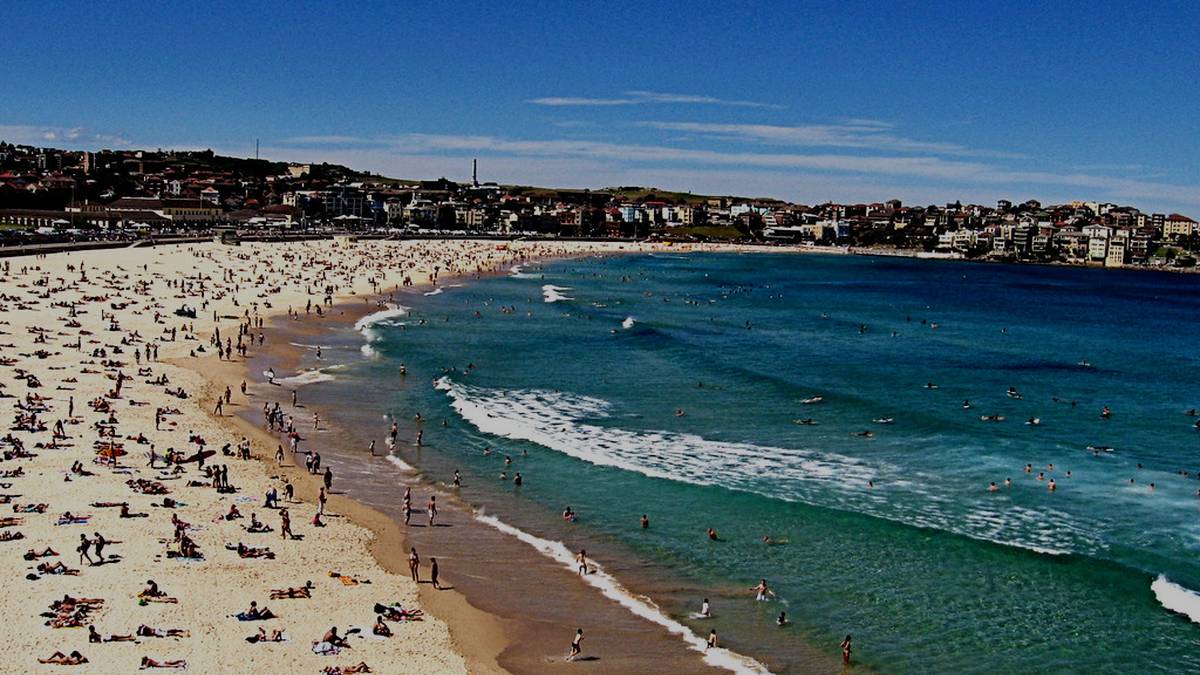
So who is around Al Bayyinah? The centre opened in Springvale in 2024. The SMH said it had often posted on Instagram alongside an account called Station of the Seekers, which had featured Islamic State sympathisers. The paper said the centre had also had the backing of Sydney preacher Wissam Haddad, who is linked to the Al Madina Dawah Centre, a prayer hall in Bankstown. The SMH reported that Bondi shooter Naveed Akram attended Al Madina and met Islamic State supporters through people there. Akram and his father, Sajid, are alleged to have killed 15 people at the Chanukah event at Bondi Beach on 14 December 2025. Those are allegations and links that have already been reported. They don’t mean Abu Ahmad had anything to do with Bondi, and nobody has said he did.
Josh Roose, an associate professor at Deakin University who studies extremism, told the SMH that Haddad had in effect set up an “outpost” in Melbourne. “If authorities don’t crack down on these centres as soon as they emerge, then we’re inviting, quite frankly, extremists, Salafists, jihadist Islam, into the suburbs,” Roose said. He said calling to take up arms was “more radical than anything Hizb ut-Tahrir ever said, and they were banned.” But he also named the problem both Hanson and Spender keep running into. If a preacher were ever charged, Roose said, he could argue the call to arms was loose or general talk, not a real call to violence. That’s a hard case to prove.
Hanson didn’t wait for the royal commission. The same day, she put out a media release on X headed “Labor’s inaction is enabling radical Islamic terrorism.” The SMH ran her key lines the next morning, and they tie Bondi and the sermon together.
“We need stronger federal powers to shut down the extremist and fundamentalist mosques and Islamic prayer centres. These centres are popping up across our suburbs and seemingly allowing terrorist recruitment and advocacy to fester unchecked,” Hanson said.
“Give ASIO and the AFP the resources and targeted powers to dismantle these networks. Bondi should have ended the excuses. Australians must never pay for this government’s political cowardice with their lives. Christians aren’t calling for jihad. Hindus aren’t calling for jihad.”
That last bit is the heart of her pitch. Hanson doesn’t want broad hate-speech laws that cover everyone. She wants laws aimed at fundamentalist Islamic preachers, the people who recruit for them and the networks behind them. In the statement as posted, she accused Labor and the Greens of reaching for broad laws because they were too scared to confront radical Islamic terrorism head-on.
The SMH made the same point in plainer words. Hanson talked about the “advocacy” of terrorism, the paper said, but stopped short of backing broad anti-vilification laws that would make it easier to go after religious leaders, neo-Nazis or others who promote hatred based on religion, race, gender or sexuality. So there’s the split in one sentence. Same sermon. Opposite answers.
According to the statement as posted, and as carried by One News Australia and Rebel News, One Nation had five demands. First, federal powers to close fundamentalist mosques and radical prayer halls. Second, more money and targeted powers for ASIO and the AFP to break up extremist networks. Third, an end to what Hanson called Labor’s blocking of One Nation’s Foreign Terrorist Fighters Bill, which is aimed at Australians who joined ISIS. Fourth, a stop to new migration from countries the foreign affairs department rates “do not travel” because of terrorism, kidnapping and violent crime. And fifth, a call for Home Affairs Minister Tony Burke to say whether any taxpayer money was going to Islamic groups that encourage or enable terrorism.
On money, Hanson pointed to a decision that’s already on the record. On 4 March 2026, Multicultural Affairs Minister Anne Aly scrapped a $670,000 election promise to the Taha Humanity Association of Victoria, a Dandenong group, citing “social cohesion concerns.” The ABC and the SMH both reported it at the time. Dandenong is in the same south-east Melbourne belt as Springvale. Hanson’s argument is political. Labor will pull a grant on cohesion grounds when it wants to, she says, but it still won’t give Canberra a power to lock the doors of a prayer hall. You can buy that argument or not. The grant decision itself is real.
Rebel News reported that neither Burke nor Prime Minister Anthony Albanese had responded to Hanson by the time it published. When the SMH followed up the next day, the Attorney-General’s office answered on the wider hate-speech fight instead.
Now to Spender, because there’s a reason the SMH put her name next to Hanson’s in its headline.
Spender’s seat of Wentworth takes in Bondi Beach. She told the SMH that Abu Ahmad’s statements proved “why we needed stronger and nationally consistent hate speech legislation.” She went on: “I hope the royal commission will make recommendations relating to this, but regardless, I will continue the push and urge all politicians who express sincere concern about hate preachers to back stronger protections.”
Put that next to Hanson’s “Christians aren’t calling for jihad” and you can hear the fork in the road. Spender wants one national hate-speech standard that could reach preachers, neo-Nazis and anyone else who vilifies people for who they are. Hanson wants a narrower federal hammer aimed at fundamentalist Islamic networks and the buildings she says host them. Both say Bondi changed what the government owes people. They don’t agree on which law should do the job.
To follow either argument, you need to know what happened in January. After Bondi, Albanese tried to pass a package that would ban neo-Nazi and Islamist hate groups and make it a crime to promote hatred, through what are called anti-vilification laws. Vilification means publicly stirring up hatred or contempt against a group. The SMH reporting and the Attorney-General’s Department both tell the story of what happened next. The Nationals worried that cracking down on violent talk would chill free speech and hand a future government a weapon against conservatives. The Greens worried it would shut down fair criticism of Israel’s war in Gaza. Without the numbers, Albanese cut the bill in half.
Parliament passed the part that could get through on 20 January 2026. Its full name is a mouthful: the Combatting Antisemitism, Hate and Extremism (Criminal and Migration Laws) Act 2026. It set up a way to ban hate groups, raised the jail terms for urging violence, created tougher offences for preachers and added new visa powers. What got dropped was the broader vilification piece, the part that would have given authorities more room to go after hate preachers and neo-Nazis who vilify people over race, gender or religion.
A spokesman for Attorney-General Michelle Rowland told the SMH that the government wanted to pass laws against vilification after Bondi, but “the Coalition stopped it from happening.” The SMH said the Coalition was contacted for comment. That’s the government’s line. Hanson would say the vilification law was the wrong tool anyway. Spender would say its absence is exactly why a July video can turn into a national political row in September. Both claims can sit side by side, and nobody needs to guess at a Senate vote count to see why.
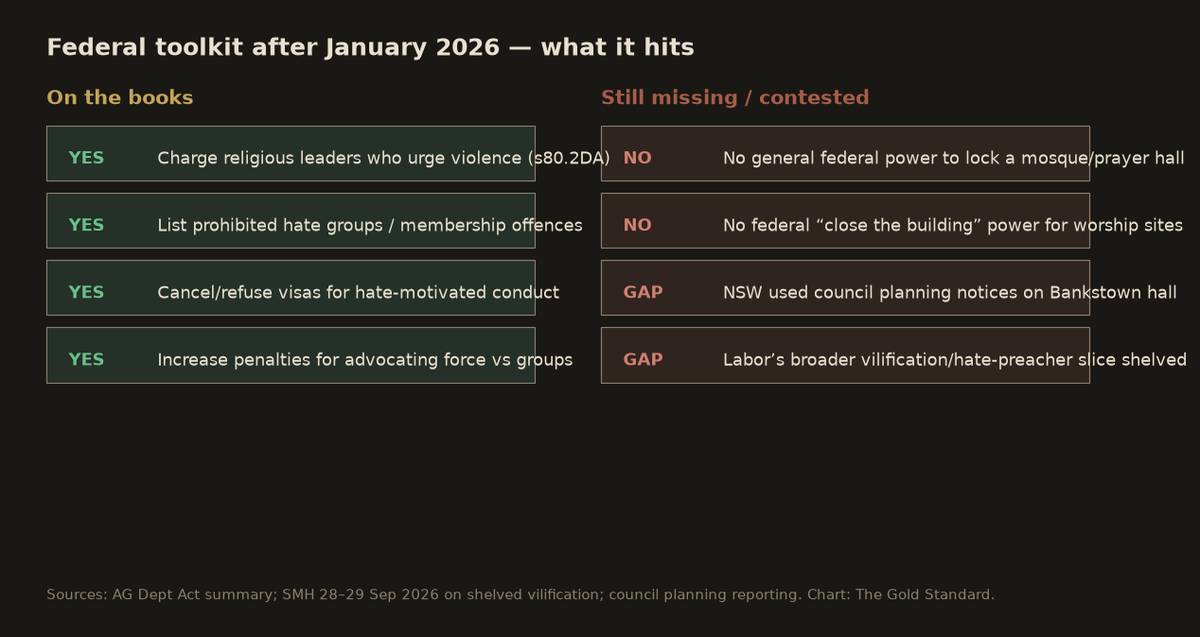
So what did pass? The Attorney-General’s Department says the Act raises the penalties for existing federal hate-crime offences. Those are the offences for urging or threatening violence, or damaging property, against protected groups. It creates tougher versions of those offences, called aggravated offences, for religious officials or spiritual leaders who commit them, and for people who encourage children toward that kind of violence. It says courts must treat hatred based on race, nationality or ethnic origin as a reason for a heavier sentence. It widens the grounds for refusing or cancelling a visa over hate-driven conduct. And it lets the government list groups that engage in hateful criminal conduct, making it a crime to direct, join, recruit for, train with, fund or support them.
The department also lists what the Act doesn’t do, and that matters just as much. It doesn’t make non-violent political opinions a crime. It doesn’t punish people just for stating a belief, or for peaceful criticism of foreign governments or political ideas. It doesn’t define “antisemitism” in law. And it doesn’t include a racial vilification offence. Here’s the bit Hanson leans on. Nothing in the Act gives Canberra the power to close a place of worship.
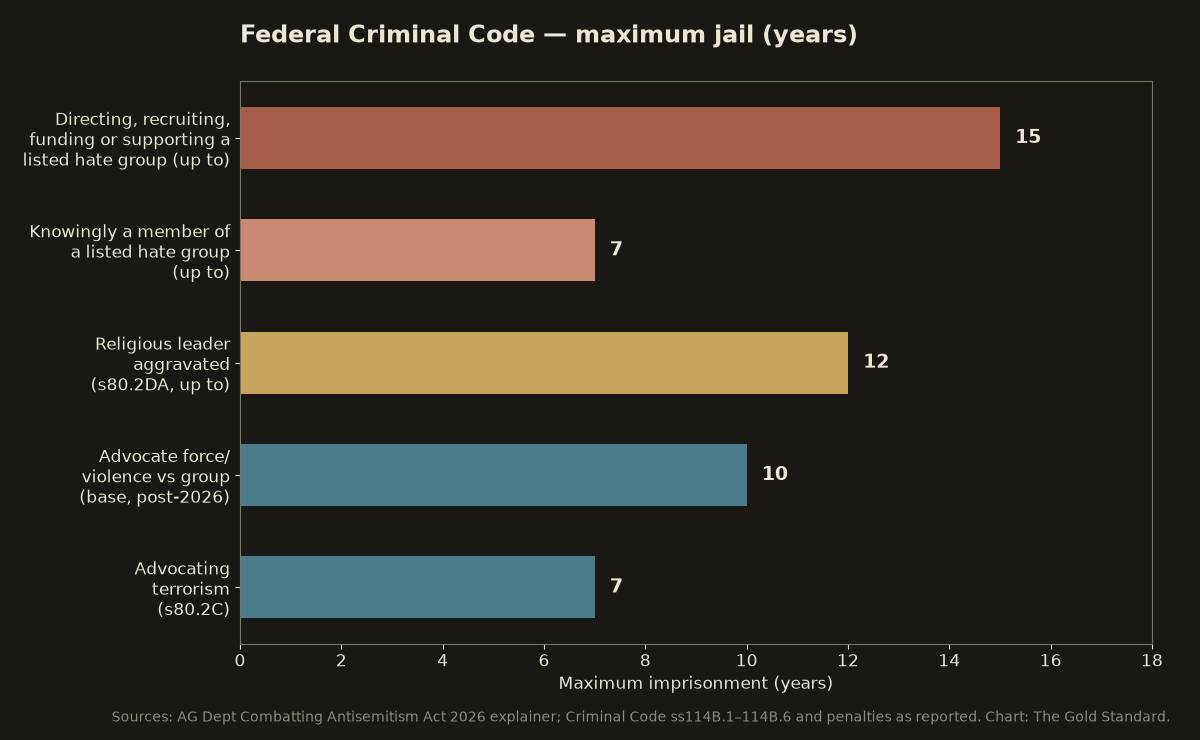
The preacher offence is Section 80.2DA of the Criminal Code, the main federal crimes law. It’s headed “Aggravated offence for religious officials or other spiritual leaders etc.” The Act became law on 21 January 2026 and took effect the next day, Thursday 22 January. Under the Code as it stands, a religious leader who urges or threatens violence against a group while giving religious instruction or pastoral care faces up to 10 years in jail. That rises to 12 years if the conduct would also threaten the peace, order and good government of the Commonwealth. In plain terms, that’s the more serious version, where the violence being urged would threaten the country’s basic order.
The basic offences went up too. Urging force or violence against a group, under section 80.2A, used to carry up to five years. It’s now seven. The more serious form, where it threatens the peace and good order of the Commonwealth, went from seven years to 10. Separately, advocating a terrorist act, under section 80.2C, carries up to seven years.
Here’s the gap Hanson is selling as the whole story. Even if police one day charged a preacher under section 80.2A or 80.2DA, those laws target a person. They don’t, on their face, give Canberra a key to padlock a mosque, stop a prayer hall running as a place of worship, or seize the building. Labor can say criminal law is the right tool, and buildings are a matter for the states and councils. Hanson can say that if you jail one preacher and leave the hall open, another preacher just walks in. Both of those things can be true at once.
Bankstown is the real-world example. Haddad’s Al Madina Dawah Centre wasn’t shut by a federal counter-terror order. On 23 December 2025, nine days after Bondi, Canterbury-Bankstown Council issued cease-use notices, because the site had never been approved as a prayer hall. That’s planning law doing a national security job. The SMH had already described the wider problem. Without the vilification powers that got dropped, it said, authorities had been privately grumbling that they couldn’t go after these unofficial suburban firebrands. Grumbling isn’t a charge sheet. The council notice was a different kind of tool altogether. It was about zoning.
Haddad has his own court record. On 1 July 2025, the Federal Court found his lectures carried “age-old tropes against Jewish people that are fundamentally racist and antisemitic.” That was Justice Angus Stewart’s judgment in a case brought by Jewish leaders including Peter Wertheim and Robert Goot. It was a civil case about racial vilification, not a criminal trial. One News Australia reported in August 2026 that Haddad hadn’t paid the legal costs the court ordered. He denies knowing anything about the Bondi attack. No court has tested any formal link between Haddad and the shooters beyond the reporting on who attended his centre.
Abu Ahmad has answered too. On Monday 28 September, the Al Bayyinah centre posted a statement from him on Instagram, and Guardian Australia reported it the next day. He said the lines the SMH quoted came from a passage of a book he was reading in a lesson on al-Walāʾ wal-Barāʾ, an Islamic idea usually translated as loyalty and disavowal. The statements, he said, “were not a personal call from me for Muslims to attack Christians, Jews or other non-Muslims.” The post attached a video he said explained the passage, and said the teaching “does not permit harming, oppressing or being unjust towards peaceful non-Muslims.” Quoting the book without the explanation, he said, gave “a completely different impression of what was being taught.” That’s his defence, and it deserves to be heard in full. It’s also the kind of argument Roose said would make a prosecution hard. Hanson isn’t waiting for any trial. Neither is Spender.
Australia’s peak body for imams spoke up as well. The Australian National Imams’ Council, known as ANIC, said it was “deeply concerned” about the reports. It said it “strongly and unequivocally condemns any call by any religious or non-religious preacher, leader or individual to take up arms against civilians, religious communities or the Australian people.” ANIC said it wouldn’t make findings about the man or the exact context until it could properly review the material. And it said one person’s alleged conduct shouldn’t be used to condemn or blame a whole faith or community.
That last point lands close to Hanson. The SMH reminded readers that she was widely condemned earlier this year for suggesting there were no good Muslims. That came in a February TV interview. Albanese called her remarks disgraceful, according to One News Australia, which also reported that the AFP spent months looking at complaints before closing the file and finding she’d committed no offence. It’s one reason Labor hears her mosque demand as more than a legal tweak.
Jewish community leaders didn’t sound like One Nation press officers. They didn’t sound like free-speech purists either. Peter Wertheim, co-chief executive of the Executive Council of Australian Jewry, told the SMH there had been “an air of unreality about the way the hate speech debate has been conducted to date.” People who had “deliberately and calculatedly promoted hate speech against targeted communities,” he said, had “successfully played well-meaning civil libertarians for suckers.” And then: “It’s not a left-right political issue.”
Zionist Federation of Australia president Jeremy Leibler said Jewish Australians “should not have to wait until threats of violence become acts of violence before authorities can respond.” He added: “Freedom of speech and freedom of religion are fundamental rights, but neither provides a licence to incite violence against other Australians.”
Federal Court Justice Ian Jackman gave a speech in August to the Samuel Griffith Society, a conservative legal group that has long opposed anti-vilification laws. He called for a rethink of how judges approach free speech. It would not have occurred to Australians in the 1990s, he said, “that other Australians would abuse their freedom of political communication to publicly intimidate and vilify Jews.” That’s a reference to the implied freedom of political communication, a limited free-speech protection the High Court found in the Constitution in the 1990s.
The Catholic Archbishop of Sydney, Anthony Fisher, backed Jackman. In late August he pointed to the NSW Court of Appeal’s April decision striking down the Minns government’s anti-protest laws. He asked whether Australia had the balance right between that freedom of political communication and other freedoms, including “the freedom to gather and worship in peace.”
Labor MP Josh Burns, the member for Macnamara, has been pushing his own party toward the broad anti-vilification laws Spender wants. In his submission to the royal commission, he said his office had received 10,000 emails, 1,000 phone calls and countless social media messages since the 7 October Hamas attacks on Israel. The overwhelming majority, he said, were strongly held views expressed respectfully. But a portion showed an ugly strain of prejudice. He said the word “Zionist” was sometimes being used as a substitute for “Jew,” “deployed alongside antisemitic vitriol, and wielded as a shield against the charge of antisemitism.” His conclusion: “That is not political criticism. It is hate, dressed in political language.”
So it’s not one chorus. Hanson wants buildings and networks targeted as an Islamic extremist problem. Spender and Burns want a general hate-speech law that would cover the next preacher and the next neo-Nazi without singling out one religion. Wertheim wants the civil-liberties argument rethought for an age of deliberate hate. Fisher and Jackman want the free-speech balance looked at again. ANIC wants violence condemned without blaming a whole community. Rowland’s office blames the Coalition for the missing vilification law. And the Coalition hadn’t replied when the SMH published.
Where does Tony Abbott fit? He’s been making the same argument since Bondi. It’s not about more laws. It’s about using the ones we’ve got. In an interview with the Institute of Public Affairs, reported by The Noticer on 1 January 2026, Abbott said “we don’t need more laws against hate speech” and “we need the existing laws enforced.” His complaint was about double standards. He argued that people who say something offensive to Muslims get in trouble, while radical Islamist slogans go unpunished. On 23 December 2025, on his own website, he wrote that “much could have been done under existing law” before Bondi, and he called for hate preachers to be deported or prosecuted. That puts him closer to Hanson on the target but a long way from her on the fix. He doesn’t want a new federal power. He wants the current ones used.
The security backdrop helps explain why a sermon turned into politics and not just a theology argument. The SMH noted that former spy boss Denis Richardson had said Australia should be able to openly debate fringe radicals in the Muslim community without demonising all Australian Muslims. A few days later, ASIO boss Mike Burgess said a terror attack was more likely than the official threat level of “probable” suggested. The SMH also said the AFP had arrested half a dozen men in mid-September over sharing Islamic State propaganda. Then, on Wednesday 23 September, police arrested a 65-year-old alleged member of a terrorist organisation, accused of sharing thousands of extremist files. None of that shows Abu Ahmad’s July talk was a recruitment pitch. It does explain why a Bondi MP and a senator who runs on national security both jumped on the same clip.
There’s older reporting too. ABC Four Corners reported in April 2025, as the SMH recalled, that Haddad had expanded Al Madina, boosted his online reach and re-energised a national pro-IS network that “now includes an affiliated prayer centre in Melbourne, Al Bayyinah Islamic Centre.” The SMH said Ahmad reportedly visited the Bankstown centre in early 2025 and gave a sermon that took aim at “infidel” Western powers. One News Australia, a partisan outlet, quoted him from a lecture at the Bankstown hall saying, “The Palestinian flag is under my foot. The only flag that we hold is … the flag of the messenger of Allah.” One News Australia dates that lecture to July 2025, while the SMH puts his reported Bankstown visit in early 2025. Either way, these are earlier published lines, and they’re why Roose’s word “outpost” stuck.
So why is a federal senator asking for a power that states and councils sometimes already use? It comes down to how power is split in Australia. The Constitution doesn’t give Canberra a general say over churches and mosques. Federal law is strong on terrorism, foreign fighters and crimes committed over phones and the internet. But land use, building approvals and a lot of public order rules belong to the states and local councils. That’s why the Bankstown hall fell to a council notice. And it’s why Hanson’s idea, a federal power to shut the doors of extremist prayer centres, would be a big expansion of what Canberra can do. It wouldn’t be a small fix to section 80.2DA. Liberals and Nationals who worry about government overreach might see it as a precedent that could one day be turned on other pulpits. Hanson says the threat isn’t the same across religions. Spender says the law should be. That’s the deeper argument under the legal one.
NSW has already built its own tools. On 7 May 2026, the state parliament passed a law aimed at unlawful places of public worship. According to the NSW government, it lets councils ask the Land and Environment Court to cut off water, electricity and gas to places that ignore cease-use orders, and it lifts penalties for breaking planning orders. So the states are building tools that deal with buildings, while federal criminal law still deals with people. Hanson wants to take a building tool, put it in Canberra’s hands and point it at extremist centres.
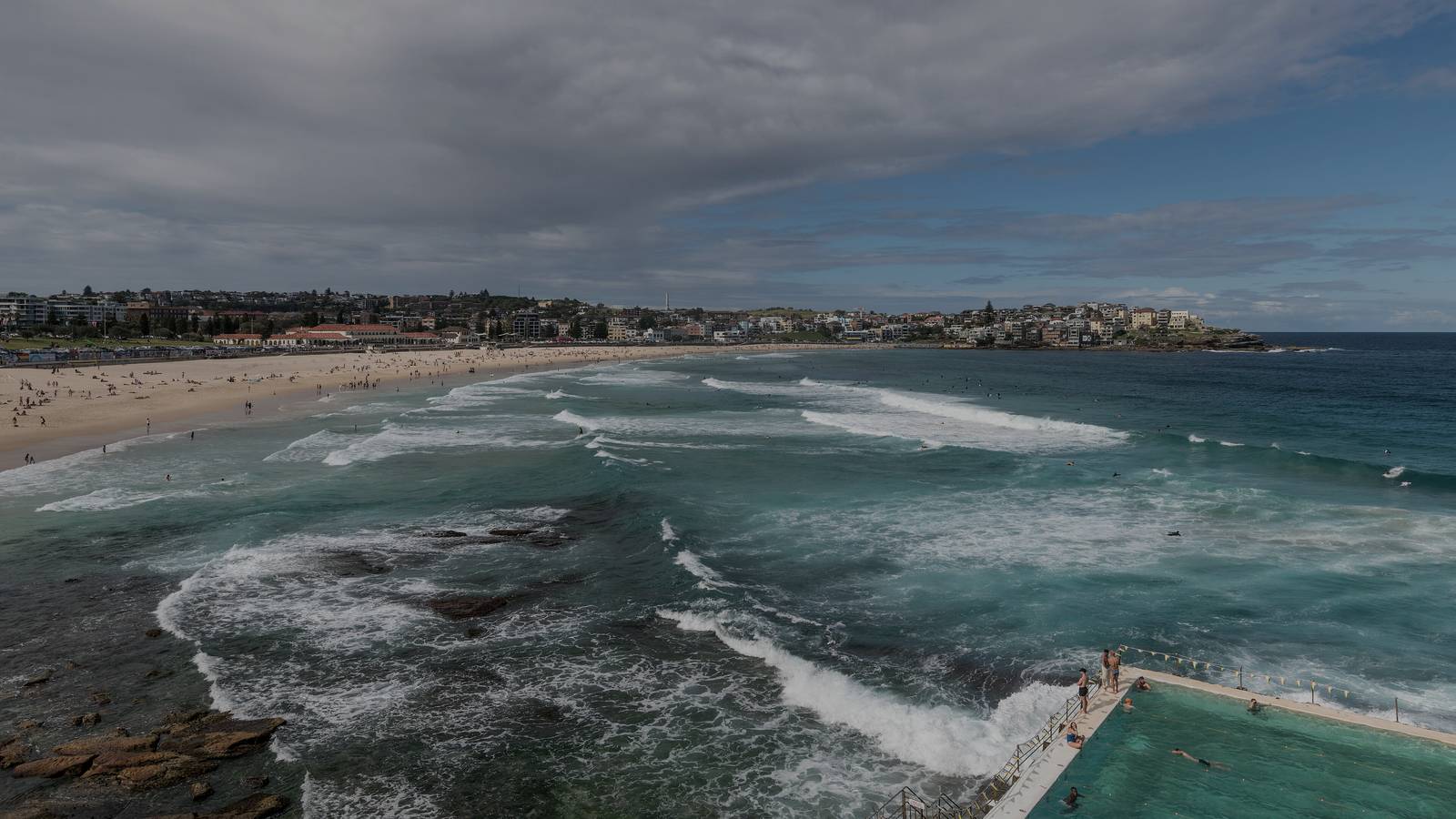
A word on the Bondi numbers, because figures get sloppy when feelings run high. Fifteen people were killed at the Chanukah by the Sea celebration on 14 December 2025. Police declared it a terrorist attack. Police shot Sajid Akram dead. His son, Naveed Akram, is accused of 15 murders and of committing a terrorist act. Those charges haven’t been tested in court. Hanson says “fifteen people were murdered in a terrorist act.” We use the language of charges and allegations for the son, because that’s where the case stands.
And did the January law already ban groups like Hizb ut-Tahrir? Yes, in that case. On 5 March 2026, the government listed Hizb ut-Tahrir as the first prohibited hate group under the new law, on ASIO’s advice. A parliamentary committee backed the listing in May. That’s the group Roose was talking about. Under the Criminal Code, knowingly being a member of a listed hate group carries up to seven years. Directing one, recruiting for it, training with it, funding it or supporting it can carry up to 15. Some outlets have reported that membership alone carries 15 years, but the Code says seven. To list a group, the minister needs written advice from ASIO’s chief and the written agreement of the Attorney-General. But one listing isn’t a list of every extremist prayer room. It doesn’t make every such room unlawful.
You might ask whether “shut down the mosques” is dog-whistle politics in a national security coat. Fair question. Hanson’s record includes the “good Muslims” row this year and decades of hard lines on immigration. The fair answer, going by her actual words, is that she aimed at “extremist and fundamentalist” centres that she says seem to be allowing terrorist recruitment and advocacy, not every mosque in Australia. Community groups will say that adjective won’t survive once officials start deciding who counts. Hanson will say refusing to use the adjective is how Bondi happened. Our job is to put her words and the distrust of them on the table, side by side, and let neither dress up as the other.
Spender’s phrase “nationally consistent” does real work too. Hate-speech and vilification laws differ from state to state. A preacher, a protest chant and a Telegram channel don’t stop at the border. Spender wants a national minimum standard, so the lessons of Bondi aren’t stuck in NSW law. Hanson hears that as another speech code like section 18C, the part of the Racial Discrimination Act that bans offending or insulting people over race. If anyone ever gets the numbers to write such a law, they’ll have to choose where the line sits. Is it urging violence? Promoting hatred? Insult? Every choice makes a different set of enemies.
Jackman’s audience wasn’t a progressive law conference. That’s why his line about 1990s Australians carries weight on the right. Fisher did similar work from a Catholic pulpit. Free speech and free protest matter, he said, and so does the freedom to gather for worship without being intimidated. When Hanson points to Bondi and Spender points to Bondi, neither is inventing the fear. They’re competing to own the fix.
Roose’s comparison with Hizb ut-Tahrir deserves a second look. His point was about escalation. In his view, take-up-arms language goes further than anything that now-banned group said in public. Yet Al Bayyinah’s clip sat on social media from July and only became national news in late September. That delay is part of Hanson’s charge against the government. On the other side sits Ahmad’s explanation that he was reading from a book, and the high bar for proving that someone urged violence. Courts test that bar, not TV panels.
If you only remember a few things, make it these. One: on 28 September, the SMH reported Abu Ahmad’s July sermon at Al Bayyinah, including the call to “take up arms” against enemies and not to take Jews and Christians as friends. Two: the same day, Hanson demanded federal powers to shut extremist mosques and prayer centres, plus more resources for ASIO and the AFP, under the line “Bondi should have ended the excuses.” Three: Spender demanded stronger national hate-speech laws. Four: Labor’s January law created tougher offences for preachers and a way to ban hate groups, but no federal power to lock a mosque, and the broader vilification law was dropped. Five: Ahmad says he was reading from a book, not calling for attacks. Six: ANIC condemns calls to take up arms against civilians, without prejudging the full context of the clip. Seven: the Bankstown hall linked to Haddad was shut by council planning notices on 23 December 2025, not by a federal law.
Listen again to the two lines that will travel. Hanson: “Bondi should have ended the excuses.” Spender: the remarks show “why we needed stronger and nationally consistent hate speech legislation.” Same beach. Same week. Different laws. That’s the news.
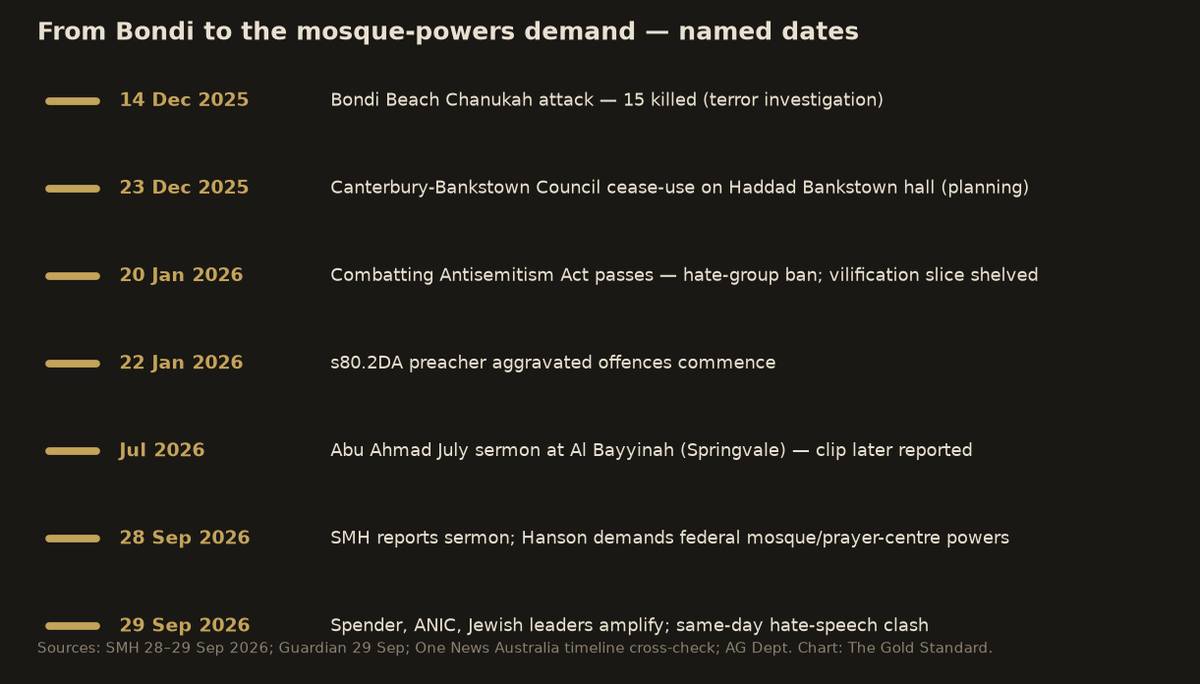
Here are the key dates in one place. 14 December 2025: the Bondi Chanukah attack, 15 dead. 23 December 2025: Canterbury-Bankstown Council issues cease-use notices for the Bankstown hall. 12 January 2026: the government announces its bill, then comes a chaotic week of talks. 20 January 2026: the cut-down Act passes Parliament. 22 January 2026: the preacher offence and the rest of the Act take effect. 5 March 2026: Hizb ut-Tahrir becomes the first listed hate group. 7 May 2026: NSW passes its places-of-worship law. July 2026: Abu Ahmad’s recorded lesson at Al Bayyinah. 28 September 2026: the SMH publishes its report on the sermon, and Hanson issues her statement. 29 September 2026: Spender, ANIC, Wertheim, Burns and Rowland’s office weigh in, as reported by the SMH and the Guardian.
If you live near Springvale, this isn’t abstract. There’s a prayer centre that opened in 2024, a clip from July, a national argument in September, and a senator naming “mosques and Islamic prayer centres” as the thing Canberra should be able to shut. If you live in Wentworth, the story runs through Bondi’s sand and Spender’s push for a hate-speech law. And if you live anywhere else, the question is how Australia answers the next take-up-arms sermon. Is it a charge against a person, an order against a building, a vilification law, or another press conference about courage?
Hanson’s statement also ties Labor’s “political cowardice” to Australian lives. That’s campaign language. The fact underneath it is the gap between federal offences that target people and the power to control buildings. You can call that gap a scandal, or you can call it how the Constitution was designed. What you can’t do, on the facts as they stand, is claim the Commonwealth already has a general power to close mosques and just won’t use it. It doesn’t. That’s why she’s asking for one.
Spender’s hedge on the royal commission is practical. She’ll take a recommendation if one comes, and she’ll keep pushing if it doesn’t. Burns is doing similar work inside Labor. Rowland’s office is still arguing about who blocked the vilification law in January. None of that writes Hanson’s building power into the Criminal Code. And none of it makes Ahmad’s explanation true or false.
One more look at the SMH’s reporting on the network, because some people will read too much into it and others too little. The centre was supported by Haddad. It was described as an affiliated prayer centre in Melbourne, in the April 2025 Four Corners language the SMH repeated. It posted alongside an account that featured IS sympathisers. And Akram reportedly attended Al Madina in Sydney. Those are published links of association and place. They are not a claim that Al Bayyinah had anything to do with Bondi. Roose wants early crackdowns on centres like this. Hanson wants a federal law to make that possible. Spender wants a speech law that doesn’t depend on zoning inspectors. Those are three different bets on which institution should act.
And one more look at the “unofficial pulpits” problem the SMH described. Unofficial can mean a hall running as a prayer room without full planning approval, or a preacher without a recognised religious post, or both. Bankstown showed the planning route. Section 80.2DA is the route that targets the person. A vilification law would have targeted what’s said. Hanson’s ask is a fourth route: a federal power to close extremist Islamic centres as a type of building. Democracies argue about new powers like that for years. The Bondi death toll is why this one isn’t a polite theory any more, in Wentworth or in One Nation’s list of demands.
The headline line stands because Hanson said it on the record. Bondi should have ended the excuses. Whether you hear that as moral clarity or as a slogan aimed at Muslim Australians depends on which of her other lines you remember. Her statement, the reaction the next day, the January law, the July sermon and the December graves all belong in the same conversation. The verdict is for readers and, if charges ever come, for a court.
The paper
Comments
No notes on this story yet.
Sign in to comment