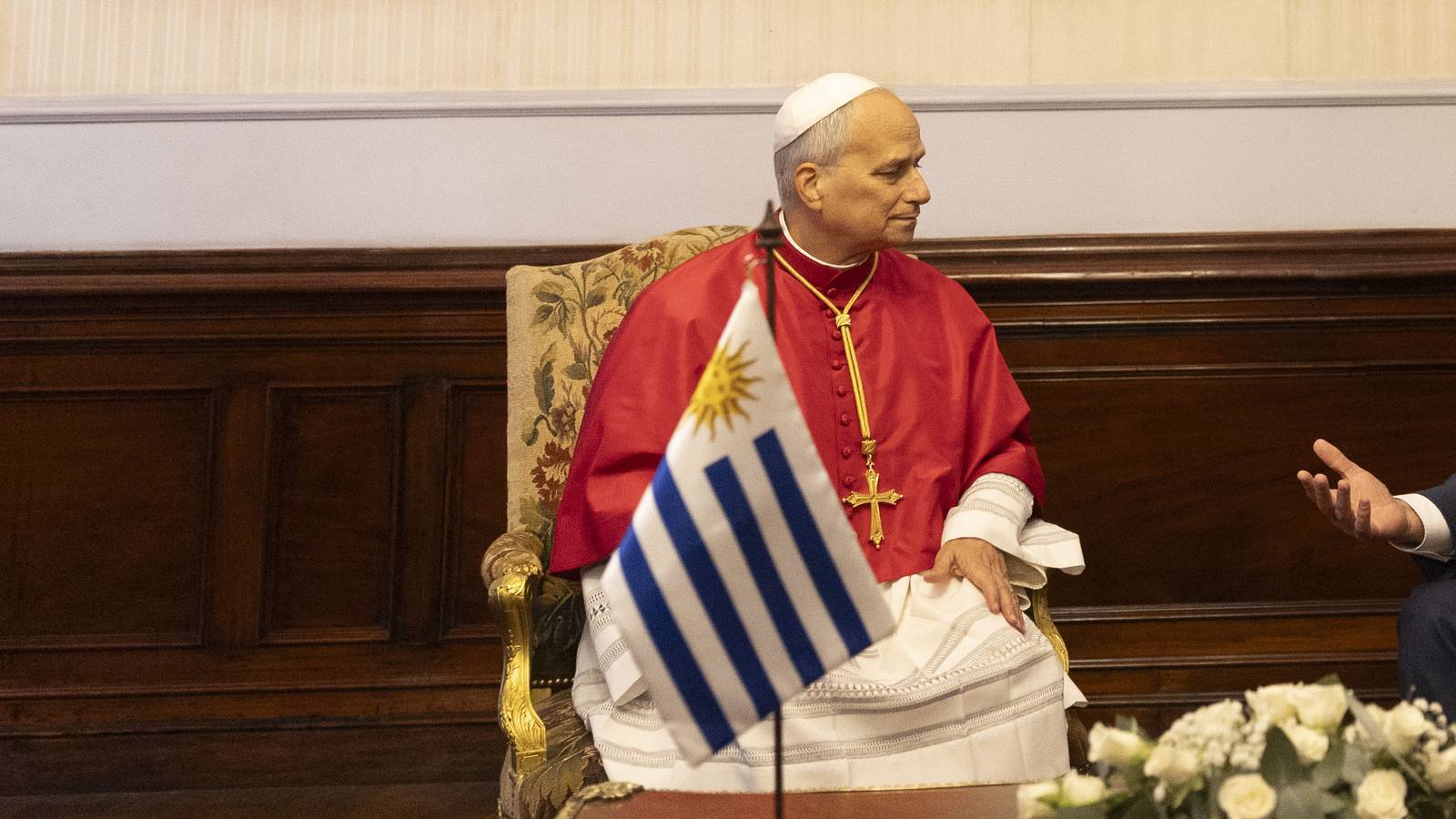
Pope Leo XIV has told a Catholic aid agency marking its 100th birthday that helping Eastern Christians stay in their homelands is "an essential work of hope". He said it at the Vatican on Friday 20 November, to a delegation from the Catholic Near East Welfare Association, known as CNEWA.
One of the people who should have been in the room wasn't. CNEWA says its Jerusalem regional director, Joseph Hazboun, was stopped by Israeli authorities from boarding his flight from Tel Aviv to Rome, and the gift he was carrying for the Pope went with him.
What CNEWA is
Pope Pius XI founded the Catholic Near East Welfare Association in 1926. On its own site, CNEWA describes its purpose as "an instrument of love and a sign of hope for those in need scattered throughout the historic but unstable lands of the ancient Eastern churches."
Those lands are the Middle East, Northeast Africa, India and Eastern Europe. The agency names the countries where its local partners work: Iraq, Israel, Jordan, Palestine, Lebanon, Syria, Egypt, Eritrea, Ethiopia, India, Armenia, Georgia and Ukraine.
The "Eastern churches" are the Christian communities that grew up in those regions, with their own ancient liturgies and traditions. Some are in full communion with Rome, as Eastern Catholic churches. Others are Orthodox. CNEWA works through local bishops, priests, religious sisters and lay people, and it says it helps people whatever their faith. Vatican News lists the kinds of help it gives: education, health care, essential supplies and emergency relief for refugees, offered to anyone in need regardless of religion.
What the Pope said
Seventy representatives from CNEWA's regional offices joined the audience, OSV News reported, carried by the National Catholic Reporter. The delegation was led by Archbishop Ronald Hicks of New York and CNEWA's president, Msgr Peter Vaccari.
Leo thanked them for a century of work "including supporting bishops and clergy, preparing men and women for leadership, strengthening Catholic education, caring for those in need, responding to emergencies and accompanying local churches as they seek to minister to their communities."
He described the agency as a bridge. "Through your activities, the closeness of the universal church is made concrete for countless people who might otherwise feel forgotten or abandoned," he said.
Then he turned to the present. CNEWA's service, he said, "is particularly necessary at the present time" because "across the Middle East and in other regions, Eastern Christians continue to face the effects of war, persecution, instability and poverty."
The line that stood out was about what's lost when people leave. "When a Christian family is forced to leave its homeland, much more is lost than a place of residence: a community is weakened, a living tradition is placed at risk and the presence of the church is diminished," the Pope said.
That's why, he said, "accompanying Christians of the East in their homelands is an essential work of hope." At a time "when so many of them are tempted to discouragement," he told the delegation, "your presence is a reminder that they are not alone and that suffering and uncertainty do not have the final word."
He also tied the aid to something bigger than relief. By helping families stay "rooted in their communities," he said, CNEWA helps "preserve the spiritual, the liturgical, the cultural and human heritage of the Eastern churches — a treasure that belongs not only to these local communities but to the entire Catholic Church, thus enriching the whole Body of Christ."
Vatican News reports he also remembered those who have died, entrusting "to the Lord those who have lost their lives amid war and violence, especially those who remained faithful to their communities and to their Christian heritage in the midst of great suffering."
The empty seat
Michael La Civita, CNEWA's director of communications and marketing, was in Rome for the audience. He told OSV News what happened to his Jerusalem colleague.
"The staff was able join us, but Joseph was not," La Civita said. Hazboun had been carrying the agency's gift for the Pope: a ceramic porcelain model of the edicule, the small shrine built over the traditional site of Jesus' tomb inside the Church of the Holy Sepulchre in Jerusalem. La Civita said it was "created specifically for the Holy Father."
Because it was packed in Hazboun's checked luggage, "unfortunately we came empty handed," La Civita said.
He drew a wider point from it. "I think that message is probably a metaphor for what is happening in that part of the world today, where you have these arbitrary violations of human dignity," he told OSV News. CNEWA's mission, he said, is the opposite: "promoting human dignity and the value of every human life."
That's CNEWA's account. OSV News didn't report any explanation from Israeli authorities for why Hazboun wasn't allowed to board, and we haven't seen one.
"The same story as it was in 1926"
La Civita has been with CNEWA a long time. He said this was the fourth Pope he has met in that role, and that hearing the address in American English, from the first Pope born in the United States, struck him personally.
He also said the agency's work hasn't changed much in a hundred years. "What is interesting is how our story is very much the same story as it was in 1926," he said. "And that is: crisis, emergency and how the people in their need, regardless of who they are, of their faith community or not, turn to the church and ask for help. And so that story has not changed."
He's under no illusions about that. "We exist to put ourselves out of business," he said. "In a perfect world, there would be no need for aid agencies." Until then, he said, it's "always better to light one candle than curse the darkness. So we've been lighting a lot of candles and we're not going to stop lighting those candles yet."
What comes next
The centenary carries on in New York. CNEWA's Christmas Concert for Peace is on 13 December at Our Lady of Lebanon Maronite Catholic Cathedral in Brooklyn, and its Healing and Hope gala dinner is on 15 December at the Plaza on Fifth Avenue. Sr Raffaella Petrini, president of the Governorate of Vatican City State, who accompanied the delegation, will receive CNEWA's Faith & Culture Award in New York in December.
The Pope closed by reminding the delegation that what they do isn't only charity. Vatican News reports he called their aid an expression of Christian fraternity and of "the communion that unites the members of Christ's Body across nations, cultures and continents."
If you'd like to pray with this one, his own words give the intention: for Christian families in the Middle East and beyond who are deciding whether they can stay, and for the people helping them to.
If this story helped, you can help keep the paper going: Support the paper.
The paper
Comments
No notes on this story yet.
Sign in to comment