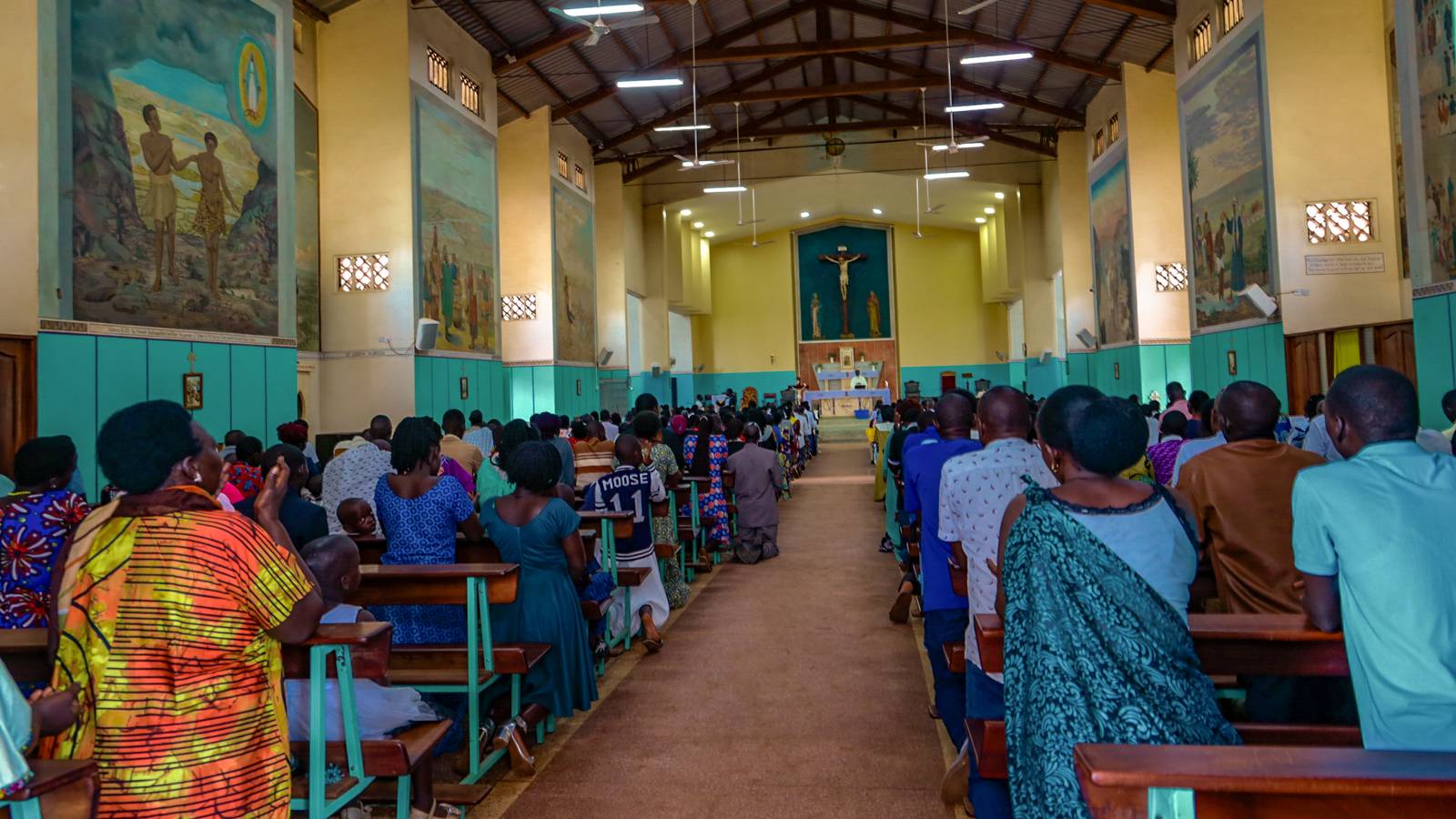

Where will most of the world's Christians live in 2070? If the Pew Research Center's new projections hold, more than half of them will be in sub-Saharan Africa, and the country with the most Christians won't be the United States anymore. It'll be the Democratic Republic of the Congo.
That's one of the findings in The Future of World Religions: Population Growth Projections, 2020-2070, which Pew released on 18 November, US time. It models seven religious groups across 201 countries and territories, which together hold 99.98% of the world's people. Pew built the model with researchers at the Center for Advanced Studies of Population and Religion at Krakow University of Economics in Poland.
The big numbers
Start with the global picture, because it's not a story of decline. Pew counts about 2.27 billion Christians in 2020 and projects nearly 2.96 billion by 2070. That's roughly 687 million more people, a rise of 30%.
The world's population is expected to grow by 29% over the same stretch, so Christians hold their ground as a share of humanity. They were 28.8% of the world in 2020 and are projected at 29.1% in 2070. Call it 29% either way.
What changes is who's on top. Muslims are projected to grow by 80% and pass Christians in number by 2035. By 2070 there'd be more than 3.6 billion Muslims, or 36% of the world, against just under 3 billion Christians. Pew says the main drivers are age and fertility. In 2020 the median Muslim was 24, nearly a decade younger than the median non-Muslim at 33.
People with no religion go the other way globally. Pew has them falling from 24% of the world to 17%, mostly because China's population is expected to shrink.
The centre moves south
Here's the shift that will matter most to churches. In 2020, 31% of the world's Christians lived in sub-Saharan Africa. By 2070, Pew projects 54%.
The raw numbers are striking. Sub-Saharan Africa's Christian population goes from about 697 million to almost 1.6 billion, a gain of 896 million. Everywhere else combined, the number of Christians falls by about 210 million.
Europe takes the biggest hit. Its Christian population drops from about 505 million to 324 million, and its share of the world's Christians halves, from 22% to 11%. Christians would still be a slim majority of Europeans, at 52%, down from 67%.
North America slides from 63% Christian to 46%. Christians would remain the largest group there, but not a majority. Latin America and the Caribbean stays heavily Christian, falling from 85% to 77%. Asia and the Pacific gains about 23 million Christians but stays at around 6% of the region.
The list of the 10 biggest Christian countries gets redrawn too. In 2020 it was led by the United States with 217 million, then Brazil, Mexico, the Philippines and Russia. By 2070 Pew expects Congo to lead with 299 million Christians, about one in every 10 on Earth. The US drops to second with 174 million, then Ethiopia, Brazil, Nigeria, Tanzania, Mexico, the Philippines, Uganda and Angola. Russia and Italy fall out, and no European country makes the cut.
"The global change in what one might think of as the center of gravity in Christianity is interesting," Alan Cooperman, Pew's director of religion research, said at a news conference reported by Christianity Today. "You take the trends we see now and take them all the way out to 2070, and the distribution of Christians around the world looks very different from the way it does today."
Babies and switching
So why is this happening? Pew points to two forces pulling in opposite directions.
The first is births. Christians worldwide average 2.5 children per woman, above the replacement level of about 2.1. But that average is carried by Africa. Christian women in sub-Saharan Africa average 4.0 children, and the rate tops 6 in Congo and Chad. In Europe it's 1.4, and in North America 1.7. Age adds to the gap. The median Christian in sub-Saharan Africa is 20. In Europe it's 45.
The second force is what Pew calls religious switching, meaning people who were raised in one faith and now identify with another, or with none. Christianity loses more people this way than almost any other group. Pew estimates 85% of people raised Christian still call themselves Christian as adults. Of the 15% who've left, 13% now have no religion and 2% joined another faith. Most other big groups keep more than 90%, with Buddhists the exception at 83%.
Add it up and Pew expects switching to cost Christianity about 105 million people worldwide by 2070, more than offset by about 792 million in natural growth. Europe is projected to lose 160 million Christians through deaths outnumbering births and another 35 million through people leaving the faith. The 14 million Christian migrants it's expected to gain won't fill that hole.
"In the United States, we have seen over the last few decades a decline in the Christian share," said Conrad Hackett, Pew's associate director of research. "But we're projecting that globally there will be an increase in the number of Christians … with growth in sub-Saharan Africa offsetting declines in Europe and in North America."
Ten countries lose their Christian majority
Pew lists 10 countries that had a Christian majority in 2020 and won't by 2070. They're Spain, the United States, Switzerland, Sweden, Togo, Germany, Canada, Benin, Estonia and Belgium.
Spain has the steepest projected fall of any country, from 69.5% Christian to 41.2%. Canada drops from 53.3% to 33.3%. The US lands at 47.8%. The United Kingdom, which Pew put just under half in 2020, falls from 49.4% to 25.4%.
Switching matters a lot in those places. Pew says that if nobody switched after 2020, the UK would be 40% Christian in 2070, not 25%. Five of the 10 countries, Spain, the US, Switzerland, Germany and Sweden, would keep a Christian majority.
Cooperman made the point about the US in reverse. "If we were to (hypothetically) shut off the spigot of religious switching, which by and large has brought people from Christianity into the unaffiliated category … if we were to say, 'No more of that' all the way until [2070], we would still project a decline in the share of Christians," he said.
Only four countries are projected to become substantially more Christian. They're Suriname, Guyana, Botswana and one of our Pacific neighbours, Fiji, which rises from 69.5% to 75.4%.
What about Australia?
Australia is on the list of big decliners. Pew puts the Christian share at 46.8% in 2020 and projects 28.8% by 2070, an 18-point fall. That's a bigger drop than Pew projects for the United States or Germany.
The other lines in Pew's Australian table move too. People with no religion go from 42.3% to 46.8%, making them the biggest group. Muslims rise from 3.5% to 9.8%, Hindus from 3.0% to 6.9%, and Buddhists from 2.6% to 3.8%. The overall population climbs from about 25.7 million to 39 million, which means migration is doing a lot of the work. New Zealand follows a similar track, from 40.3% Christian to 29%.
Pew's 46.8% doesn't match the official count, even though Pew lists the 2021 Census as its source. The Australian Bureau of Statistics puts it at 43.9% in 2021, down from 52.1% in 2016 and 61.1% in 2011, while 38.9% said they had no religion. The census question is voluntary, and 93% of people answered it.
What it means for churches
You can already see the shift playing out. Christianity Today notes that the Catholic Church, the Anglican Communion and the United Methodist Church have all had recent fights between African members and leadership in the US or UK. This year, an alliance of African Anglican churches took a major step toward independence from the Archbishop of Canterbury, CT reports.
Mission is changing direction too. CT says the Presbyterian Church (USA)'s foreign mission board closed last year, and that more missionaries now come from countries such as Brazil and South Korea. Earlier this month, the Anglican Communion launched Vision36 in Nairobi, aiming to plant or renew a million churches and congregations by 2036.
The growth also isn't happening somewhere safe. Congo, the country Pew expects to have the most Christians in the world, is where an Islamic State-linked militia has killed as many as 143 Christians in under two weeks this month.
One caution before anyone treats 2070 as settled. Pew says these are projections of recent trends, not predictions, and its model doesn't try to account for wars, disasters, epidemics or economic shocks. Shorter-term data can move as well. Last month Pew found US religion has held steady since 2020, with the youngest adults attending more than people a few years older. But the broad direction in this report comes from births, ages and decades of switching, and those don't turn around quickly.
If this story helped, you can help keep the paper going: Support the paper.

The paper
Comments
No notes on this story yet.
Sign in to comment