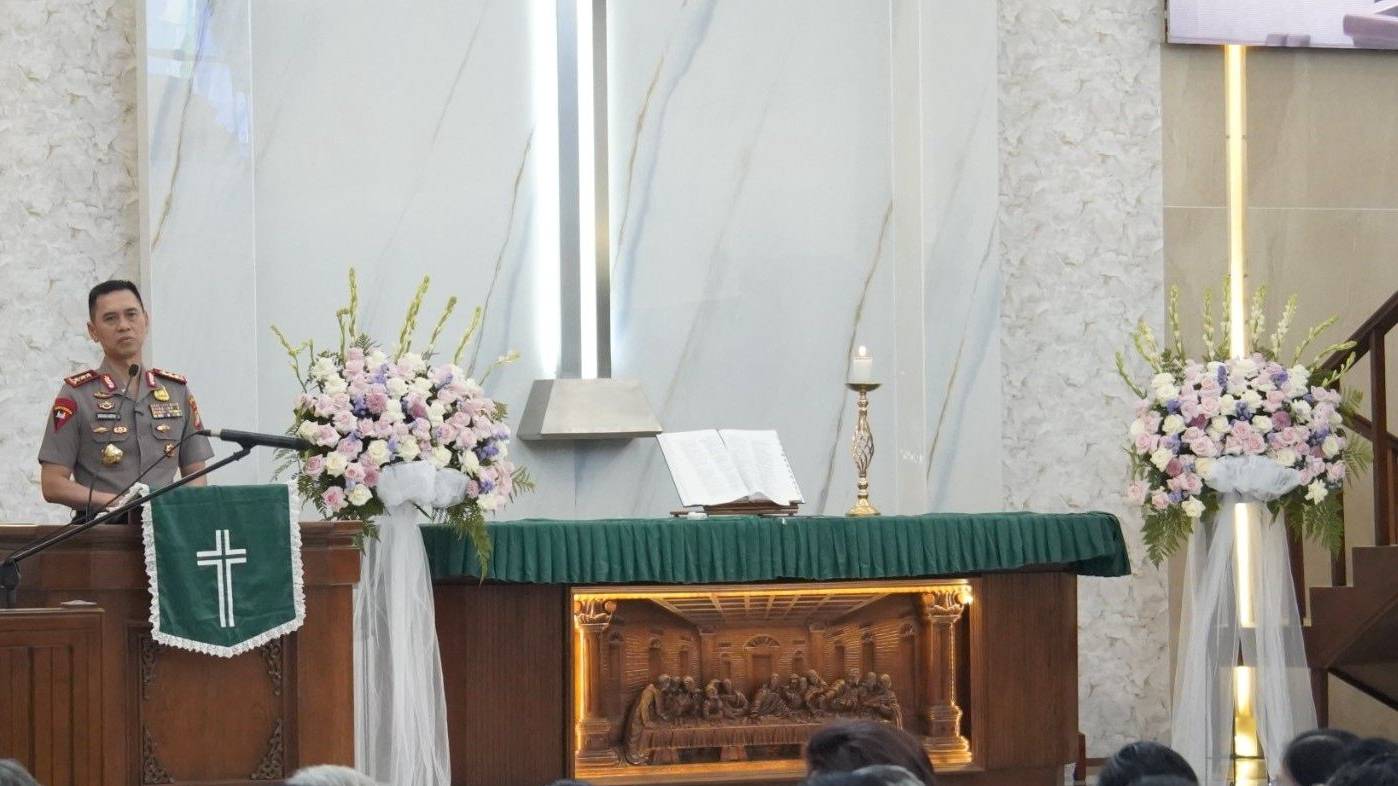

Picture a Sunday service where a senior police officer walks to the front to deliver a public safety message and teach the congregation a new police greeting. In Indonesia that's been happening in churches across the country for the past few weeks.
Police call it Minggu Kasih, "Sunday of Compassion." Some church leaders and rights groups say it's starting to look like the state keeping an eye on the pulpit.
What the police are doing
Minggu Kasih is part of the 2026 "Quick Wins" programme of Indonesia's national police chief, General Suyudi Ario Seto, BBC News Indonesia reports. The BBC's report is in Indonesian, so the quotes we use from it are our own translation. Suyudi took the job on 1 October. Since then, officers from provincial chiefs down to local station commanders have been visiting churches, going inside and speaking to congregations.
The messages are much the same everywhere, the BBC says. Officers talk about friendship between police and people, keeping public order, and harmony between religions. They introduce the slogan "Polisi Bersama Masyarakat," or "Police Together with the Community," and a greeting made with both hands folded, which they invite the congregation to copy.
Suyudi explained the aim on Instagram. "Not just an ordinary visit! Police ranks in various regions of Indonesia are present directly among church congregations to build ties, strengthen brotherhood, and at the same time ensure that people can worship safely and comfortably," he wrote, in the post quoted by the BBC.
The visits are wide. The BBC lists provincial police visits to churches in Palembang, Ternate, Nabire in Central Papua, Pekanbaru, Bengkulu, Manado and Kupang on Sunday 8 November alone. A week earlier, North Sumatra's police chief took part at the Catholic cathedral in Medan. In Jakarta, the Metro Jaya police chief, Dadang Hartanto, spoke at the Huria Kristen Batak Protestant church in Sudirman on 1 November, UCA News reports.
The three fingers
Here's why the timing has people talking. The visits arrived just as videos went viral of Protestant pastors raising three fingers from the pulpit.
The three-finger salute comes from The Hunger Games books and films, and it's become a sign of defiance against authority. UCA News says protesters used it widely at anti-government protests in late October marking two years of President Prabowo Subianto's government.
On Sunday 1 November, several pastors in Central Java and Yogyakarta raised it during their sermons, the BBC reports. Pastor Rena Sesaria Yudhita did so at GKI Gejayan in Yogyakarta and told her people the faithful need to speak up for justice without hatred. Pastor Jimmy Marcos Immanuel Sormin, at GPIB Marga Mulya, criticised the handling of forest fires and a food estate project clearing forest in Papua. Pastor Anggito Suryo Adi raised three fingers at GKJ Ketandan in Klaten.
Anggito explained why. "This is a real form of the prophetic voice that must keep living in the church so that it is not isolated from the struggles of the world," he told the BBC.
Some Indonesians online linked the two things, and asked why police were suddenly coming inside churches at all. Police describe the visits as being about friendship, public order and helping people worship safely.
Rights groups object
Imparsial, a human rights group, put out a statement on 11 November. Its director, Ardi Manto Adiputra, said the programme risks intimidating worshippers. "Congregants and pastors may feel that their activities, conversations, and even religious expression are being monitored by the state. This could become a serious problem," he said, as UCA News reported.
He drew a clear line between protecting a church and entering one. Police should provide security outside when it's needed, he said, not use altars or pulpits to promote police programmes. Speaking to the BBC, he called the altar and pulpit "part of the sacred space and religious authority of the church, not a space for state officers to promote police programmes."
Bonar Tigor Naipospos of the Setara Institute said police must not interfere in worship, "for example banning pastors from raising three fingers or banning discussion of social, economic and other humanitarian issues," he told the BBC.
One apology already
In Surabaya, in East Java, worshippers complained after police held a Minggu Kasih session at the Catholic cathedral just before Mass was due to start. The East Java police community guidance directorate apologised.
"We appreciate the input given and are making it material for evaluation, so that future activities pay more attention to timing, comfort and the solemnity of worship, while respecting the order of worship and rules of each house of worship," it said, as the BBC reported. The cathedral's parish priest, Father Cornelius Triwidya Tjahja Utama, also apologised for any disruption to prayer and said the visit was about public safety.
The churches are split
Indonesia's Catholic bishops welcomed the programme. Father Yohanes "Hans" Jeharut, executive secretary of the Bishops' Conference's commission for the laity, said: "The national police chief plays a major role in maintaining public security and order." He said the Church "is committed and ready to contribute to the common good, including by working together with the police," according to UCA News.
The main Protestant body, the Communion of Churches in Indonesia, known as PGI, set out conditions instead. Its chairman, the Reverend Jacklevyn Frits Manuputty, told the BBC visits should be voluntary, approved by the church council and announced to the congregation a week ahead, and churches should be free to say no without consequences. Any dialogue should happen after the service or in a separate forum. Officers shouldn't wear uniform, and the conversation shouldn't carry political messages, collect data on church members or stop a church speaking critically.
His reason is theological. "Congregations understand Sunday worship as the meeting of the congregation with God, so if dialogue is slipped into the worship service, the worship space risks being instrumentalised," he said. "This relationship is a critical partnership, not dependency."
Even Anggito, who raised the three fingers, welcomed better ties with police. He said his own church had police speak after the service had finished, and from the altar area rather than the pulpit.
Some say it's routine
Not everyone sees a threat. Poengky Indarti, a former member of Indonesia's police commission, told the BBC police are entitled to visit churches, mosques and other places of worship to keep order and prevent crime, and it's better than police only showing up when there's trouble. Bambang Rukminto of the Institute for Security and Strategic Studies said such visits have gone on for a long time and the timing is a coincidence, though he warned a top-down order risks becoming stiff and ceremonial.
Why it matters here
Indonesia is our nearest big neighbour and has the world's largest Muslim population, with a Christian minority. Indonesian law protects freedom of worship. The question in this case isn't whether police can protect churches. It's who gets to stand at the front on Sunday. Churches elsewhere in Asia are feeling state pressure too. In India, churches in Maharashtra have been cancelling or limiting Bible camps since an anti-conversion law began there in August.
Franciscan priest Yohanes Kristoforus Tara summed up the concern to UCA News. "Such a presence, even when presented as a goodwill visit, could send the message that the state has intervened in the Church's internal affairs," he said.
If this story helped, you can help keep the paper going: Support the paper.
The paper
Comments
No notes on this story yet.
Sign in to comment