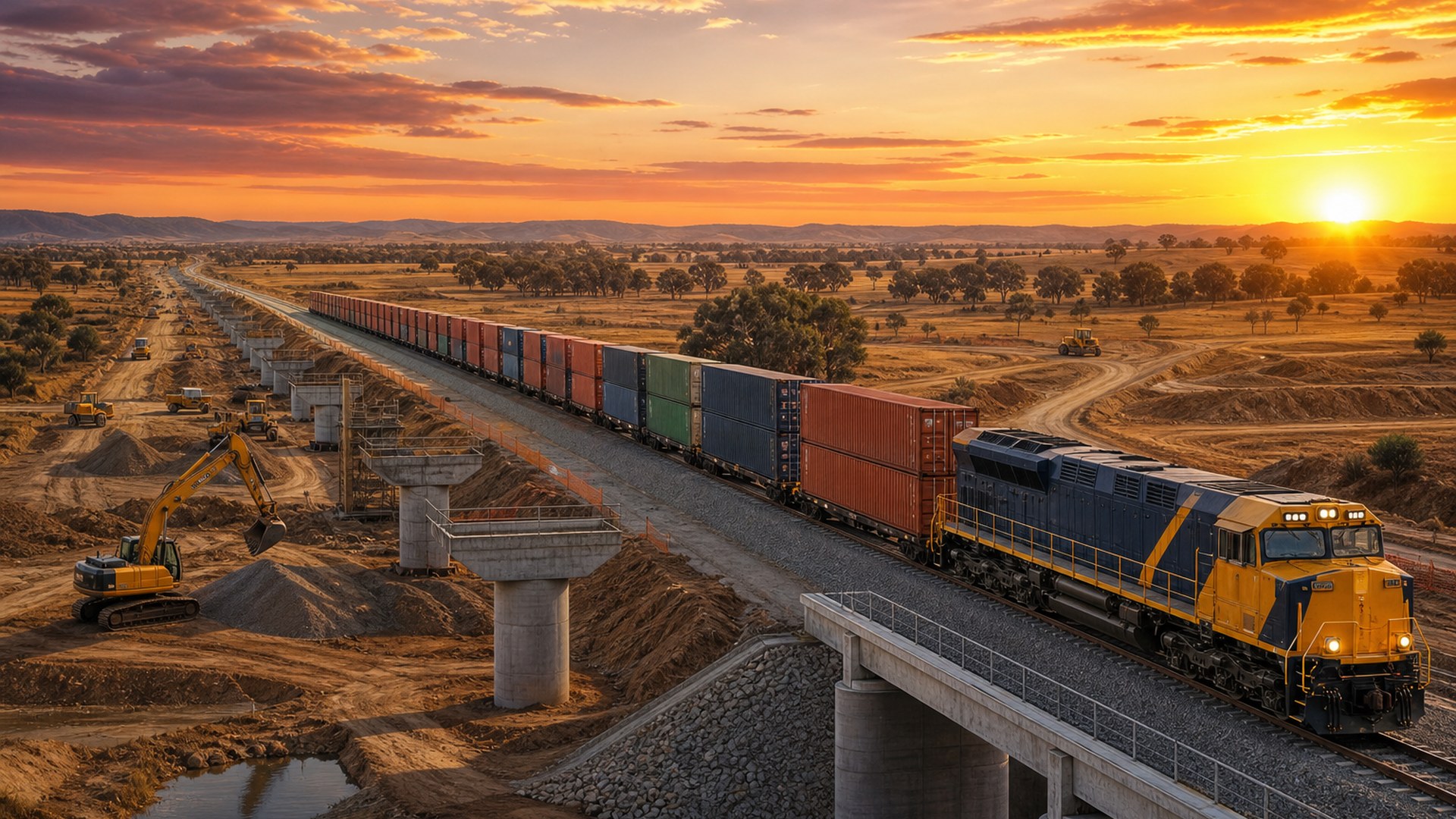

Inland Rail is holding to twenty-seven. The Australian Government’s published priority is to complete the Beveridge, Victoria, to Parkes, New South Wales, spine by the end of 2027 — double-stacked freight on that corridor, not a slogan about a different decade.

May 2026 scaled the full Melbourne-to-Brisbane vision back after the ACIL Allen work put the wider cost above A$45 billion and delivery at or beyond 2036. About A$1.75 billion was reallocated to Australian Rail Track Corporation network upgrades. The corridor north of Parkes stays preserved with Queensland and New South Wales. Inland Rail Pty Ltd is constructing; ARTC commissions. That is the reported packet from inlandrail.com.au progress material and the Guardian and Railway Gazette coverage in May 2026.

Say the geography out loud before the politics. Beveridge sits north of Melbourne on the Victorian approach. Parkes sits in central western New South Wales. The job on the Government’s priority list is to finish that Beveridge–Parkes section so double-stacked freight can run the corridor by the end of 2027. Double-stack means containers stacked two-high on the wagons the network is being built to clear. The figure that matters for shippers is clearance and schedule, not a tourist map of every town between Melbourne and Brisbane.

Tap to enlarge

May 2026 is the reset date in the public reporting. The full Melbourne–Brisbane Inland Rail vision — the longer national story people still say in the same breath — was scaled back after ACIL Allen’s cost work came in above A$45 billion with delivery at or beyond 2036. That is not a soft delay note. That is a cost and calendar reading that moved money and scope. About A$1.75 billion was reallocated to ARTC network upgrades. The corridor north of Parkes was preserved in the settlement with Queensland and New South Wales. Preserved is the careful word the coverage used: the northern aspiration stays on the map as a corridor, not as the same near-term construction clock as Beveridge–Parkes.

Who builds and who commissions. Inland Rail Pty Ltd is the constructing entity on the works the progress pages describe. The Australian Rail Track Corporation commissions. That split matters for anyone who reads a rail story as one logo. Construction and commissioning are different gates. The 2027 hold is a construction-and-commissioning hold on the Beveridge–Parkes priority, not a promise that every northern pin is pouring concrete on the same calendar.

Local spend is part of the reported ledger. More than A$732 million has gone with more than 1,200 local businesses, including about A$63 million with First Nations businesses, on the figures Inland Rail’s own progress material has carried. Those are procurement numbers, not ribbon-cutting adjectives. Twelve hundred-plus local businesses is a supply-chain footprint along the corridor. Sixty-three million with First Nations businesses is a named slice of that spend. Hold the numbers as published. The sources didn’t print a town-by-town split, so I’m not writing one.

Sites are supposed to be double-stack ready by the end of 2026. Construction complete by the end of 2027 — that is the Government priority language for the Beveridge–Parkes job. Ready and complete are different words on a project plan. Ready means the clearances and works that let double-stacked consists use the corridor. Complete means the construction program for that priority section is finished on the public clock. The year between end-2026 readiness and end-2027 completion is the reported sequencing, not a guess.

Length on the existing network side: about 617 kilometres of existing corridor plus upgrades and new build, on the progress framing Inland Rail has used for the works package people are actually watching. Existing plus upgrades plus new is how a freight spine gets made without pretending every kilometre is greenfield. The double-stack brief is what turns those kilometres into a product shippers can put on a timetable.

Why twenty-seven is the headline and not thirty-six. The ACIL Allen reading that put full Melbourne–Brisbane delivery at or beyond 2036, with cost above A$45 billion, is exactly why the May 2026 reset pulled the near-term priority back to Beveridge–Parkes and moved about A$1.75 billion toward ARTC network upgrades. You can still talk about Brisbane in the national conversation. The published near-term hold is twenty-seven on the Victorian–NSW spine. Mixing those clocks is how readers get lost.

Corridor north of Parkes, preserved with Queensland and New South Wales, is the diplomatic and planning remainder that keeps the longer vision from being erased. Preserved corridor is not the same as funded construction complete by 2027. Report both facts in the same breath so nobody pretends the reset deleted the north or that the north is somehow still on the same 2027 gate. Inland Rail Pty Ltd constructs what is funded and scheduled. ARTC commissions what is ready to enter service. Queensland and New South Wales sit in the preservation language for the northern corridor.

Freight is the point of the wire. Double-stacked containers on a dedicated inland spine are meant to pull volume off highways that already carry too much of the east-coast task. That is the policy sentence behind the engineering sentence. The engineering sentence is clearances, existing kilometres, upgrades, new build, and a 2027 completion priority from Beveridge to Parkes. The policy sentence is interstate freight moving on rail instead of eating the Hume and the Newell. I’m staying on the reported construction and money facts; the freight-shift argument is the published rationale, not a traffic model I’m drawing here.

Money again, because the countable lines are the story. Above A$45 billion and delivery at or beyond 2036 for the full vision — ACIL Allen, as reported in May 2026. About A$1.75 billion reallocated to ARTC network upgrades. More than A$732 million with more than 1,200 local businesses, including about A$63 million First Nations. Those four money facts are the ledger. Sites double-stack ready by end 2026. Construction complete end 2027 on the Beveridge–Parkes priority. About 617 kilometres existing plus upgrades and new. That is the works ledger.

Sources for this piece: inlandrail.com.au progress pages for the construction and local-spend framing; Guardian and Railway Gazette coverage from May 2026 for the scale-back, the ACIL Allen cost and delivery reading, the A$1.75 billion reallocation, and the corridor-preservation language with Queensland and New South Wales. If a later brief changes a dollar or a gate, the later brief wins. This piece holds to what those sources carried for the May reset and the twenty-seven priority.

Plain for the drive-time read. The Government wants Beveridge to Parkes done for double-stacked freight by the end of 2027. May 2026 admitted the full Melbourne–Brisbane dream was priced above A$45 billion and timed at or past 2036, so about A$1.75 billion went to ARTC upgrades and the north of Parkes stayed preserved with the two states. Inland Rail Pty Ltd builds. ARTC commissions. Local businesses — more than twelve hundred of them — have taken more than A$732 million of work, including about A$63 million First Nations. Double-stack ready by end 2026. Construction complete end 2027. Existing corridor about 617 kilometres in the mix with upgrades and new build.

What this is not. It is not a claim that Melbourne–Brisbane freight rail is finished in 2027. It is not a claim that the northern corridor is cancelled. It is not a town-by-town construction diary beyond what the progress pages publish. It is a hold-to-twenty-seven story on the priority spine, with the May 2026 cost reset sitting in the same paragraph so the calendar makes sense.

Rail writers chase opening days. This one chases the published priority and the published reset. End of 2027 for Beveridge–Parkes double-stack. May 2026 for the ACIL Allen shock and the A$1.75 billion ARTC shift. End of 2026 for double-stack-ready sites on the reported sequence. Inland Rail Pty Ltd on the tools. ARTC on the commissioning stamp. Local spend above A$732 million across more than 1,200 businesses. First Nations slice about A$63 million. Corridor north of Parkes preserved with Queensland and New South Wales. Full vision costed above A$45 billion with delivery at or beyond 2036. Hold those facts.

Close it on the title. Inland Rail holds to twenty-seven. Beveridge, Victoria, to Parkes, New South Wales. Double-stacked freight. Construction complete by the end of 2027 on the Government’s priority. The longer Melbourne–Brisbane map still exists as ambition and as a preserved northern corridor, not as the same near-term clock. May 2026 told the country why. The progress pages tell the country who is building and what the local spend looks like. That’s the roads piece for a freight spine that finally has a year you can say out loud without crossing into the next decade.