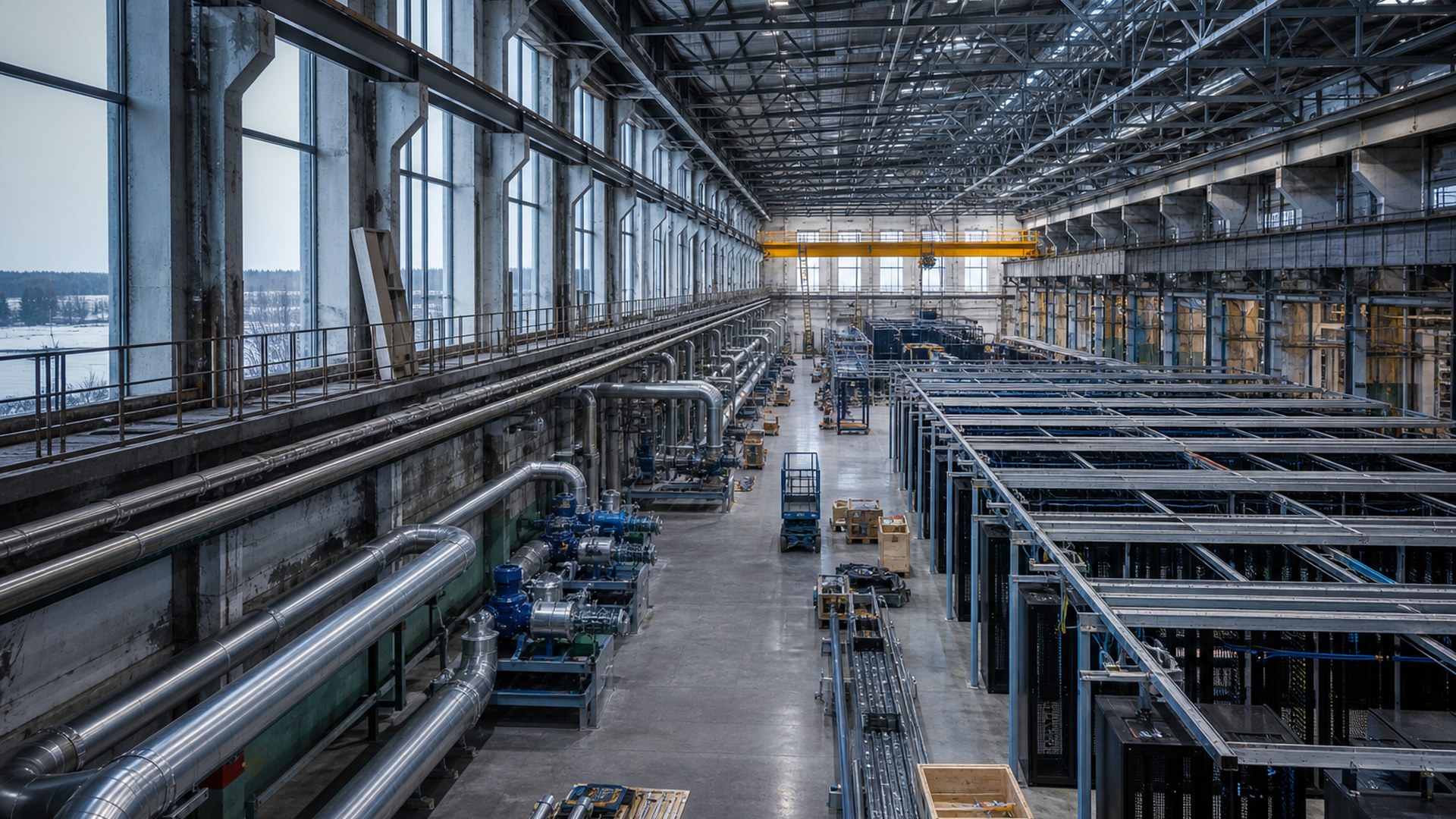

EuroHPC Joint Undertaking has signed a procurement contract with Bull for LUMI-AI, the next-generation supercomputer planned for CSC's data centre in Kajaani, Finland, built on AMD Instinct MI430X GPUs and 6th Gen AMD EPYC CPUs with 256 cores.
The machine is pitched at roughly ten times the AI capacity and nearly twice the HPC performance of the current LUMI system, with deployment targeted for the second half of 2027 as the backbone of the LUMI AI Factory.
Kajaani keeps the LUMI name and raises the ceiling. TechPowerUp's September 2026 coverage of the EuroHPC announcement puts the signature on a Bull procurement for LUMI-AI at the CSC data centre in Finland — same campus logic as today's LUMI, new silicon generation. The GPU side is AMD Instinct MI430X. The CPU side is 6th Gen AMD EPYC with 256 cores per the announcement sheet. Those are the two sockets that define the box before anyone argues about interconnect topology.
Scale claims are stated relative to the machine researchers already know. About ten times the AI capacity of current LUMI. Nearly twice the HPC performance. Those multipliers are EuroHPC and Bull framing carried in the TechPowerUp file, not a benchmark I ran. They tell you the design goal: keep LUMI's role as a European open-science and industry workhorse while shifting the balance hard toward training and inference alongside classical simulation.
LUMI AI Factory is the programme noun wrapped around the hardware. The next-gen system is meant to be the backbone for industry and academic users who need training, inference, and simulation under European data-governance expectations. Access for data-driven research is the policy win EuroHPC is selling with the signature — more capacity on European soil, scheduled for users who already depend on LUMI rather than only on US or commercial cloud queues. Strengthening that access path is the explicit upside in the announcement language.
Timeline is sober. Deployment is targeted for the second half of 2027. That is not a next-quarter plug-in. It is a multi-year install after procurement, facility prep, acceptance testing, and the usual supercomputer burn-in before general availability. If you are writing a grant that needs LUMI-AI cycles, H2 2027 is the planning fence on the public record. Current LUMI keeps working until the handoff is real.
Why Bull matters on the contract line: Bull, from the Atos group hardware lineage in the EuroHPC context, is the integrator named on the procurement. AMD is the silicon supplier for both the Instinct MI430X GPUs and the 6th Gen EPYC 256-core CPUs. CSC in Kajaani remains the host site. EuroHPC JU remains the European funding and governance umbrella. Those four names — EuroHPC, Bull, AMD, CSC — are the institutional stack. Get them right before the comment thread invents a fifth.
MI430X sits in AMD's Instinct roadmap as the accelerator class EuroHPC chose for this AI-forward LUMI generation. Pairing it with 256-core 6th Gen EPYC hosts is a dense CPU-GPU recipe aimed at both tightly coupled simulation and the large-batch training jobs that starve on thinner nodes. I'm not inventing FLOPS stickers the announcement did not put in the TechPowerUp piece. The relative claims — about 10× AI, nearly 2× HPC versus current LUMI — are the official scale language.
Kajaani's location is not trivia. Northern Finland's climate and CSC's existing LUMI operations give the site power and cooling practice that a greenfield campus would have to learn cold. Putting LUMI-AI in the same data-centre family as LUMI is how EuroHPC preserves operational continuity for users while swapping generations. The AI Factory branding then sits on top: one backbone, multiple user communities, industry plus academia.
Europe signed steel and silicon for a successor that multiplies AI capacity on an existing scientific campus instead of only renting overseas inference. A named GPU, a named CPU, a named integrator, a named city, and an H2 2027 deployment window are more than a memorandum of understanding. For labs that need stronger European access to large training runs and high-end simulation, that signature comes with a calendar attached.
What the September coverage does not hand you is a full rack count, a final interconnect diagram, or a euro-per-node hour. Procurement signatures come before those public deep dives. What you can say cleanly: contract signed; Bull; LUMI-AI; CSC Kajaani; Instinct MI430X; 6th Gen EPYC 256-core; about 10× AI and nearly 2× HPC versus current LUMI; deployment H2 2027; backbone of LUMI AI Factory for industry, academia, training, inference, and simulation.
Restate the numbers and the calendar. Deployment: second half of 2027. AI capacity goal: about ten times current LUMI. HPC goal: nearly two times current LUMI. CPU: 256-core 6th Gen AMD EPYC. GPU: AMD Instinct MI430X. Site: CSC data centre, Kajaani, Finland. Authority: EuroHPC Joint Undertaking. Integrator: Bull. Source window: TechPowerUp coverage of the EuroHPC announcement, September 2026.
Users should plan transitions early. Codes tuned for current LUMI's architecture will need retargeting for MI430X-class nodes and denser EPYC hosts. AI Factory access policies will matter as much as raw petaflops for companies that want in beside universities. None of that is a reason to downplay the signature. It is the work that follows a signature.
Acceptance and operations will decide when researchers actually submit jobs. A second-half 2027 deployment target means facility power, cooling, networking, and software stack acceptance still sit between today's signature and a general-user queue. CSC has run LUMI; that experience shortens some learning curves, but MI430X-class nodes are still a new generation to qualify. Treat H2 2027 as the public fence, not a soft aspiration someone invented in a blog comment.
Industry access through the LUMI AI Factory is part of why EuroHPC framed this buy as more than an academic refresh. Training and inference for companies that need European data residency sit beside university simulation campaigns on the same backbone language. How hours are allocated between those communities will be policy work after the machine is accepted. The procurement still matters because it names the capacity those policies will carve up.
Compare carefully to cloud rental maths if you must, but keep the comparison honest. A sovereign supercomputer with a published relative scale versus LUMI is not the same product as an on-demand GPU instance with a per-hour sticker. EuroHPC's pitch is durable access and European siting for data-driven research. Bull and AMD supply the metal. CSC operates the site. That institutional chain is the story TechPowerUp carried from the announcement.
For Australian and Asia-Pacific readers watching EuroHPC, the takeaway is capacity geography. Large AI training runs and coupled HPC jobs are still clustering where governments fund dense GPU campuses. Kajaani adding a roughly ten-times AI step on the LUMI line is Europe placing another marker on that map for 2027. You can disagree with any single multiplier and still report the signed procurement, the named silicon, and the calendar.
EuroHPC JU signed with Bull for LUMI-AI at CSC Kajaani: AMD Instinct MI430X GPUs, 6th Gen AMD EPYC 256-core CPUs, roughly 10× AI capacity and nearly 2× HPC versus current LUMI — EuroHPC/Bull claims — deployment in H2 2027, backbone of the LUMI AI Factory for industry and academia across training, inference, and simulation. TechPowerUp's September 2026 EuroHPC coverage is the sheet. Europe put a next-gen AI-capable supercomputer on a contract. Kajaani keeps the keys. The factory gets its backbone on a published timetable.


The paper
Comments
No notes on this story yet.
Sign in to comment