
SpaceX posted full-duration 33-engine static-fire video of Super Heavy Booster 21 at Pad 2, Starbase, Texas, on 28 August 2026 — the public tape of the booster preparing for Starship Flight 14.

Company coverage and Tesla Oracle’s 2 September read put the burn on the Orbital Launch Mount that will also host the flight; Ship 41 had already completed its Massey’s static fires — single-engine on 19 August, six-engine for about 60 seconds on 21 August.

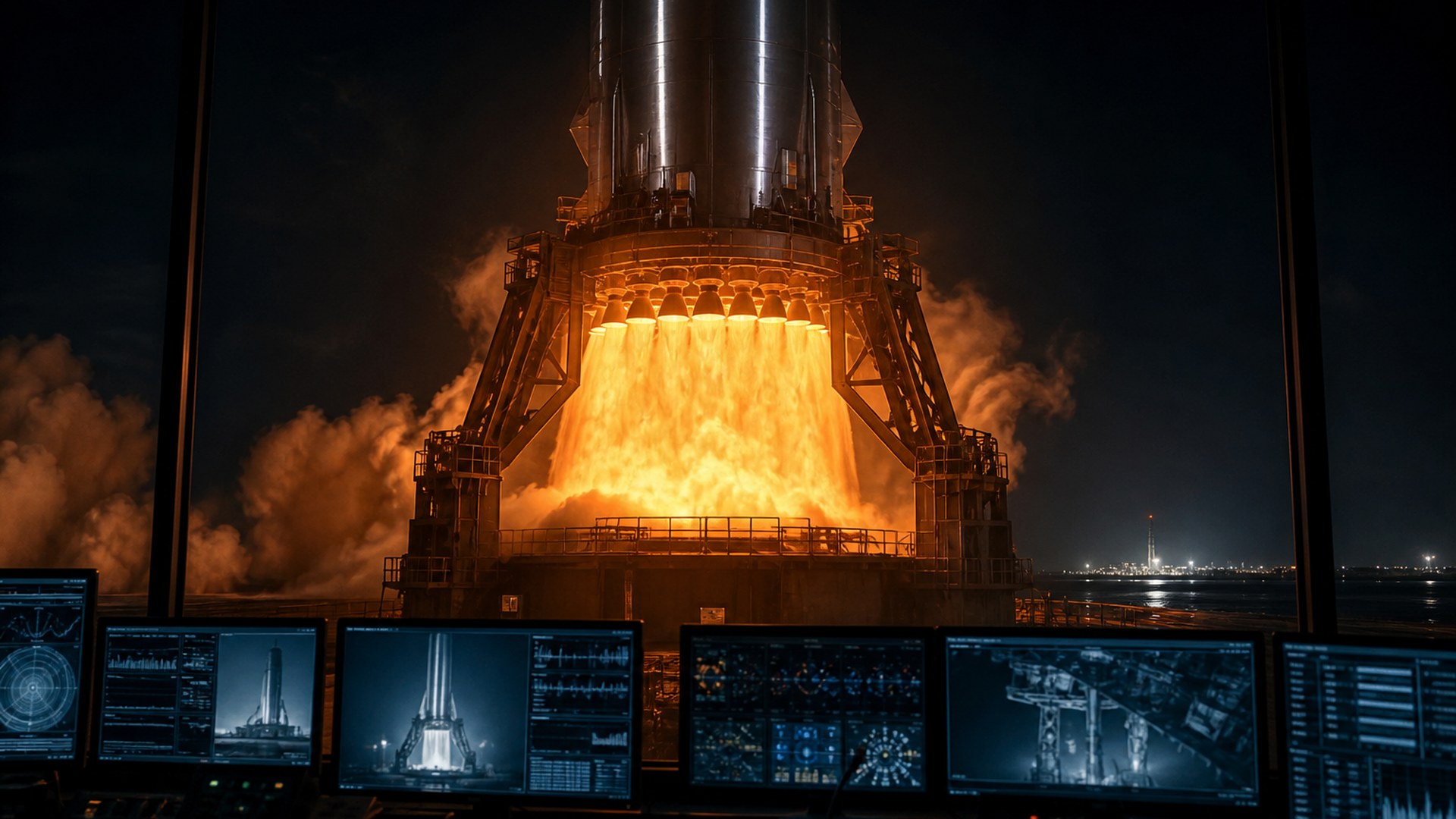
The object here is the tape, not a countdown clock. SpaceX’s own 28 August post called it a full-duration 33-engine static fire with the Super Heavy booster preparing for Flight 14 and shared video of the plume. I’m staying with what the public clip shows at a high level — engines lit, hold-downs keeping the stack on the mount, pad infrastructure taking the load — without inventing camera angles I haven’t verified on the release.

Tap to enlarge

A static fire is ignition while the vehicle stays on the ground. For Super Heavy that means coordinating all 33 Raptors in a held-down burn long enough to match what the flight needs from those engines on the stand. Space.com’s 29 August write-up framed the same test as another step toward Flight 14. Venture Atlas summarised the pad test the same week. The tape is the primary source a household can play without a press badge.

Pad 2 at Starbase is the active orbital stand for this stack. Tesla Oracle’s 2 September piece put Booster 21’s 33-engine run on that launch mount and noted the same pad is planned for Flight 14 itself. I’m not inventing a T-0 from a ground burn. Static fire is not GO. It is the last major hardware checkpoint the booster campaign needed before stacking talk gets serious.

Ship 41’s side of the same August ledger sits at Massey’s Test Site. On 19 August a single-engine static fire simulated the deorbit burn — the engine lighting that matters most once you commit to an orbital profile. On 21 August all six Raptors fired together for a full-duration run of about 60 seconds. TechTimes and Tesla Oracle both carried those dates. Spaceflight coverage lined the same sequence up as Ship qualification, then Booster 21’s 28 August full-duration burn.

What you see on the released clip, in plain language: a Super Heavy on the mount, a dense plume under the grid, and the pad taking thrust while the vehicle does not leave. SpaceX’s caption did the naming work — full duration, 33 engines, Flight 14 prep. I’m not printing unverified thrust telemetry or inventing which secondary camera caught which Raptor. The company video is the artifact. Play it. Then read the filings around it.

The numbers that are already on the record. Booster: Super Heavy Booster 21. Engines on the burn: 33. Date of the tape: 28 August 2026. Place: Pad 2 / Orbital Launch Mount, Starbase, Texas. Ship 41 single-engine: 19 August at Massey’s. Ship 41 six-engine: 21 August, about 60 seconds. Programme: Starship Flight 14. Sources: SpaceX’s 28 August post and video; Tesla Oracle 2 September; Space.com 29 August; TechTimes’ Flight 14 static-fire ledger.

Why the tape matters. Ground tests are usually the boring middle of a campaign until the company publishes the plume. Once the clip is public, the static fire stops being a rumour and becomes a watchable object — the same way a webcast becomes the story for a launch night. Wren’s job is the pictures and where to find them. The orbital filing and the September NET belong elsewhere. This is Pad 2 on 28 August.

Raptor 3 thrust figures show up in secondary coverage — Tesla Oracle cited about 280 tonne-force per engine and a combined figure on the order of 9,240 tonne-force if all 33 light together. Treat those as attributed secondary numbers, not a telemetry readout I ran. The verified fact is simpler: SpaceX said all 33 fired for a full-duration static fire and posted the video the same day.

Flight 14 context without stealing the breaking lead. FCC paperwork and airspace planning markers in early September pointed at a mid-September NET around 15 September 2026 for an orbital-class attempt with Ship 41 and Booster 21. FAA flight authorisation was still described as pending in early September coverage. Ship catch language from the Q2 call was walked back toward a later flight in some reports, with Indian Ocean splashdown still the expected ship end on those reads. I’m noting the conflict carefully and leaving the licence clock where it belongs.

I’m not inventing what I don’t have. I don’t have an independent camera log of Pad 2 that day. I don’t have a verified second-by-second shot list beyond what SpaceX released. I won’t invent drone orbits, crane angles, or which hold-down clamps moved. High level: plume, hold-downs, pad, full-duration 33-engine burn, Flight 14 prep. That is the honest frame.

Where the tape sits in the August cadence. Cryogenic proof work on the booster earlier in the summer. Ship 41 to Massey’s mid-August. Single-engine 19 August. Six-engine 21 August. Booster 21 to Pad 2 for the 28 August full-duration run. Tesla Oracle called that set the major tests for both stages. Spaceflight coverage treated the booster burn as clearing the last significant hardware checkpoint before stacking. The pictures close that paragraph.

The 28 August 2026 Texas evening post is already the next calendar morning depending on the hour of the upload. The point of the filing isn’t the local time of the X post. The point is that a full-duration 33-engine object exists in public and can be replayed without a badge.

Compare it to other tapes without confusing the identifiers. A Vandenberg Starlink webcast is a Falcon 9 night launch and a Pacific droneship. A Roman Falcon Heavy tape is LC-39A and a telescope on the nose. This is Starbase Pad 2, Super Heavy Booster 21, held down, 33 Raptors, 28 August. Different coast. Different vehicle. Different product. Same rule: official footage as primary source.

There’s a reason households reach for this clip. Static fires used to live behind fences and press pools. When SpaceX posts the full-duration plume the same day, the test becomes something you can watch on a phone between emails. That changes how a campaign reads. You don’t need a badge to see thirty-three Raptors hold the stack on the mount. You need a link and a few minutes.

The held-down burn also tells you something about what Flight 14 is asking of the hardware. A full-duration static fire is not a short ignition check. It’s the engines running long enough to stand in for the flight profile on the ground — propellant flow, thermal soak, throttle behaviour, the whole coordinated bank of Raptors doing their job while the clamps refuse to let the booster leave. If that run looks clean in the company video, stacking talk gets louder for a reason.

Ship 41’s Massey’s work sits next to that booster story without being the same story. The single-engine deorbit simulation on 19 August and the six-engine roughly sixty-second run on 21 August are ship qualification. They don’t replace Booster 21’s pad burn; they complete the August hardware ledger that Flight 14 coverage keeps citing. TechTimes and Tesla Oracle both put those dates on the record. Spaceflight write-ups treated the sequence as ship first, then booster — which is how the calendar actually ran.

Pad geography matters for anyone scrubbing the replay. Pad 2’s Orbital Launch Mount is the stand that will also host the flight attempt on the company reads. You’re not looking at a remote test stand disconnected from the launch campaign. You’re looking at the mount that Flight 14 is supposed to use, with Booster 21 lighting thirty-three engines while the hold-downs keep the vehicle planted. That continuity is part of why Space.com and Venture Atlas treated the burn as a step toward the flight, not a side show.

Secondary thrust colour stays secondary. Tesla Oracle’s roughly 280 tonne-force per Raptor 3 and the combined order-of-magnitude figure if all thirty-three light are useful colour when attributed. They’re not a load-cell printout from Pad 2 that day. SpaceX’s claim — all thirty-three, full duration, video posted — is the verified core. I’m staying on that line.

The September NET around mid-month, the FCC and airspace markers, the FAA authorisation still described as pending in early September coverage — those are the paper around the tape, not the tape itself. Ship catch language walked back in some reports, Indian Ocean splashdown still expected on others: I’m noting the conflict without pretending a ground burn settles it. Wren’s lane is the pictures. Play the plume. Then read the filings.

Close the book on what the public tape shows. SpaceX released full-duration 33-engine static-fire video of Booster 21 at Pad 2 Starbase on 28 August 2026 preparing for Flight 14. Ship 41’s Massey’s campaign — single-engine 19 August, six-engine about 60 seconds on 21 August — sits on the same pre-flight ledger. Sources: Tesla Oracle 2 September, Space.com, TechTimes, SpaceX’s own post. Play the plume. Then read the FCC and FAA paper around the September NET. The tape is the news.