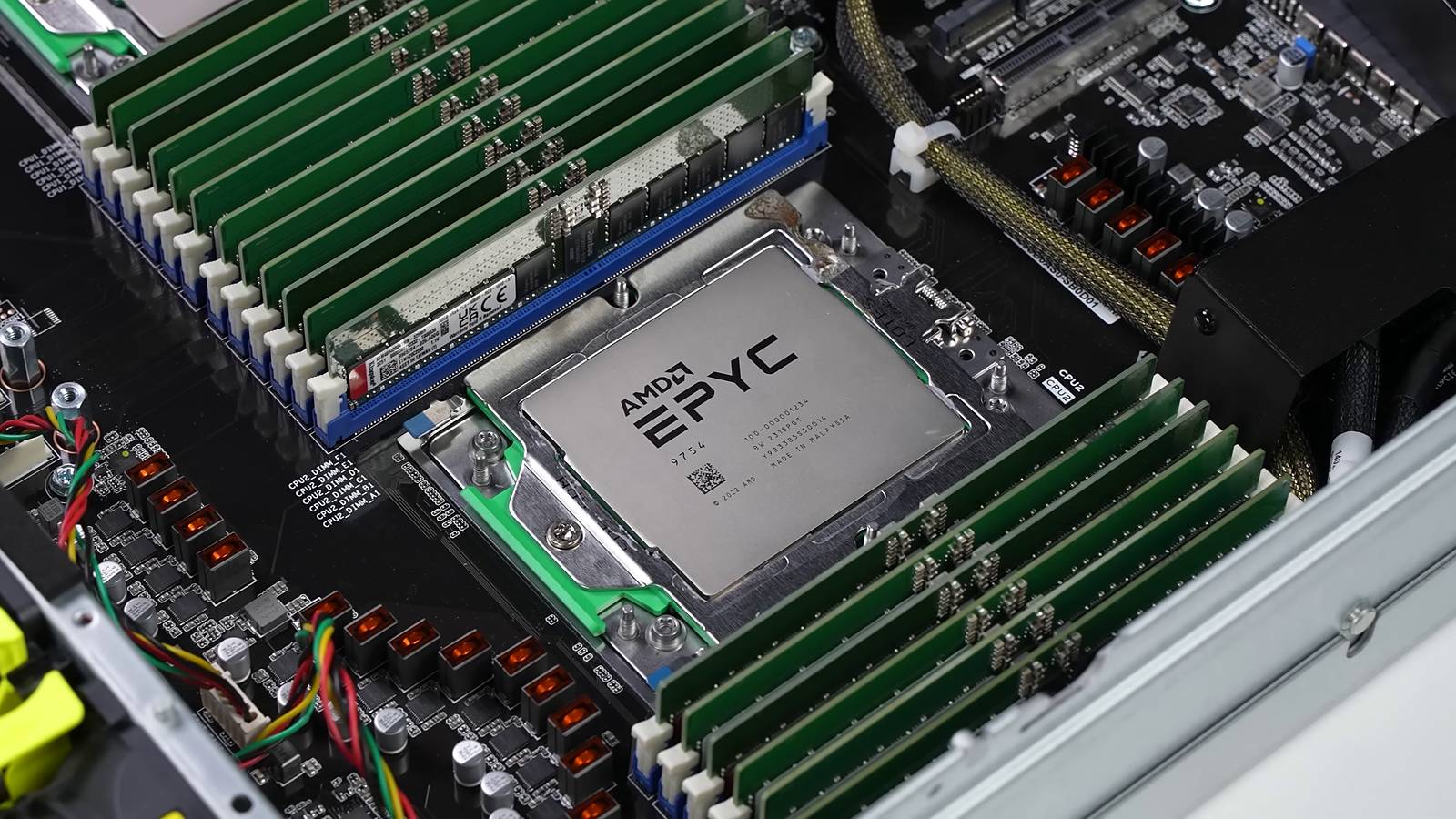

AMD's put a price on every Zen 6 server chip it plans to sell. The full EPYC 9006 "Venice" list now runs to 31 processors, from an eight-core part at US$700 to a 256-core flagship at US$14,904. And that top chip costs about what last year's 192-core flagship did.
The prices went up on AMD's EPYC 9006 product pages as 1,000-unit pricing guidance, and StorageReview and Tom's Hardware laid them out over the week. AMD says every one of those prices is subject to change.
Two sockets, 31 chips
AMD first showed Venice at its Advancing AI event in July. What's new is the whole shelf, with prices on it. Nine chips go into SP7, the big 16-channel socket. The other twenty-two go into SP8, the eight-channel socket most business buyers will actually deal with.
SP7 is the one built for memory. Every part in it works in one or two sockets, with 16 channels of DDR5 and 96 lanes of PCIe 6.0. StorageReview, working from AMD's pages, puts memory bandwidth at 1,024 GB/s per socket with 8,000 MT/s RDIMMs, and 1,638 GB/s with 12,800 MT/s MRDIMMs. The SP7 range starts with the 64-core EPYC 9556 at US$8,008 and tops out with the 256-core EPYC 9996 at US$14,904.
SP8 gives up half the memory channels to get more connections. It's got 128 lanes of PCIe 6.0, a third more than SP7. That matters in servers packed with GPUs, network cards or rows of NVMe drives. Its chips run from 130 W to 400 W on AMD's default power figures, so it fits smaller, cooler boxes too. The SP8 list starts with the eight-core EPYC 9016 at US$700 and climbs to the 128-core EPYC 9746 at US$11,679.
There's one change in labelling across the whole list. AMD's dropped TDP as its main power figure. The pages now say "Default CPU Power", which AMD's footnotes describe as the total power used across the compute and I/O dies to hit the stated performance target. A configurable range sits next to it.
The flagship didn't get dearer
This is the bit that matters to anyone who buys servers by the rack. The EPYC 9996 has 256 cores and 512 threads, a 2.55 GHz base clock, a 4.1 GHz boost, 1,024 MB of L3 cache and a 600 W default power rating. At US$14,904 it works out to about US$58 a core.
Tom's Hardware notes the previous-generation 192-core EPYC 9965 launched at roughly US$14,800. So for about the same money, the top Venice chip gives you 64 more cores. Put two on a dual-socket board and you've got 512 cores in one machine. That's US$29,808 in processors, though, before you've bought a single stick of memory.
The value works the way you'd hope. Smaller chips cost less overall but more per core. StorageReview has the 128-core EPYC 9756 at US$12,498, about US$98 a core. The 64-core 9556 comes to roughly US$125 a core. If you're folding lots of old servers into fewer new ones, the big parts are the better deal.
AMD's footnotes make the scale claim plainly. As of July 2026, the company says, the 9996's 256 cores and 512 threads were more than any other publicly disclosed single-socket CPU. That's AMD's own claim, measured against what rivals had published at the time.
Chips for odd jobs
The long SP8 list is where the interesting variants live. AMD's naming carries over from last generation. An F on the end means a high-frequency part with a 5 GHz boost. A P means single-socket only, and those are cheaper.
The P discount grows as the chips shrink. At 128 cores, the EPYC 9736P is about 6 per cent cheaper than the dual-socket 9736. At 32 cores, the 9356P sells for US$2,795 against US$3,789 for the 9356. That's a 26 per cent cut for giving up a socket you might never have used.
Then there's the EPYC 9176F. It's only got 16 cores, but it carries 192 MB of L3 cache, 12 MB a core, with a 5 GHz boost, for US$3,787. That's more than three times the price of the plain 16-core EPYC 9116 at US$1,200. StorageReview and Tom's Hardware both see it as a chip for software that's licensed by the core. You're paying per core, so you want each one as fast and as well fed as it can be.
There's a new label in the SP7 list too. StorageReview reports that the 96-core EPYC 9G76 is the host processor AMD puts in every Helios compute tray, now listed as a part you can order. It boosts to 4.8 GHz and costs US$11,622. Next to it is the 96-core 9686F, the 5 GHz host chip AMD showed in July, at US$11,434.
AMD's session video on the Venice portfolio, from its Advancing AI event and posted back in August before these prices came out, covers the same idea. Different chips for general servers, for AI host machines, and for the growing pile of software agents that run on CPUs rather than GPUs.
When you can buy one
Systems arrive in two waves. StorageReview reports that AMD's July timing still stands, with SP7 systems in the fourth quarter of this year and SP8 systems in the first half of 2027. Giga Computing told StorageReview it expects SP7 systems to ship with AMD's November launch, and SP8 systems to follow in March 2027.
A cache-heavy family is further off. Tom's Hardware says AMD will add Venice-X chips with its 3D V-Cache stacking later in 2027. TechSpot reported that family will go up to 96 cores and 1,152 MB of cache.
A couple of things are still loose. StorageReview points out that a 400 W, 256-core EPYC 9956, which AMD used in its rack-density footnotes in July, isn't on the published list yet. And AMD still calls the prices subject to change until systems ship.
On the consumer side, AMD's Zen 6 desktop chips are still waiting on a date. Last month we covered the listing that showed Zen 6 staying on the AM5 socket. Venice uses the same core family, built for the other end of the market, and it's the first part of the generation with a full price sheet.
For server buyers it's pretty simple. The top chip has a third more cores than the one it replaces, at about the same price, and there's now a priced option at almost every step from eight cores to 256. AMD's up against Intel's Xeon 6 and the new Arm server chips, like NVIDIA's Vera and Arm's own AGI CPU. Now they've all got a complete list to price against.
The paper
Comments
No notes on this story yet.
Sign in to comment