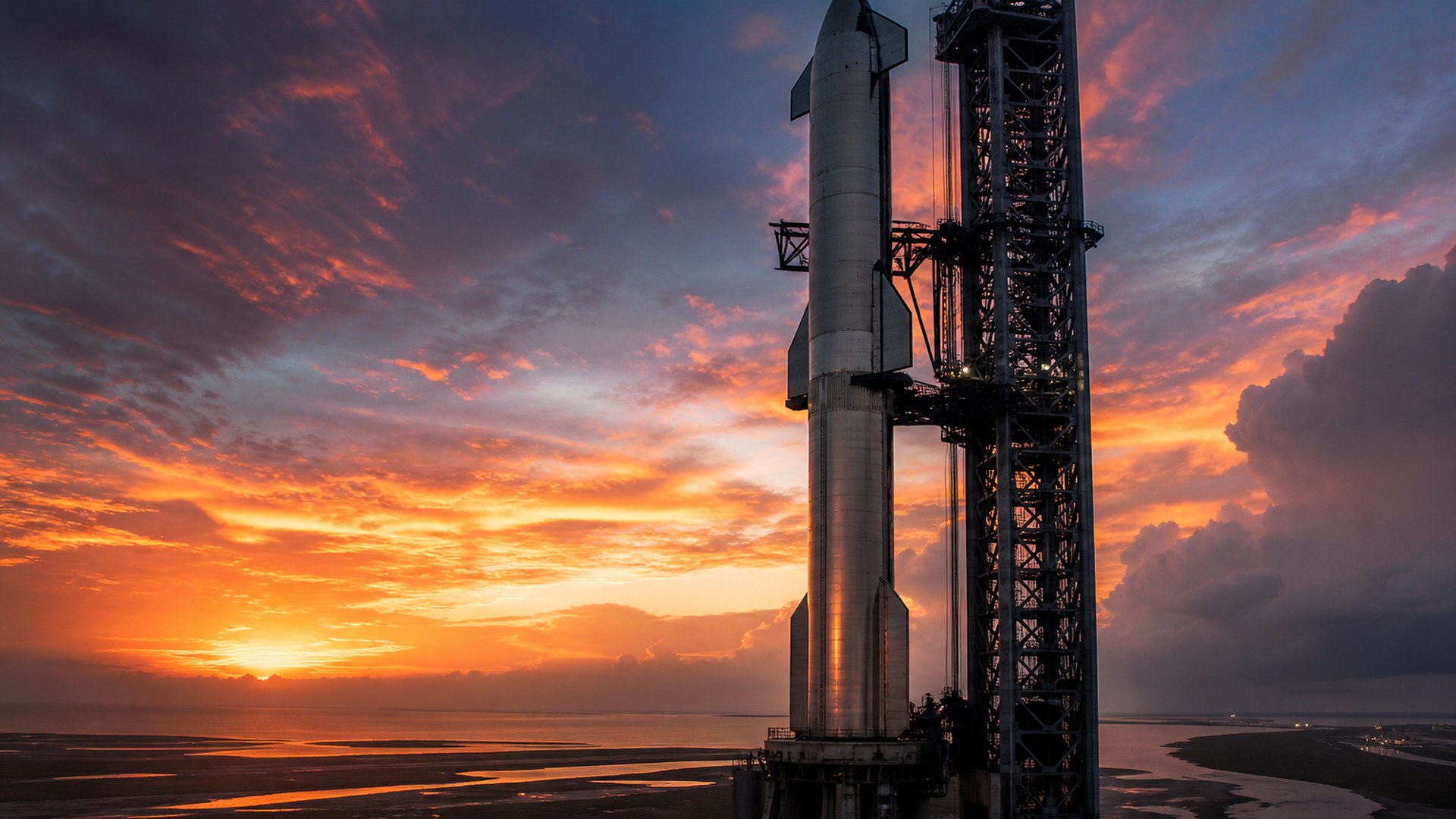

Starship Flight 14 is on a no-earlier-than mark around 15 September 2026 from Starbase's Orbital Launch Pad 2, with Ship 41 and Booster 21. The FCC filings describe orbital insertion and on the order of twenty operational Starlink V3 satellites.
FAA flight approval was still pending in early September coverage. Ship-catch talk from the Q2 call got walked back in later remarks toward a later flight, with Indian Ocean splashdown for the ship and Gulf splashdown for the booster on those attributed reads.
Here's the peg. SpaceX's communications paperwork and airspace planning markers in early September put a mid-month NET on Flight 14. Tesla Oracle, TechTimes, LookToSpace, and Starpath all carried versions of the same September 15 floor. Treat it as a floor. Starship dates move. I'm not printing a countdown clock SpaceX hasn't confirmed as a firm T-0.
What the FCC line actually does matters more than the calendar chatter. Filings in late August asked for authority that describes an orbital second stage and Starlink V3 communications on the mission, with a requested window opening 15 September 2026 on the radio forms. An STA is radio authority. It is not the FAA launch licence. TechTimes' 2 September piece said the August 31 STA was the first FCC document for Starship that explicitly describes orbital insertion rather than a suborbital arc. That sentence is the news.
Hardware has already spoken on the stand. Ship 41 ran a single-engine static fire at Massey's on 19 August simulating the deorbit burn, then a six-engine full-duration burn of about sixty seconds on 21 August. Booster 21 followed with a full-duration thirty-three-engine static fire at Pad 2 on 28 August. Those burns cleared the major ground-test gates on the public ledger. Stack, software, and licence still sit between a static fire and liftoff. Engines lighting on the stand is progress. It is not a GO call.
Catch talk needs careful dating, not a mash of remarks from different weeks. On the Q2 2026 earnings call, Elon Musk discussed catching the ship with the tower on the next flight. On 20 August he tempered that, saying SpaceX would probably catch the ship with the tower in a few months rather than on the immediate next flight. TechTimes, TeslaNorth, KeepTrack, and LookToSpace all kept Indian Ocean splashdown as the expected ship end for Flight 14 after that walk-back. Booster splashdown in the Gulf rather than a tower catch shows up on the same attributed reads. Earlier FCC language that described returns to the launch site sits as superseded intent once the catch slipped. Label rumour, earnings remarks, and current expected recovery separately, and you'll stay honest.
NASA Administrator Jared Isaacman put his own early September expectation on the record. On 14 August he said he expected Flight 14 in early September and that a cadence of roughly one flight a month or faster through the rest of the year would give NASA confidence in Starship's schedule for Artemis. Mid-September NET markers arrived later as hardware and FAA paper lined up. Isaacman's remark is expectation, dated. It is not a NASA launch assignment, and it doesn't override the NET the radio and airspace paperwork started carrying.
Why orbit matters on this attempt is the long thread under the calendar. Every prior Starship integrated flight flew a suborbital arc. Flight 13 on 24 July lofted production V3 hardware on a demo path and soft-splashed Ship 40 in the Indian Ocean; those satellites were not meant to join the constellation. Flight 14 is set up, if insertion holds, to put on the order of twenty operational Starlink V3 satellites into a working orbit. V3 size and mass are why Starship's bay matters — Falcon 9's fairing is the wrong shape for that generation on an economical cadence. That's company and trade coverage, not a fairing measurement I took with a tape.
The FAA gate deserves plain language without invented drama. As of early September reporting — TechTimes on 2 September among others — SpaceX had not announced FAA approval for the orbital mission profile. Environmental clearances and contingency-landing paperwork moved in the same news week; those are not the same stamp as a flight licence for this stack. Temporary flight restrictions around Brownsville can mean preparation without meaning an imminent window. The licence clock stays honest when you refuse to conflate those stamps.
Numbers that hold today, on the public paper: NET around 15 September 2026. Site: Starbase, Texas, OLP-2 / Pad 2. Ship: 41. Booster: 21. Profile on filings: orbital insertion. Payload framing: about twenty operational Starlink V3. Ship recovery on current attributed plan: Indian Ocean splashdown. Booster recovery on those reads: Gulf splashdown. Catch: deferred in the 20 August remarks relative to the Q2 call talk. FAA: pending in early September coverage. The sourcing trail runs through TechTimes, LookToSpace, Starpath, Tesla Oracle, and TeslaNorth.
Static fires done. Orbital language on the FCC paper. A September floor in airspace planning. Artemis stakeholders watching cadence. The open items are still open: FAA licence, final stack, weather, range. You can say the programme is pointed at orbit without pretending the stamp already landed. That restraint is the story's spine, not a hedge for show.
If the date slips, the filing and the static-fire ledger don't vanish. If the licence clears and the stack flies, the first orbital Starship attempt becomes the next object on the wire. Either way, Ship 41 and Booster 21 are the named hardware, Pad 2 is the stand, and orbit is what the paperwork now describes. Prior flights stayed suborbital on purpose. This one is written differently on the radio forms, and that difference is why mid-September is worth watching closely.
One more pass on recovery so nobody walks away with the wrong end state. Tower catch for the ship was the Q2 talk. August walked it back. Indian Ocean for the ship and Gulf for the booster are the recovery verbs on the current attributed reads. Earlier return-to-launch-site language on older FCC paper shouldn't be pasted into a September briefing as if it still governs. Rumours about an early catch will keep circulating; the dated remarks already on the record are what you can defend.
Artemis watches the cadence more than any single NET. Isaacman's August line about roughly one flight a month or faster was confidence talk for NASA's schedule, not a booking. Flight 14's mid-September floor sits later than that early September hope, which is exactly how Starship calendars have behaved: the hardware and the licence set the pace, and the public NET follows. A monthly drumbeat through the rest of 2026 would matter for Artemis planning whether Flight 14 lifts on the fifteenth or a week after.
Starlink V3 is the payload reason the orbital ask exists. Flight 13 proved you can loft the hardware and bring the ship home soft in the Indian Ocean without claiming constellation membership. Flight 14, on the FCC description, is meant to insert operational birds. About twenty of them. That's a small constellation bite by Starlink standards and a large one by Starship standards until the bay flies for real. Company coverage has been clear that Falcon 9 isn't the economical ride for this generation's shape and mass. Starship is the bet.
Pad 2 at Starbase is where Booster 21 already lit all thirty-three. Massey's is where Ship 41 did the deorbit simulation and the six-engine run. Those are August facts. September's remaining verbs are stack, software, weather, range, and the FAA stamp. Temporary flight restrictions near Brownsville will keep showing up in local coverage; they prep airspace, they don't mint a launch licence. When SpaceX announces approval for the orbital profile, that sentence will move the story overnight. Until then, pending means pending.
Flight Fourteen sets September fifteenth as the NET the public paper is using. Orbital insertion. About twenty Starlink V3 if the burn holds. Catch deferred on the August walk-back. FAA still the gate in early September reads. Isaacman wanted early September cadence confidence for Artemis. The engines already lit on the stand in August. The licence is the remaining verb.


The paper
Comments
No notes on this story yet.
Sign in to comment