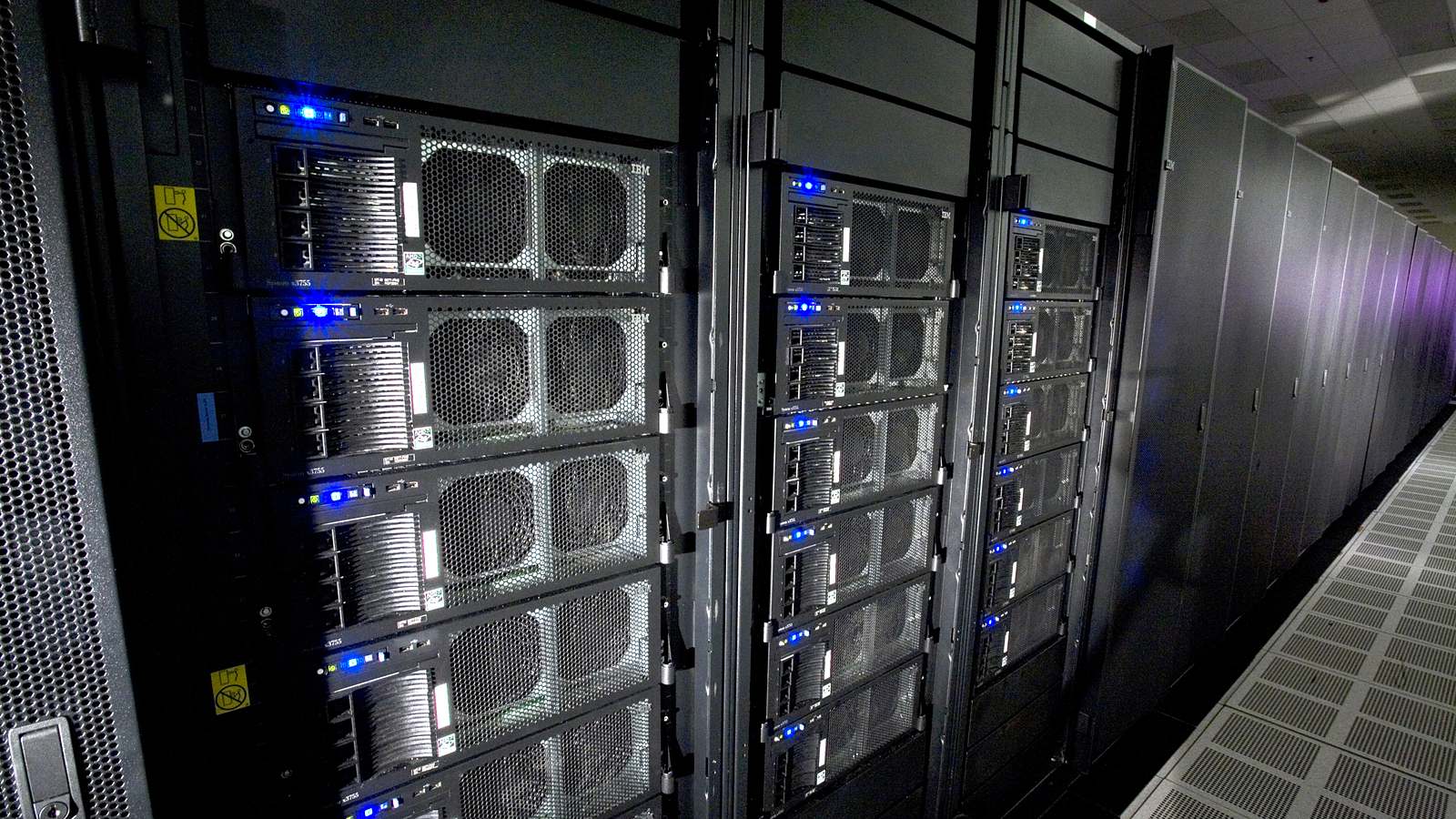

Los Alamos National Laboratory has its first NVIDIA Vera CPU systems up and running. The lab said on 30 September that a Vera server delivered in August is now sitting in its Darwin testbed. Engineers there are benchmarking it and getting software ready for three new supercomputers, called Mission, Vision and Veritas.
It's an early step, but it's a real one. The lab's announcement says the machine went from delivery to installation, software setup, and performance and stability testing. It's now supporting benchmarking and application readiness work.
What's in the box
The hardware's an air-cooled NVIDIA MGX Vera CPU node. It puts two Vera CPUs, each with 88 of NVIDIA's custom Olympus cores, into a two-socket server. The two chips talk to each other over NVLink Chip-to-Chip, NVIDIA's high-bandwidth link between processors.
That's 176 cores in one node, built on Arm. We covered the chip's wider debut when AWS said it would bring Vera to its cloud. The Los Alamos install is a different thing. It's a national laboratory putting the processor to work on the code it'll actually run.
Darwin is where the lab tries out new hardware before it commits to it at scale. The lab says the Darwin team, backed by the National Nuclear Security Administration's Advanced Simulation and Computing program, installed and set up the server soon after it arrived.
"Los Alamos National Laboratory will be one of the first institutions to receive the Vera CPU technology during an ongoing, rigorous collaboration between the Laboratory and NVIDIA," Gary Grider, the lab's senior director for computing technology, said in the announcement.
Three machines waiting
Vera's real job is in three systems the lab has on order. The lab says all three will use Vera CPUs and NVIDIA Rubin GPUs.
Mission is the big one. It'll be the fifth Advanced Technology System in the NNSA's Advanced Simulation and Computing program, and it'll replace the Crossroads supercomputer for classified national security work, according to an NVIDIA blog post from June. Mission won't be one design all the way through. It'll be split into three partitions. Ranger runs on Vera CPUs. Sandstone uses Vera Rubin NVL-4 nodes. Starlight uses Vera Rubin NVL-72 racks. All three will share one software environment and high-performance storage.
Vision is for open science. NVIDIA's post says it'll handle materials and nuclear science, energy modelling, biomedical research and AI. Veritas will serve the lab's Laboratory Directed Research and Development program and test agentic AI for science, the post says. The Vera nodes in Darwin are headed for both Mission's Ranger partition and Veritas.
NVIDIA's June post put numbers on the plan. Mission is set to include about 2,300 standalone Vera CPUs on HPE Cray GX240 blades, and Veritas about 1,150. The systems use HPE's Cray Supercomputing GX5000 architecture with NVIDIA's Quantum-X800 InfiniBand networking.
"In its eventual deployment in Mission's Ranger partition, the Vera CPU will support the NNSA's highest complexity 3D multi-physics simulations and provide the technology foundation for Agentic AI powered workloads," said Galen Shipman, chief architect of advanced technology systems at Los Alamos.
Why a CPU matters here
Most supercomputer news these days is about GPUs. Los Alamos is making a point about the CPU, because a lot of its simulation work doesn't fit neatly onto hardware built for cloud AI.
"At the Laboratory, we've concentrated on tailoring hardware technologies in Mission to address simulation characteristics that are not well represented in the broader cloud- and AI-driven market," said Ben Santos, the lab's HPC Platforms program director.
The lab says Ranger will deliver high-frequency, high-bandwidth cores with lots of memory, both in total and per core. NVIDIA's offered its own early numbers on why that matters. In its June post, NVIDIA said that in the lab's testing Vera beat the CPUs in Crossroads by more than three times on Branson, an open-source Monte Carlo heat transfer code. NVIDIA said it was seven times faster on workloads for URSA, the lab's Universal Research and Scientific Agent. It also said a single Vera CPU gives more than four times the memory per core of the x86 chip it was compared with. These are NVIDIA's own figures from early testing. Nobody's checked them independently yet.
This isn't a new partnership. The lab says the Vera work builds on more than a decade of co-design with NVIDIA, including the Grace CPU that powers Venado, the supercomputer NVIDIA and HPE built for Los Alamos. NVIDIA says Venado is an HPE Cray EX system installed at Los Alamos in 2024, with NVIDIA's GH200 Grace Hopper Superchips and Grace CPU Superchips. Vera's the next step, with more cores and more memory per core, and the lab helped shape what went into it.
Shipman said the lab had collaborated "with ARM, NVIDIA and HPE over many years on architectural specification and requirements definition", and that having Vera in the testbed lets it "further validate our codesign decisions".
The timeline
The lab's announcement lays out what's next. The full Ranger partition will go into Mission in 2027, alongside Sandstone. Mission's Starlight partition and Vision's Transformer partition could arrive as soon as late 2026.
When the NNSA unveiled Mission and Vision in July, it said it expects full deployment of the two systems in 2027 and 2028. NNSA Administrator Brandon Williams said then that co-designing the machines with HPE and NVIDIA would help scientists "reduce the time needed for discovery from months to minutes". That's a goal, not a measured result.
NVIDIA's Ian Buck called the testbed the start of that work. "The next era of scientific discovery will be powered by supercomputers that bring AI and simulation together," Buck, NVIDIA's vice president of hyperscale and HPC, said in the lab's announcement.
Los Alamos isn't the only lab planning big new machines. In Europe, EuroHPC has signed for LUMI-AI in Kajaani, Finland, due in the second half of 2027 on AMD GPUs. The Los Alamos news is smaller, just one server in a testbed. But it's the moment a chip on a slide becomes a machine the lab can run its own code on. Getting software ready a year or more before the full system lands is how labs stop a new supercomputer sitting idle on day one.
The paper
Comments
No notes on this story yet.
Sign in to comment