
One Nation’s vote is climbing again. The Guardian Essential poll out on Tuesday 29 September has Pauline Hanson’s party on 25 per cent of the primary vote. That’s up two points in a month. The Coalition fell four points to 22 per cent, which equals its lowest ever result in that poll.
Labor bounced back to 29 per cent, up three. Roy Morgan’s fortnightly poll came out the same day. It had One Nation on 25.5 per cent, just half a point behind Labor’s 26, and it found One Nation’s support peaking at 32.5 per cent in Queensland.
Both polls were done before the Reserve Bank lifted interest rates for the fourth time this year. And both turned up something else. Most Australians want the migrant intake cut, and big majorities back some of the hardline enforcement ideas One Nation’s been pushing. Yet more people say migration’s been good for the country than say it’s been bad.
The Essential numbers
Essential surveyed 1,022 people in the week before the poll came out. Here’s where the parties landed, according to Guardian Australia’s report.
Labor was on 29 per cent, up from 26 in August. One Nation was on 25, up from 23. The Coalition was on 22, down from 26. The Greens held steady on 12.
The Coalition’s slide is the bad news for Angus Taylor. Twenty-two per cent is the Coalition’s equal lowest in Essential’s polling. Think about the month Labor’s had. A rate rise, rising inflation, criticism of its migration plan and of how it handled a cyber attack. And the Coalition still went backwards.
For One Nation, it’s a recovery rather than a new high. In late August the same poll had it down to 23 per cent from a May peak of 28, which we reported in the August Essential poll. It’s now won back two of those five points.
Labor’s numbers are jumping around too. Essential had it on 31 in July, 26 in August and 29 now. The Guardian’s Josh Butler summed it up. “As federal politics is rocked by the resurgence of One Nation as a genuine third force, the primary votes for major parties are fluctuating month-to-month.”
What voters said about migration
The migration questions might be the most interesting part of the poll. They were asked after a month in which both One Nation and Labor put out migration plans. One Nation’s would cut temporary visa holders by more than 750,000 over three years, which we covered in One Nation’s migration plan. Immigration Minister Tony Burke followed with Labor’s plan a few days later.
Essential found 46 per cent of people see migration as a positive for Australia, and 39 per cent see it as a negative. But 55 per cent want the yearly migrant intake lowered. Another 29 per cent want it kept the same, and 16 per cent want more.
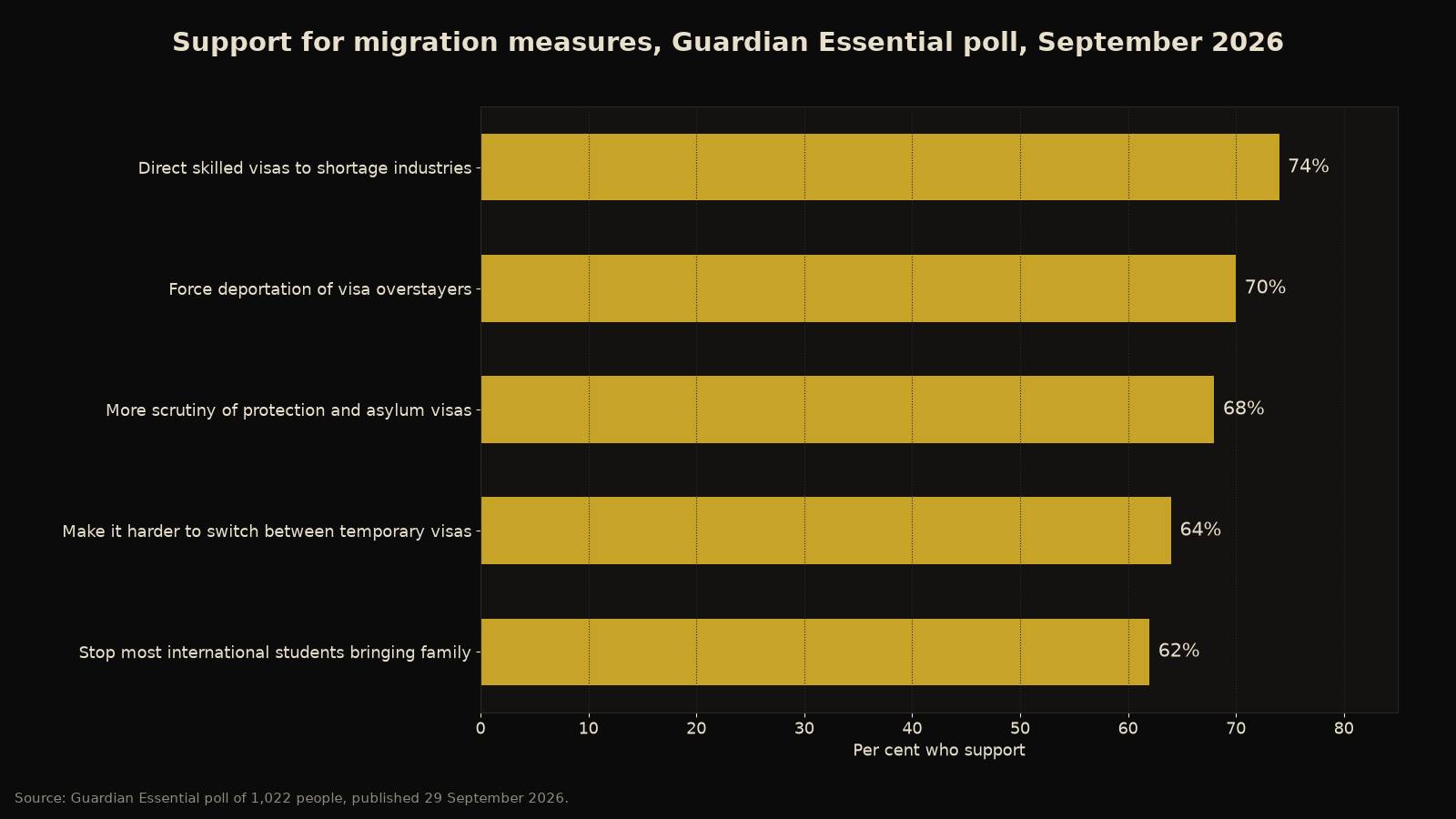
Then came the specific measures. Seventy per cent backed forced deportation of people who overstay their visas. Sixty-eight per cent wanted greater scrutiny of protection and asylum visas. Sixty-two per cent supported stopping most international students from bringing family members to Australia. One Nation and the Coalition have both run with those ideas.
Labor’s measures went down well too. Burke’s plan to make it harder for temporary migrants to hop between visa types to stretch out their stay had 64 per cent support. Steering skilled worker visas toward industries with shortages, like health and construction, had 74 per cent.
Taylor’s floated tying migration numbers to how many new homes get built. But 70 per cent of people said that even if the government built enough homes and expanded services to keep up with population growth, they’d still want immigration cut. That’s a tough number for the Coalition’s approach. It’s a comfortable one for One Nation, which promises cuts no matter what.
Essential’s executive director Peter Lewis doesn’t read the results as a simple swing to the right. “This week’s report shows that while there is support to cut the immigration numbers, there is actually growing numbers who see immigration as positive for the nation,” he said. “The findings suggests it is important not to be dragged into a zero sum game here,” he added, saying “most people want immigration slowed down with clear rules, rather than to stop it altogether.”
Among people who wanted immigration cut further, refugees and family members of people already living here were the groups most often picked for cuts.
Not everyone thinks One Nation’s sums add up. Abul Rizvi, a former deputy secretary of the immigration department, has said Hanson’s deportation model would cost “many, many billions of dollars” and would shut down aged care homes and construction sites, the Guardian reported.
Roy Morgan’s picture
Roy Morgan’s poll, out the same day, used a bigger sample over a longer stretch. It interviewed 2,569 voters from 14 to 27 September.
Labor was on 26 per cent and One Nation on 25.5. The Coalition was on 22.5, made up of the Liberals on 20 and the Nationals on 2.5. The Greens were on 15, and independents and others on 11. Seven per cent couldn’t say who they’d vote for.
Earlier in the month, Roy Morgan’s weekly poll had One Nation narrowly in front, 25.5 to Labor’s 25, which we covered in the AFR Power list story. Across the full fortnight, Labor edged back ahead by half a point. That’s well inside any sensible margin of error. Statistically, the two are level.
Roy Morgan also estimates what happens once preferences are counted, and that’s where Labor’s still in good shape. In a straight Labor versus One Nation contest, it has Labor on 53.5 per cent and One Nation on 46.5. Against the Coalition, Labor leads 52.5 to 47.5 going by how people said they’d direct their preferences, or 52 to 48 using preference flows from the 2025 election. Roy Morgan’s call is that Labor would win a majority if an election were held now.
Where One Nation is strongest
The state breakdown shows where One Nation’s vote is bunched up. Its best state was Queensland, on 32.5 per cent. Its weakest was South Australia, on 18.5.
Labor’s pattern was close to the mirror image. It was strongest in New South Wales on 28.5 per cent and weakest in Queensland on 20.5. So in Queensland, One Nation was polling 12 points ahead of Labor. The Coalition did best in South Australia on 27 and Victoria on 26.5. The Greens’ best state was Victoria on 16, and their worst was NSW on 12.
There’s a big caution with those state numbers. The state samples are much smaller than the national one. Roy Morgan interviewed 506 people in Queensland and only 228 in South Australia. Smaller samples mean bigger margins of error, so take the state figures as a rough guide, not a precise reading.
Even so, the Queensland number matters. It’s Hanson’s home state, and it’s got the most federal seats outside NSW and Victoria. A party polling above 30 per cent there, with Labor near 20, would be in the running for a lot of seats.
The mood
Roy Morgan also asked if the country’s heading in the right direction. Sixty-three and a half per cent said it’s going the wrong way. Only 21.5 per cent said the right way. A majority said wrong direction in every state. It was highest in Western Australia at 70.5 per cent and lowest in South Australia at 56.5.
That kind of mood is good soil for a protest party. The Guardian’s political editor Tom McIlroy made that point in an analysis on Wednesday. “The times suit One Nation more and more,” he wrote. “Pauline Hanson’s ability to reflect voters’ grievances and disillusionment back to them is unrivalled, and nothing is more powerful for protest parties than sustained economic pain for households.”
All four September polls side by side
Line up the four main national polls from September and you get a range, not one answer.
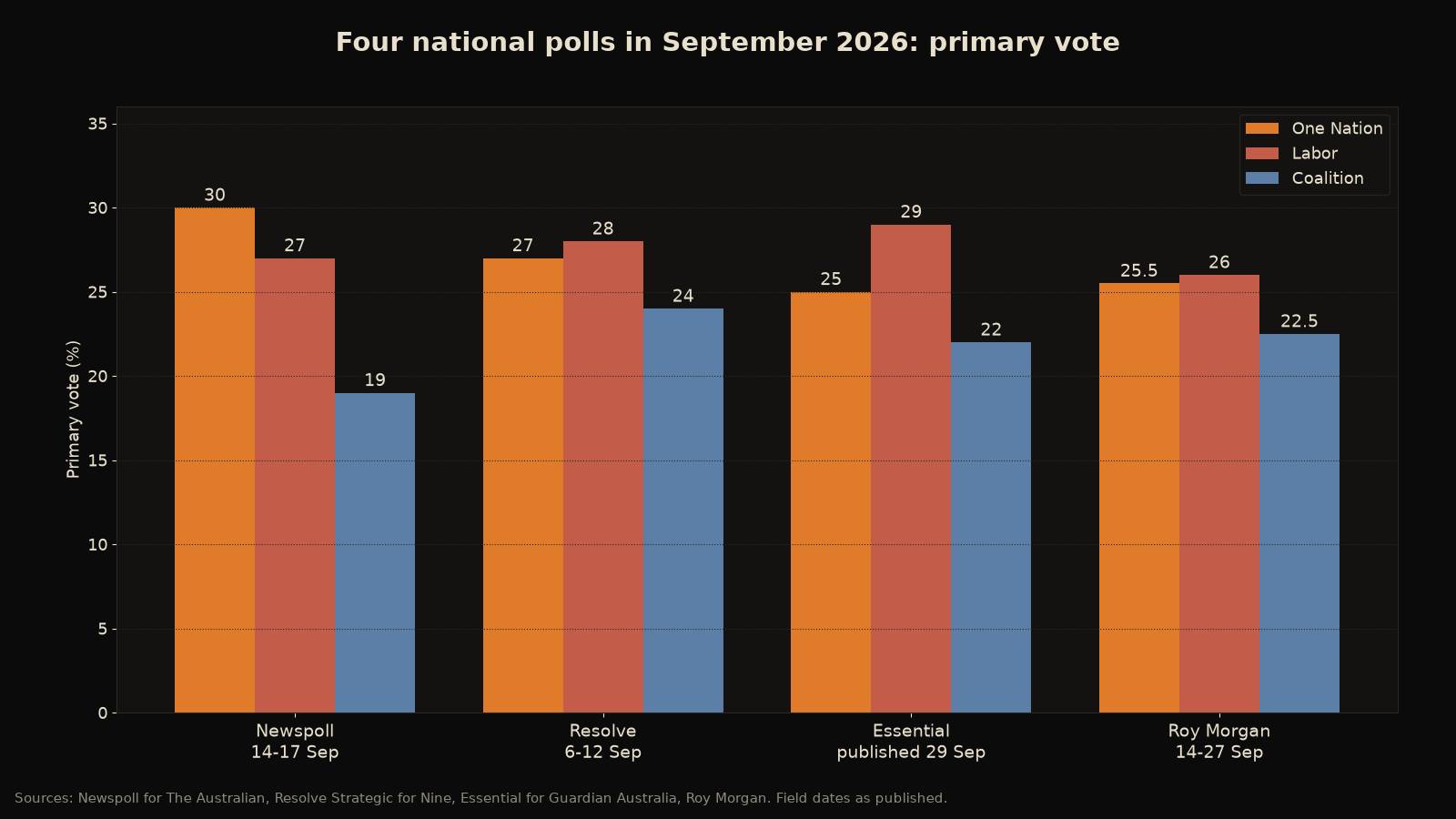
Newspoll, taken from 14 to 17 September among 1,244 voters, had One Nation in front on 30 per cent, Labor on 27 and the Coalition on 19. Resolve Strategic, taken from 6 to 12 September among 2,250, had Labor on 28, One Nation on 27 and the Coalition on 24. Essential has Labor 29, One Nation 25, Coalition 22. Roy Morgan has Labor 26, One Nation 25.5, Coalition 22.5.
So One Nation’s somewhere between 25 and 30 per cent, depending on who’s asking. Labor’s between 26 and 29. The Coalition’s between 19 and 24. Every pollster has One Nation ahead of the Coalition. Of these four, only Newspoll has One Nation clearly ahead of Labor.
The gaps come down to method. Pollsters sample in different ways, some online, some by phone, some a mix. They weight their results differently to match the population. Some push undecided voters harder to pick a side. Those choices matter more than usual when a third party’s polling this high, because there’s less history to check against.
What all four agree on is the shape of the race. It’s a three-way contest. One Nation and Labor are fighting for first on primary votes, and the Coalition’s running third.
Hanson’s own ratings
The polls aren’t all good news for Hanson herself. Newspoll had her approval down three points to 44 per cent and her disapproval up three to 51, after a run of bad press. On Newspoll’s three-way preferred prime minister question, Albanese was on 44 per cent, Hanson on 32 and Taylor on 24. Resolve’s version had Albanese on 29, Hanson on 25 and Taylor on 21.
So people are more willing to vote One Nation than to say Hanson would make the best prime minister. That gap’s common for minor party leaders. It’s also a reminder that a big primary vote doesn’t automatically mean voters see a party as a government in waiting.
Why the timing matters
Both the Essential and Roy Morgan polls were in the field before the Reserve Bank lifted the cash rate to 4.60 per cent on 29 September. Hanson’s response was to call for Treasurer Jim Chalmers to resign, as we reported in her response to the rate rise. The next day, headline inflation came in at 4 per cent for the year to August. And the week before, unemployment had climbed to a near five-year high, McIlroy noted.
Roy Morgan said its next poll would show the impact of the rate decision. If the rate rise hurts Labor, the question is who picks up those votes. On the September numbers, the Coalition isn’t catching much of Labor’s discontent. One Nation is.
There’s a new face to watch as well. The Greens elected David Shoebridge as leader on Wednesday 30 September, after Larissa Waters stood down for health reasons. The Guardian’s Full Story podcast billed his plan as one to beat One Nation and replace Labor. The Greens have been between 11 and 15 per cent across the polls. Whether a more combative Greens leader pulls votes from Labor, from One Nation’s protest vote, or from nobody will show up in the next round of polling.
What it means
Three things stand out from this week’s numbers.
First, One Nation’s August slump looks like a dip, not a turn. It’s back in the mid 20s in Essential and level with Labor in Roy Morgan.
Second, the Coalition is the party in real trouble. It’s third in every poll, and Essential has it at its equal lowest point. On migration, where it’s tried to compete with One Nation, voters say they’d still want cuts even under the Coalition’s housing-linked approach.
Third, Labor’s still ahead where it counts most, after preferences. Roy Morgan has it beating either opponent. That’s because Greens voters and a lot of independents’ voters put Labor ahead of One Nation and the Coalition. For One Nation to win seats in big numbers, it needs either a bigger primary vote or much stronger preference flows from Coalition voters than it gets now. That’s why talk of a Liberal-One Nation understanding keeps coming back.
The next Newspoll and Resolve surveys are due in the coming weeks, along with Roy Morgan’s post-rate-rise numbers. They’ll show whether One Nation’s climb back to 25 is holding, and whether a fourth rate rise and 4 per cent inflation push it higher.
The paper
Comments
No notes on this story yet.
Sign in to comment