
Pauline Hanson, Fatima Payman and Dai Le barely agree on anything when it comes to policy. On Thursday the three women walked into a Canberra press conference together and said the system for handing out political staff is completely broken.
On Thursday, 17 September 2026, One Nation leader Pauline Hanson, independent senator Fatima Payman and independent MP Dai Le stood side by side. They asked Prime Minister Anthony Albanese for a fairer, more open way of handing out personal advisers under the Members of Parliament (Staff) Act 1984. AAP reported that their unity was itself the proof. Modelling they gave journalists had One Nation on 0.83 staff per parliamentarian, against 4.09 for Labor and 1.47 for the Coalition.
Here's how it unfolded. There's the joint press conference and the numbers. There's the August letter Hanson says nobody answered, and the five-member mark for a minor party that she says One Nation now meets. Then there's the history that makes Thursday look so unlikely. That includes their 2024 Senate clash over citizenship, Hanson's "no good Muslims" line in February, and Payman calling out a "certain Queensland senator" on migration just two days earlier.
Start with the claim that set the tone. AAP reported the three told journalists their unity showed the system was "completely broken". It wasn't a policy love-in, and it wasn't a merger. It was three crossbench and minor-party figures who disagree on almost everything, saying the Prime Minister's power over staffing is the problem they share.
Payman put what they have in common this way: "We have different views on almost everything, but what we have all in common is we're all women." AAP carried that quote, and so did The Queenslander's version of the same AAP story by Lucinda Garbutt-Young. Daily Mail's Nicholas Comino ran a close variant: "We have different views on almost everything, but what we have in common is that we're all women." AAP has the joint line. The Conversation, republished by Evening Report, has Payman's longer attack quotes that came next.
The law is simple enough to explain in a few sentences. Federal MPs and senators get electorate staff for their local offices. Separately, they can get personal employees. These are advisers who work on policy, laws, media and politics. The Members of Parliament (Staff) Act 1984 gives the Prime Minister the say over those broad arrangements. The Parliamentary Library's policy brief from January 2026 says that, compared with the UK, Canada and New Zealand, Australia is unique in leaving all of those staffing decisions to the Prime Minister. There's no public set of rules for how personal employees are handed out. The Department of Finance publishes staff numbers three times a year for Senate estimates. That's the bare minimum of openness, and the three say it isn't enough.
Hanson has been pushing this for months. The Nightly's Andrew Greene reported on 28 and 29 August 2026 that Albanese had refused to answer written requests for more advisers. Greene obtained an 11 August letter Hanson sent to Albanese. She wrote that she was putting One Nation's request on the record and asking that the allocation "now be reviewed and updated as a matter of priority." She reminded the Prime Minister she'd already written on 4 February 2026, when One Nation had five federal parliamentarians, four senators and one House member, and that she'd had no reply.
The August letter followed the party's growth. "Since then, David Farley has won the Farrer by-election. We now have six federal parliamentarians: four senators and two members of the House," Hanson wrote, as Greene reported. She said the party had looked again at its earlier request and cut it back a lot, "benchmarking it directly against your allocation to the Australian Greens."
That's the argument about the threshold. Hanson said Commonwealth law treats five members as the mark for a recognised non-government minor party. "The Australian Greens meet that threshold and you have allocated their adviser staffing on that basis," she wrote. "One Nation now meets this threshold." By her count, and by the Daily Mail and Conversation figures used around Thursday's press conference, the Greens have 11 parliamentarians and 17 personal staff positions. One Nation's request in August, as The Nightly reported it, was for nine staff, or 1.5 per MP. That was up from the four advisers it had then for six parliamentarians.
The counts don't quite match from one outlet to the next. The Nightly's late-August story said four advisers for six parliamentarians. Michelle Grattan's piece in The Conversation, republished by Evening Report on 17 September, said One Nation had six in parliament after Farrer and only five staff in total. AAP's modelled figure of 0.83 staff per parliamentarian is closer to five for six. Daily Mail said One Nation's six-member team had five extra staff, against 17 for the Greens' 11. The "four" in the August letter came earlier. The numbers shift, but the complaint doesn't.
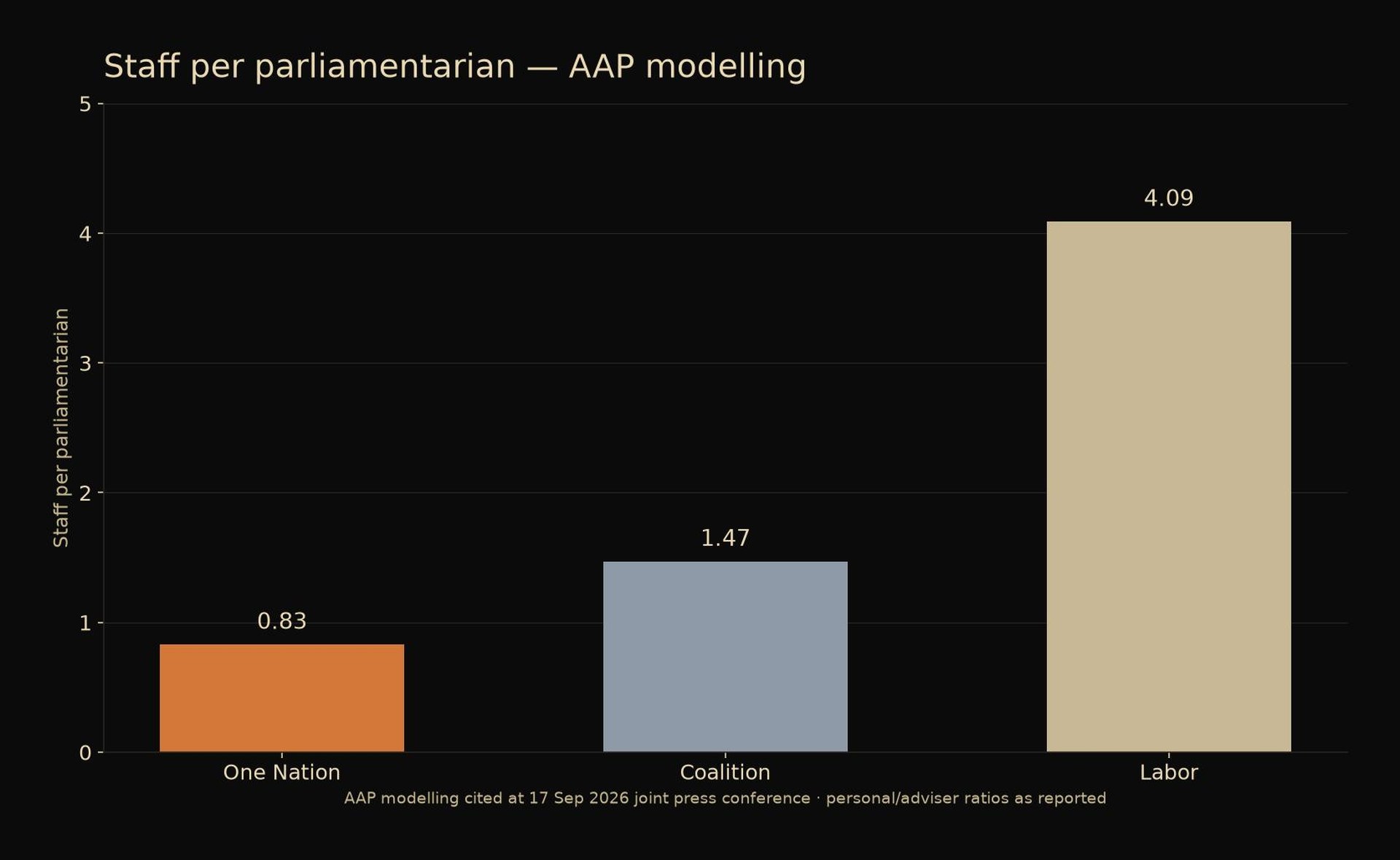
AAP laid the ratios out plainly. One Nation has 0.83 staff per parliamentarian, Labor 4.09 and the Coalition 1.47. Those are the three bars the joint campaign wants voters to see. Politicians hire their own electorate and personal staff, AAP noted, but the Prime Minister has the final say over how many staff each one gets. That's the same point about the 1984 Act, put simply.
Payman's own case is the sharpest one. She quit Labor in mid-2024 over Palestine and now sits as an independent. Grattan wrote that, leaving electorate staff aside, Payman has no personal staff at all. Fellow independents David Pocock and Lidia Thorpe have two each, by Grattan's comparison. Thorpe defected from the Greens. Daily Mail said figures released earlier this year showed Payman was the only independent parliamentarian without a single extra adviser. She's been saying for months that this is discrimination. On Thursday she said it with others beside her.
Le's raw numbers are smaller, but she's still part of the fairness argument. She won the seat of Fowler in 2022 as an independent, taking a seat that had always been safe for Labor. AAP and Grattan both say she has one personal staffer. On Thursday, Le talked about the process, not just the numbers. She told the joint press conference there were "no published criteria, no explanation, no appeal" when it came to staffing.
She went on: "When support is decided that way, it won't be fair, and it won't be seen to be fair. Staffing is not just about a desk in an office. An additional personal staff member strengthens the whole electorate office." Then she listed the work, saying "They can support electorate offices by helping coordinate complex matters, prepare briefings and correspondence, engage with government agencies and stakeholders, and ensure broader issues affecting our community are properly raised in Canberra." That's from Grattan's transcript. It sums up the crossbench case in one breath. Staff help serve the community, they're not just more bodies for a party's war room.
What Hanson said on Thursday matched her letters. She said that for a year "I have been asking, requesting, begging – actually, I have been begging the prime minister to listen to what is happening in my office and to allow me the staff to do my job." AAP carried a shorter version of the same line: "I have been begging the prime minister to listen to what is happening in my office and to allow me the staff to do my job." Grattan has the longer version, with the asking, requesting and begging. AAP has the shorter one.
She kept pressing Albanese on accountability. "I'm calling on the prime minister again: please give us the resources that we need to do the job for the Australian people. You're hurting the Australian people." Then she said, "You said you'd be open and honest, accountable and transparent. You've been everything but." Then she got personal, saying "And therefore, the people are really seeing through this prime minister, who is selfish […] he doesn't give a damn about the people, and he certainly doesn't respect the other elected members of parliament in this place in giving us the resources that we need to do our jobs." Grattan carried those lines, with the gap marked after the word selfish.
AAP's quotes from Hanson on why she thinks One Nation's being held back were blunter still. She accused Albanese of seeing the "writing on the wall" and trying to hold back One Nation's success after it won the Secret Harbour by-election for Western Australia's state parliament earlier this month. "I think it's nasty, and the people are seeing right through this government and through our prime minister. I'm going to keep going with this." That's the link she wants people to make between the state win and the federal fight. Luke Herdegen won Secret Harbour in WA. This isn't a story about that by-election. It's about Hanson using that win as leverage in a federal fight over staff.
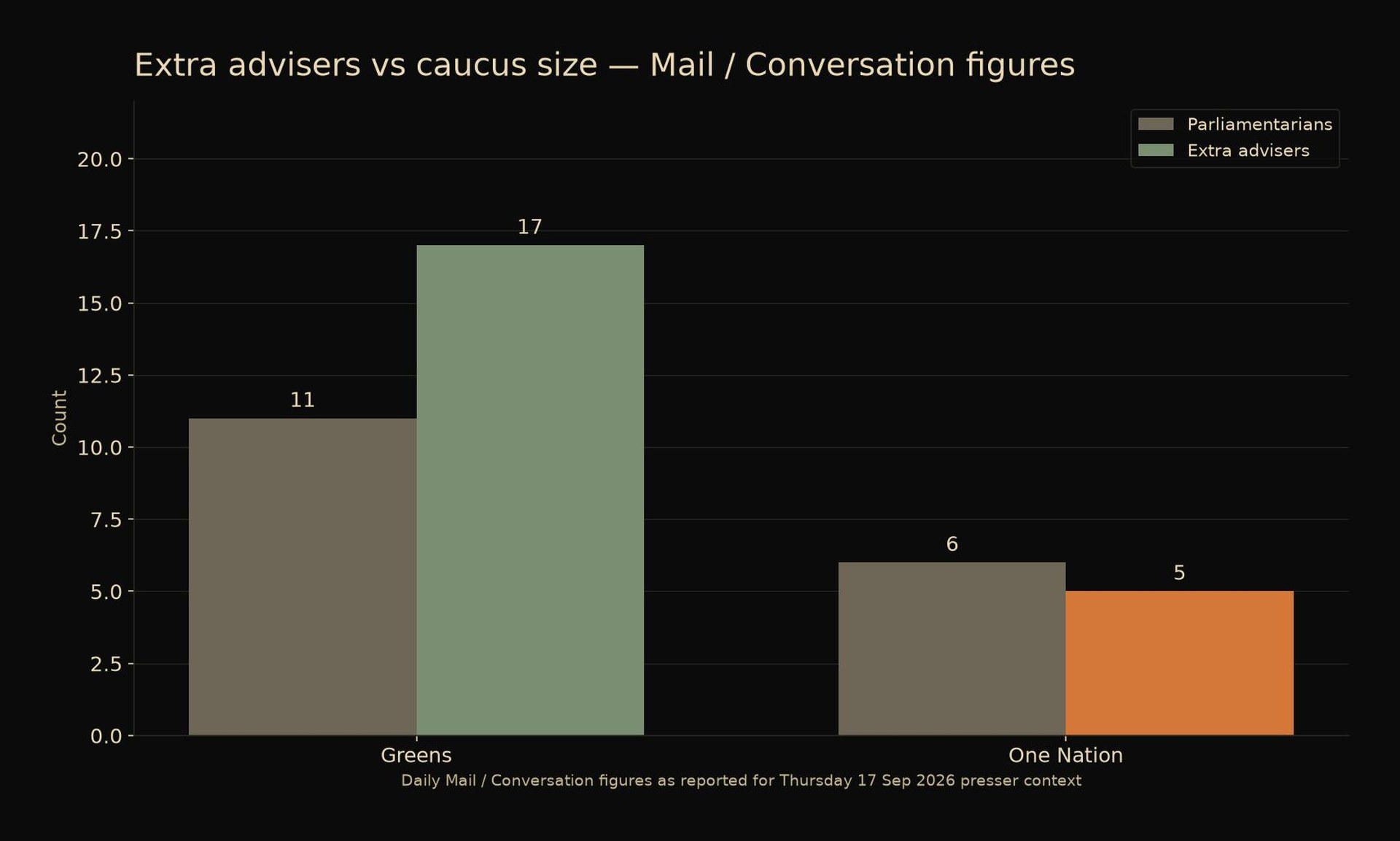
The Greens are the yardstick One Nation keeps holding up. Daily Mail's Comino wrote that the Greens, with one lower-house MP and 10 senators, have been given 17 extra staff. One Nation's six-member team gets five. Grattan led with the growth. One Nation doubled its Senate seats from two to four at the 2025 election, but got no extra staff. After winning the Farrer by-election, it had six in parliament and five staff in total. That's the maths behind the complaint.
The Mail also gave the size of the government and opposition teams. Labor's 124 MPs are backed by more than 500 advisers and ministerial staff, Comino wrote. The Coalition's 68 parliamentarians have 96 extra support staff. Those numbers mix different kinds of staff in one comparison. Political arguments tend to blur ministerial and personal staff, even when Finance's tables keep them apart. What the three want people to see is the gap in support. The government side has plenty. The Greens, as a recognised party, get a party allocation. One Nation says it now clears the same bar and still has very few personal staff.
Payman's attack on Albanese on Thursday was the most personal of the three. Grattan called it highly personal. Here it is, word for word, from The Conversation as republished by Evening Report:
"Australia has heard the prime minister’s recent comments on melons, on Grace Tame, and Kylie Minogue."
"He brags about his female majority caucus and the government’s track record on women’s rights. But are those rights only granted to women who agree with him?"
"I know the prime minister wants to punish me, but he should not be allowed to play favouritism."
"There should be an independent process that guides resourcing when it comes to parliament, not the whim of a petty man."
Daily Mail's version of the same attack was close. Comino wrote that Payman pointed to Albanese's comments calling former Australian of the Year Grace Tame "difficult", remarks involving Japanese Prime Minister Sanae Takaichi, and a podcast where Albanese joked about wanting to "shag" pop star Kylie Minogue. The Mail quoted her like this: "Australia has heard the Prime Minister's recent comments about melons, Grace Tame and Kylie Minogue." Then it quoted, "He boasts about leading a female-majority caucus and points to his government's record on women's rights. But are those rights only extended to women who agree with him?" The wording's slightly different, with "brags" against "boasts" and "granted" against "extended".
Payman also told the room, according to the Mail: "We don't have to agree with each other, but we can come together, join forces, and say we demand better from this government." AAP carried her line about maturity alongside it. "Australians want to see politicians act in a mature way to put their differences aside when it comes to common causes, and we're here demanding transparency from this government." The three accused Labor of trying to punish them for disagreeing with it. That's what ties them together. They say it's punishment, it's favouritism, and there are no published rules.
Now for the history that makes Thursday look strange if you only read the friendly headlines. It's the first time Hanson and Payman have shown a united front, AAP noted. They usually clash on basic policy. A big row broke out on the Senate floor in 2024 when Hanson tried to have Payman investigated over citizenship. Payman called her "vindictive, mean, nasty" as a result. Daily Mail's longer account says Hanson questioned whether Payman was eligible to sit in parliament, because she was born in Afghanistan and had once held Afghan citizenship. Payman accused Hanson of being a "disgrace to the human race". The Mail says Payman also accused Hanson of racism and of spending years spreading hatred and division.
February added another wound. Pauline Hanson said there were no "good" Muslims in a media interview, AAP reported. She then gave a muddled apology, saying "some" Muslims could be good, and meaning those who didn't practise their faith. That remark sits alongside the 2024 Senate fight in their history. It didn't stop Thursday's joint appearance.
Tuesday came even closer to the press conference. Senator Payman called out a "certain Queensland senator" for stirring up a divisive, hate-filled debate on migration, AAP said. She didn't need to name Hanson for the press gallery to know who she meant. Two days later she stood beside her. AAP's closing note on that was dry. None of that seemed to matter on Thursday.
That's the politics of a common cause. It isn't a story about making up, unless they say it is, and they didn't. They talked about staff, about openness and about being women. They left the fights over migration and citizenship on the shelf for an hour.
It helps to lay out the law, so you can see why the request lands on Albanese's desk and nowhere else. The Parliamentary Library brief of 21 January 2026 is called "Allocating parliamentarians' staff: insights from the UK, Canada and New Zealand". It says federal MPs and senators in Australia get staff in two categories, electorate employees and personal employees. Electorate employees help with parliamentary and local work, not party business. Personal employees are basically any extra staff. Subsection 12(2) of the Members of Parliament (Staff) Act 1984 gives the Prime Minister the say over these broad arrangements, including how many staff are employed and on what conditions.
For electorate staff, the Special Minister of State has been handed the power to make some decisions, most recently through the Members of Parliament (Staff) (Employment Arrangements) Determination 2025, the Library notes. For personal staff, there's no public set of rules for how they're handed out. Finance publishes the number and make-up of personal staff three times a year, and tables those figures at the Senate Finance and Public Administration Committee's estimates hearings. The Library also points to its June 2024 analysis of how personal staff have changed over time.
Reformers keep coming back to the comparison with other countries. Compared with the UK, Canada and New Zealand, Australia is unique in letting the Prime Minister decide all parliamentarians' staffing, the brief's key points say. Those other Westminster parliaments mostly use parliamentary processes to hand out staff to non-ministers, either through committees or through the Speaker's office. The UK's Independent Parliamentary Standards Authority, or IPSA, is the only one that sits outside both the government and parliament.
That's the kind of model Payman's pointing to when she says there should be an independent process, not the whim of a petty man. In the quotes carried by The Conversation and the Mail, she didn't name IPSA on Thursday. The Library brief is the public guide to what "independent" can mean in Westminster countries. The UK has Short Money and Cranborne Money for non-government parties. Canada has its Board of Internal Economy and minimum sizes for recognised parties. New Zealand has Speaker's Directions under the Parliament Act 2025. The Library notes that Australia's path under the 1984 Act went a different way from an early view, in December 1983, by the Department of the Prime Minister and Cabinet, that MPs' staff should be controlled by Parliament.
Greens leader Larissa Waters argued last year, as The Nightly recalled in August, that it was "completely inappropriate that minor party and Independent parliamentary staffing is entirely at the discretion of the Prime Minister." Waters isn't one of Thursday's three. Her line shows the complaint isn't only coming from One Nation. Pressure from the crossbench and minor parties has been building from 2025 into 2026. The Library brief says the way staff are handed out has already been the target of a Private Senators' Bill, and of motions in August, September, October and November 2025 to set up a committee inquiry.
The Prime Minister's office declined to comment when The Nightly contacted it for its late-August story on the letter. In the reports from AAP, The Conversation, the Mail and The Queenslander on Thursday's press conference, there was no published reply from Albanese giving the three any new staff. If a formal reply comes later, that'll be a separate story.
Here's the timeline again, so the fight over ratios has dates attached. At the 2025 federal election, One Nation's Senate seats went from two to four, according to Grattan, with no extra staff to match. In early 2026, it had five federal parliamentarians, four senators and one House member, and Hanson wrote her 4 February letter. Then David Farley won the Farrer by-election, and One Nation reached six federal parliamentarians. Hanson's 11 August letter cut back the request, used the Greens as the yardstick and argued the five-member mark. In late August, The Nightly reported she'd had no reply and the Prime Minister's office had no comment. In early September, One Nation's Luke Herdegen won Secret Harbour in WA's state parliament, and Hanson later linked that win to what she calls the federal crackdown. On Thursday 17 September came the joint press conference with Payman and Le.
Farrer and Secret Harbour are in different parliaments. Farrer is federal, and Secret Harbour is in Western Australia's state parliament. Hanson mixes them together in her political argument, as momentum for One Nation and pushback from Albanese. But it's worth keeping the legal side separate when you hear her quotes. The 1984 Act covers federal personal staff. Staffing in WA's parliament isn't what Thursday's request asks Albanese to fix. The six federal parliamentarians and their five staff are.
Payman leaving Labor in mid-2024 is the other big change on the independent side. She left over the government's position on Israel and Gaza, Grattan and the Mail both note. Since then she's complained constantly about discrimination over personal staff, Grattan wrote. Thursday was the first time that complaint stood alongside Hanson's and Le's. The Mail says Payman argued the system gives the government huge power over its political opponents. That's her claim about the system. Her personal claim is that she's being punished for quitting and for disagreeing.
Le's win in Fowler in 2022 still shapes how her one staffer looks. Fowler had been a Labor stronghold. Winning it as an independent put her on the crossbench, with local voters whose expectations don't shrink just because she has so few personal staff in Canberra. Her Thursday quotes treat an extra personal staffer as extra help for her electorate office, with briefings, government agencies and community issues raised in Canberra. She doesn't treat it as a party research unit. That's a different focus from Hanson's argument about the minor-party threshold. It was the same press conference, but a different idea of what's going wrong.
The line about all being women is doing political work. Payman said Australians want politicians to act maturely and put differences aside for common causes. She also said what they share is that they're all women. That sits next to her attack on Albanese for talking up his female-majority caucus. Her charge is that his support for women is selective, with rights and respect for women who agree with him and punishment for women who don't. She named his comments on melons, Grace Tame and Kylie Minogue as evidence. That's her case against him. The request for staff is the actual ask.
Hanson, for her part, sticks to resources and respect for elected members. She talks about begging, about being heard, and about doing the job for the Australian people. She calls the crackdown after Secret Harbour nasty, and says people are seeing through the Prime Minister. She doesn't need Payman's argument about women to make her case. She uses the Greens comparison and the unanswered letters. But on Thursday she shared the stage anyway.
If you're keeping track of who said what about whom before Thursday, AAP has the clearest short list. In 2024, Hanson tried to have Payman investigated over citizenship, and Payman called her vindictive, mean and nasty. The Mail adds that Payman called her a disgrace to the human race and accused her of racism and spreading hatred. In February 2026, Hanson said there were "no good Muslims", then gave a muddled apology about "some" Muslims who don't practise their faith. On Tuesday 15 September, Payman talked about a "certain Queensland senator" and a hate-filled migration debate. On Thursday 17 September, they held the joint press conference on staff. AAP's point is the contrast. Their policy disagreements didn't disappear. The staffing complaint was just enough for them to share a microphone.
So what did they actually ask for? They want fairer allocations and more openness. Payman wants an independent process. Le wants published rules, explanations and a way to appeal. For Hanson, the concrete ask in August was nine personal staff, based on what the Greens get, after earlier, bigger requests she says she cut back. What they said on Thursday, as reported, was more about the broken system and the begging than about any new number announced at the podium. The letters still have the number.
Here's what they didn't ask for, going by the quotes in these reports. They didn't ask for a change to how electorate staff are worked out. They didn't propose merging their offices, a confidence motion or a joint ticket. This was a request for staff with a show of unity attached. Or a principle of unity, if you take Payman's line about maturity at face value. You can decide whether it was a stunt or a principle. The facts of the staffing fight stand either way.
A note for readers overseas. Australia's federal parliament sits in Canberra. Fowler is a House seat in western Sydney. Farrer is a huge regional and rural House seat in NSW. Distances and seat maps don't change the point about the Prime Minister's power. They just put the names on the map.
Go back to the UK for a moment, because that's the clearest contrast the Parliamentary Library draws. Since 2009, IPSA has run the scheme that pays for staff and business costs for MPs in the House of Commons. Before that, Commons MPs voted on government motions based on recommendations from the Members Estimate Committee. Members of the House of Lords don't get staff as part of their entitlements. Separately, non-government parties in the Commons get Short Money, which is funding that can pay for extra staff. It's been set by a House resolution since 1975, with minimum and maximum levels since 2016. The Lords have run a similar Cranborne Money scheme since 1996. Oversight sits with parliamentary committees chaired around the Speakers, not with the Prime Minister alone. That's what "not the whim" looks like in another Westminster capital.
In Canada, the House of Commons Board of Internal Economy hands out parliamentarians' staff through the Members' Allowances and Services Manual. The Speaker chairs the Board, it balances government and opposition members, and it includes the Leader of the Opposition or someone they choose. Recognised parties need 12 or more sitting MPs to get funding for National Caucus Research Offices. The Library brief notes that this threshold recently hurt Canada's New Democratic Party, when it fell from 24 MPs to 7 at the 2025 election. The Bloc Québécois has also criticised the process. In Canada's Senate, research money grows with the number of members, and minor parties need at least five members. Five will sound familiar if you've just read Hanson's August letter. It isn't the same law. But it's the same kind of counting to decide who gets recognised.
New Zealand's Parliament Act 2025, in force since November 2025, makes the Speaker decide on support services, including staff, through Speaker's Directions, which were most recently updated on 5 August 2025. A Parliamentary Service Commission with members from the parties advises the Speaker. Recognised parties get funding for extra staff based on how many members they have, with extra for leaders. Independent members don't get it. So independents in Wellington sit outside that party system. That matters when you hear Payman and Le argue as independents in an Australian system that also leaves them relying on the Prime Minister's decisions about personal staff.
The Library's conclusion is careful. There's no standard rule across Westminster parliaments, and the methods are argued over everywhere, including here. As early as December 1983, the Department of the Prime Minister and Cabinet argued that MPs' staff should be controlled by Parliament. The 1984 Act went a different way. Switching to an independent model like IPSA would be a big change. Before April 1984, the Remuneration Tribunal used to advise on staffing allocations. The Independent Parliamentary Expenses Authority, set up in 2017, and the Independent Parliamentary Standards Commission, set up in 2024, show the public focus on openness in related areas. Thursday's press conference is part of that longer reform argument, whether or not Albanese sees it that way.
The Private Senators' Bill and the motions for a committee inquiry between August and November 2025, which the Library points to, show this fight didn't start on Thursday. Waters' "completely inappropriate" line last year didn't start it either. What Thursday changed was who was in the picture. Hanson and Payman stood in the same shot. Le made the case for rules and appeals. And AAP called their unity itself evidence of a broken system, because these three don't usually share a cause.
Comino's piece in the Mail also stresses the turnaround. Hanson found an unlikely ally in Payman, who once called the One Nation leader a disgrace to the human race. Standing side by side in Canberra to take on uneven staffing allocations marked a big turnaround after years of public clashes. That's the Mail's angle. Grattan's is cooler. Usually, she wrote, they wouldn't be seen dead together. Both angles are colour. The staffing numbers are the core of the story.
On what advisers actually do, the Mail's explainer helps if you only know about electorate officers. Every federal MP and senator gets electorate staff to help run their local offices, but the Prime Minister decides how many extra advisers go to each person across Parliament. Those advisers handle policy, research on laws, media and political strategy. That's why having no personal advisers, as Payman does, or just one, as Le does, hurts more than a simple argument about who's got the bigger office.
Hanson's link to Secret Harbour is worth one more plain sentence, so it doesn't get mixed up with other stories about that by-election. She said Albanese saw the writing on the wall and was trying to hold back One Nation after its win in the WA state by-election earlier this month. AAP carried that. It's Hanson's claim about federal staffing, using the state win as political background. They're separate stories in the same month, with different facts.
The Muslim comments in February and the migration swipe on Tuesday only matter as background to the relationship. They explain why reporters in the gallery called the alliance "unlikely". They don't change subsection 12(2). They don't change how often Finance publishes its figures. They don't change the Greens' 17 or One Nation's five, as reported for this press conference. They just change how surprising the photo looks.
Payman's "petty man" line will travel further than Le's words about process. That's how the sharpest line always travels. But Le's "no published criteria, no explanation, no appeal" is the line about how the system should work. If reformers write a bill after this week, those three points are the ones that fit an IPSA-style or Speaker-run alternative. Hanson's begging is the human line. Payman's run through melons, Tame and Minogue is the attack line. All three were on the record on Thursday.
AAP's Mick Tsikas photographs showed the three together and Hanson speaking.
A word on religion in the headlines. AAP and The Queenslander used "Muslim senator" in their headlines, while the story itself named Fatima Payman. Her faith is part of her earlier clashes with Hanson. It isn't part of the staffing fight. The staffing fight is about allocations under the 1984 Act.
Here are the numbers that matter. The modelling on Thursday put One Nation at 0.83 staff per parliamentarian, the Coalition at 1.47 and Labor at 4.09. The Greens have 17 extra staff for 11 parliamentarians, and One Nation has 5 for 6. Payman has no personal staff, Le has one, and Pocock and Thorpe have two each, by Grattan's comparison. In August, One Nation asked for nine, based on what the Greens get, after a February letter, sent when it had five parliamentarians, went unanswered, by Hanson's account. Its Senate seats went from 2 to 4 in 2025 with no extra staff. It has had six federal parliamentarians since Farrer. And under the 1984 Act, the Prime Minister decides. That's the core of it.
Sources: AAP's "Pauline Hanson, Muslim senator join forces for staffing" story of 17 September 2026. Michelle Grattan's piece in The Conversation, republished by Evening Report the same day. Nicholas Comino's Daily Mail Australia report the same day. Lucinda Garbutt-Young's version of the AAP story in The Queenslander. Andrew Greene's report in The Nightly on 28 and 29 August 2026 about the February and August letters. The Parliamentary Library policy brief of 21 January 2026 on allocating parliamentarians' staff, including its account of how the 1984 Act works. Where outlets disagree on exactly how many advisers One Nation had between late August and mid-September, we've set out the difference above rather than averaging it into a number that looks more precise than it is.
One more word on the ratio chart, so nobody mistakes the modelling for an official Finance table. AAP said "according to modelling" when it reported the 0.83, 4.09 and 1.47 figures. In the text carried here, it didn't publish how the modelling was done. Finance's personal staff figures, published three times a year, are still the official count for estimates. If you need exact official totals, go to the Finance documents tabled in parliament. If you want the political fight as it played out on Thursday, the modelled ratios are what journalists were given.
The same caution goes for the Mail's line about Labor having "more than 500 advisers and ministerial staff". That lumps different kinds of staff together. Ministerial staff and personal staff aren't the same thing in Finance's terms, even when politicians lump them together in an argument. The comparison of the Greens' 17 with One Nation's 5 is the fairer like-for-like comparison of personal staff, and the Mail and The Conversation both used it for this press conference.
So where does this leave Albanese? Going by the public reporting up to Thursday evening, he has unanswered letters from February and August, by Hanson's account, a no-comment from his office in late August, and three women at a press conference accusing him of punishment, favouritism and running a broken system. Payman called him a petty man. Hanson said he doesn't give a damn. Le said there's no appeal. Those are their words. His reply, if it comes with numbers attached, will be the next chapter.
Until then, Thursday's demand stands. They said the system is completely broken. They have different views on almost everything, and they're all women. Hanson's begging for staff, and Le says there are no published rules. One Nation has five staff for six parliamentarians, against seventeen for the Greens' eleven. A senator who quit Labor has no personal advisers, and the member for Fowler has one. And it all sits with the Prime Minister under a 1984 Act, in a way the other Westminster parliaments the Library looked at don't do it.
More from The Gold Standard: If I've offended people, A volunteer the tribunal named and Hastie called them lying cowards.
The paper
Comments
No notes on this story yet.
Sign in to comment