
Senator Alex Antic won the South Australian Liberal presidency on Saturday, then said out loud what a lot of Liberals still treat as a private argument: the Coalition and One Nation will probably need some sort of understanding if they want to form government.
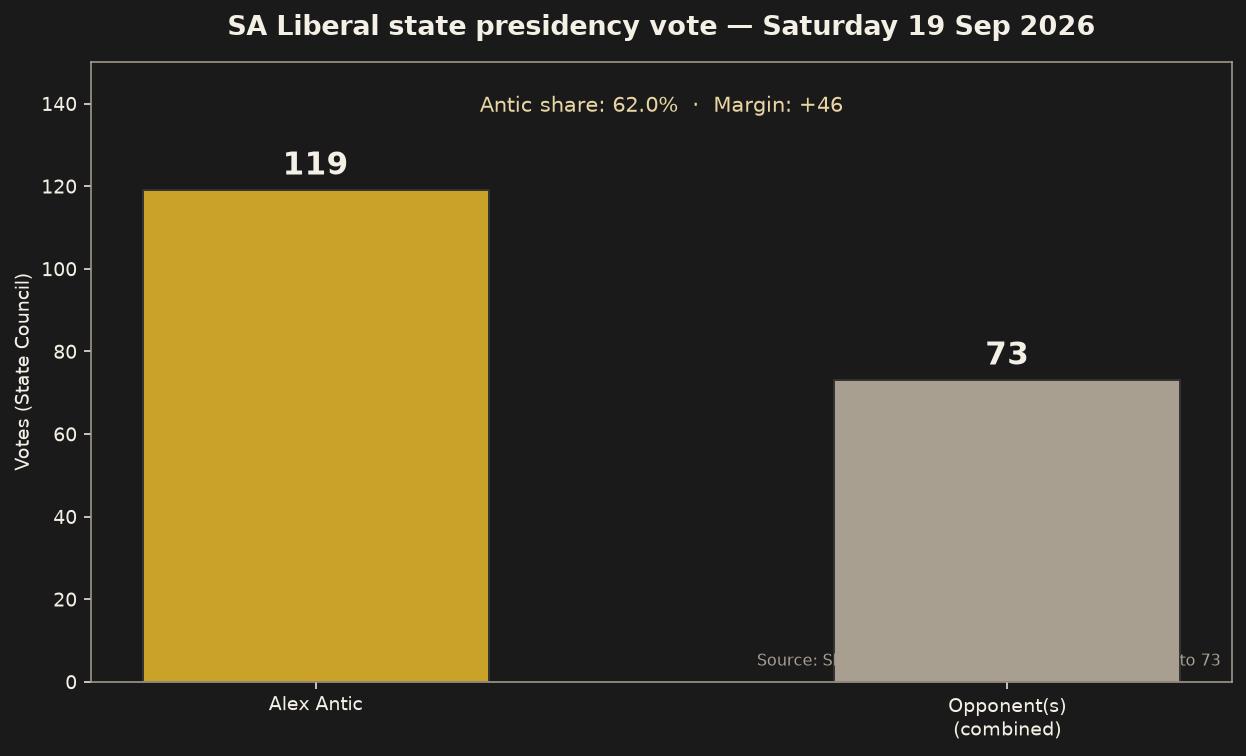
Here's what happened. On Saturday, 19 September 2026, Antic beat the establishment ticket 119 votes to 73 for the state presidency. On Monday he spoke to Reality Check Radio with South Australian interviewer Michael Arbon. On Tuesday, 22 September 2026, One Nation MP Barnaby Joyce told News24 he had spoken that morning to "very, very senior Liberals" about confidence and supply for a minority Coalition under Angus Taylor. Paul Sakkal's Sydney Morning Herald piece landed the same evening at 7:21pm — the public file that ties the two days together.
You might have missed this part. Antic did not claim he was speaking for the Liberal Party. He said the opposite. "That's my personal view, that's not the view of the Liberal Party." Taylor, asked about the presidency win on Tuesday, called it a democratic process and said he wanted a South Australian division that was election-ready. He has repeatedly said there will be no commitment to work with One Nation in any sort of coalition or seat-sharing arrangement.
So the week is not a signed deal. It is a presidency vote, a radio interview, a News24 answer, and a Newspoll backdrop that makes the arithmetic hard to ignore. One Nation on 30. Labor on 27. The Coalition on 19. The Greens on 13.
Start with the vote, because the radio comments only matter if Antic actually holds the chair. Sakkal reported Antic triumphed by 119 votes to 73 on Saturday in a battle for the presidency of the state division that pitted him against establishment figures from the moderate and conservative factions who were desperate to defeat the hardliner. That is not a narrow squeak. That is a clear State Council majority.
The presidency is not a backbench hobby. The SA Liberal president helps oversee campaign preparations, sits on candidate review, and sits on the state and federal executives. As state president, Antic now sits on the federal executive that would be required to make any call on intervention into the South Australian division. That is why Canberra was watching the count before the radio clip ever landed.
ABC state political reporter Thomas Kelsall mapped the fight earlier, on 2 August 2026, when Antic was still the only declared nominee and moderates were already talking about federal intervention on the NSW model. Kelsall quoted a moderate source saying all roads led to federal intervention and that the federal party needed to take control and establish a state division equipped to campaign to win elections. Conservatives told Kelsall the opposite story: Antic running for president was effectively a referendum on whether the Liberal Party is a conservative party.
The August file matters because it shows the presidency fight was not a surprise. Antic had already been recruiting. Kelsall reported that over recent years Antic's recruitment of evangelical and Pentecostal members — people turned off by progressive stances on euthanasia and abortion under the former state Liberal government of Steven Marshall — had shifted State Council. Moderates lost control of Morialta SEC and Sturt FEC in delegate elections. Former SA Liberal leader Isobel Redmond stood for a delegate position in Sturt and lost to a Right-aligned candidate. That is the machine behind 119–73.
Then Monday. Antic has avoided speaking with mainstream media, which he rejects, since winning on Saturday, Sakkal wrote. On Monday he spoke to Reality Check Radio. Sakkal's description of that outlet is part of the public record: it produces documentaries on the dangers of fluoride in drinking water and "worldwide digital currency" designed to stop people with right-wing opinions from buying goods and services. That is the room Antic chose for his first extended remarks as president.
The interviewer was Michael Arbon, a South Australian finance professional who until recently worked for United Australia Party senator Ralph Babet. Antic's opponents in South Australia believe Antic will push for Arbon to replace Senator Leah Blyth, Sakkal reported. Blyth, the outgoing Right-aligned president on Kelsall's August frame, is leading a push for the federal executive to take over the South Australian division. The radio quotes are the news peg.
Antic cited the latest Newspoll showing the Coalition primary at 19 per cent as proof One Nation was "here to stay" and that it was pointless for the Coalition to take "pot shots" at Hanson.
"The reality is, I think in most likelihood there is going to have to be some sort of understanding, some sort of co-operation," he said. "The political reality of this is that there is going to have to be some sort of understanding in some sort of format between the Liberal Party and One Nation, I believe, in order to form government."
Read that twice. "Some sort of understanding." "Some sort of co-operation." "In some sort of format." He is not naming a signed coalition agreement. He is naming the arithmetic. And he hedges: personal view, not the Liberal Party's view.
He also emphasised that Taylor was on the right path in restoring life to the Liberal Party. That line sits next to Taylor's public position — no commitment to work with One Nation in any sort of coalition or seat-sharing arrangement — and it is the tension the week keeps returning to. Antic praises Taylor's rebuild while arguing the rebuild still needs a deal structure with the party sitting above the Coalition on the primary.
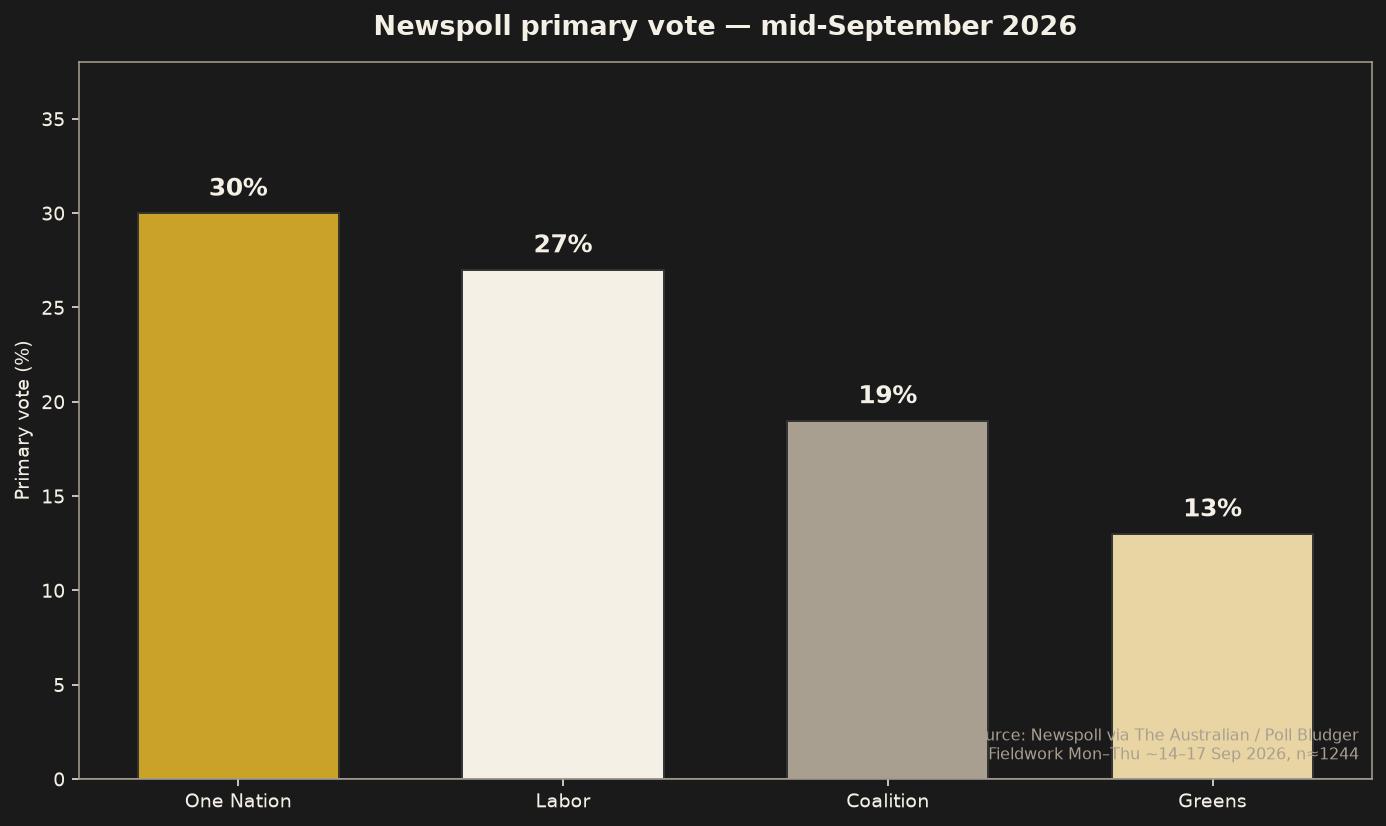
The poll numbers are not decorative. William Bowe at Poll Bludger summarised The Australian's Newspoll on Sunday, 20 September 2026, with Monday updates in the thread. One Nation held steady on 30 per cent. Labor fell two points to 27 per cent. The Coalition stayed on 19. The Greens stayed on 13. The poll was conducted Monday to Thursday from a sample of 1244.
Nine's Yashee Sharma, writing early Monday 21 September 2026, put the Labor primary in historical frame: 27 per cent — one point from the party's lowest Newspoll level under Julia Gillard in 2012. Albanese's net approval hit minus 27, with 35 per cent satisfied and 62 per cent dissatisfied. Preferred prime minister was almost level: Albanese 42, Taylor 41, with 17 per cent uncommitted on Nine's read. Poll Bludger's three-way preferred-PM measure had Albanese on 44, Hanson on 32, Taylor on 24. Hanson's personal ratings cooled a bit — approval down three to 44, disapproval up three to 51 — but the primary did not move.
Antic's radio argument leans on that 19. If the Coalition primary is stuck there, he says, pot shots at Hanson are pointless. One Nation is here to stay. The understanding has to come in some format. That is the claim. Whether you buy it depends on whether you think primaries this far from an election write the ministry list. But the numbers he is pointing at are real, published numbers.
Sakkal notes another Antic line: the Coalition should learn from the way Labor used the Greens to win support for its legislative agenda. Then Sakkal adds the counter that Antic did not mention. Labor benefits from the Greens in part because the Greens primary sits well below Labor's, so Labor often wins seats on Green preferences. One Nation is ahead of the Coalition on this Newspoll. That is a different map. A party on 30 sitting above a party on 19 is not the junior partner in the old Labor–Greens sense. It is a rival that can take seats in its own right.
That is why the presidency win and the radio clip land as one story. Antic is not a fringe blogger. He is a federal senator, the new SA Liberal president, and now a federal executive member arguing, in his personal capacity, that the Liberal Party and One Nation need an understanding to form government. Conservative powerbrokers in Canberra have fallen out with him and fear he is angling to create closer ties with One Nation, Sakkal wrote. Hanson's federal leadership and Cory Bernardi's state One Nation leadership have good relations with Antic on that reporting. Antic was pictured shaking hands and smiling with Hanson in the Senate last week, and has never ruled out defecting to One Nation when asked.
Tuesday brings Joyce.
In an interview on News24, Joyce said One Nation would probably offer the Coalition support to form a government in the scenario that Taylor won enough seats to form a majority with the help of One Nation. The phrasing in Sakkal's copy is careful: enough seats to form a majority with One Nation's help — the minority-government logic of confidence and supply, not a claim that Taylor is currently on track for a majority on Coalition numbers alone. Sakkal also notes the polls suggest that path is unlikely. The interview is still the first hard public claim this week that talks about that path are already happening.
"We've said our job is to get rid of the socialists. So either we offer supply and confidence to the Coalition, and obviously on the premise of solving the policy outcomes that we would want for that to happen, and we would want there to be clear acknowledgement that they are our policy outcomes," Joyce said.
"I will say I've had discussions as recently as this morning with very, very senior Liberals about precisely this."
That second sentence is the one that travels. Not "people in the party room." Not "sources." "Very, very senior Liberals." "As recently as this morning." "Precisely this" — meaning supply and confidence, with One Nation policy outcomes acknowledged.
He did not name the Liberals. Sakkal's piece does not name them either. Taylor's office is not quoted confirming the talks. So what is on the record is Joyce's claim, the News24 setting, and the same-day SMH write-up. Treat it as a claim with a timestamp, not as a signed memorandum.
What does confidence and supply actually mean here? In Australian practice it usually means a smaller party or independents agree to support a government on budget bills and against no-confidence motions, without joining the ministry. Joyce's version adds a price: clear acknowledgement of One Nation policy outcomes, and a regimen of looking at legislation that comes forward. In comments circulating the same night on Poll Bludger's thread, Joyce is also reported saying One Nation would expect the same deal if it had greater numbers than the Coalition. That reciprocity line matters if the primary order holds toward 2028. Who props up whom depends on who wins more seats.
Taylor's public line has not moved toward Antic's understanding. He has repeatedly said there will be no commitment to work with One Nation in any sort of coalition or seat-sharing arrangement. Sakkal adds the practical rider: it is still likely the parties will preference each other ahead of Labor, as right-wing parties have done before, and as Labor swaps preferences with the Greens. Preferences are not a ministry. They are how Australian lower-house contests usually finish when no one clears 50 on first preferences.
Asked about Antic's election on Tuesday, Taylor told reporters: "Sure, it's a democratic process and he won the vote." He deflected a question on federal intervention, saying instead that he wanted to see "a South Australian division that's election-ready." That is the leader's public box: accept the count, demand campaign readiness, do not endorse the radio thesis.
Background from March helps you hear what is new and what is not. On 25 March 2026, Dan Jervis-Bardy reported for Guardian Australia that Pauline Hanson wanted to work with the Liberals and Nationals — including on preference deals — to defeat Labor, and had offered to prop up a future minority Coalition government. She ruled out an official coalition. "I will not form a coalition with them, where I will be told what I can say, what I can do, what policies I can put up like they've controlled the National party and shut them down. I will get them supply and I will give them confidence. Don't ever try and tell me what I can and can't do," she said at a Minerals Council event.
So Hanson, in March, already put supply and confidence on the table and ruled out formal power-sharing. Joyce, in September, says discussions with very senior Liberals about precisely that structure happened that morning, with policy acknowledgement attached. Antic, the same week, says from inside the Liberal organisation that some sort of understanding will be needed to form government. The March Hanson line is background. The September Antic–Joyce sequence is the fresh file.
Murray Watt, speaking at the same March Minerals Council event on the Guardian's reporting, said the Liberals and One Nation could only form government together in the new era. "So a vote for the Liberals is a vote for the chaos and division of One Nation and a vote for One Nation is a vote for more Liberal cuts," Watt said. Labor will keep that frame warm if Antic's understanding talk becomes the Liberal brand.
Inside the SA Liberals, the intervention fight is the other half of the presidency story. Blyth is leading a push for the federal executive to take over the South Australian division Antic now controls. Sakkal reported last month that Antic's forces were pushing internally to purge a swath of members including former foreign minister Alexander Downer. Top conservative powerbrokers in Canberra said then that Antic's actions had not yet reached the legal threshold to warrant intervention. But MPs from Taylor's right faction are watching for signs Antic is unrestrained. And now Antic, as state president, sits on the federal executive that would vote on any intervention. That is a structural fact, not speculation.
Kelsall's August piece quoted Liberal elder Trish Worth, who represented federal Adelaide from 1993 to 2004, calling Antic's suggestion of a coalition with One Nation in South Australia "extraordinary and bad." Worth said someone like that standing for an important Liberal position was way out of line. Antic, asked by the ABC about Worth and about Nine reports he was angling for a merger with One Nation, said: "It's not up to me to correct the record. Stop wasting my time." Separately on the 2 Worlds Collide podcast he called the merger reports made up and "outright not right," noting even strong right-leaning Liberals would have a problem with a merger and that financial complications would follow.
A merger is one thing. Preference swaps are another. Confidence and supply is a third. A formal coalition with shared cabinets and message discipline is a fourth. Hanson ruled out the fourth in March. Antic on Monday talked about understanding and co-operation in some format — personal view. Joyce on Tuesday talked about supply and confidence with policy acknowledgement and claimed senior Liberal discussions. Taylor keeps ruling out coalition and seat-sharing. Those are four different instruments, not one scare line.
What about the Senate picture that keeps getting attached to Antic? Sakkal lists the senator's recent campaigns: against flu vaccinations, while endorsing Malcolm Roberts, and criticising powers given to ASIO. Kelsall's August file adds the June bird-flu aside Antic himself called off the cuff, which Ashton Hurn publicly rejected, and the pre-election beer with Cory Bernardi. None of that is this week's presidency count. It is why moderates treat the presidency as a brand problem for Taylor and Hurn, and why conservatives treat it as proof the membership wants a harder edge.
Ashton Hurn leads the state parliamentary party with a tiny lower-house rump after the March 2026 state election. Kelsall noted the Liberals were left clinging to opposition status with just five seats and a primary vote four points below One Nation's. That state result is the local proof-of-concept for the federal Newspoll order Antic is pointing at. In South Australia, One Nation already outpolled the Liberals. Antic's pitch to lost Liberal voters, via a conservative source in Kelsall's piece, was simple: Antic signals to those people it is okay to come home.
Whether "come home" means Liberals reclaiming One Nation voters, or Liberals learning to govern beside One Nation, is the fight inside the word "understanding." Antic's Monday quotes lean toward the second reading. Taylor's public commitments lean toward fighting for the first without a coalition deal. Joyce's Tuesday quotes assume a world where One Nation can choose to prop up a Taylor minority — or, if the seat order flips, expect the reverse.
Headtopics and other Monday–Wednesday roundups repeating the Joyce News24 answers add little beyond Sakkal on the Liberal names. They confirm the interview happened, that Joyce framed the choice as One Nation governing alone versus needing Liberals and Nationals, and that he put senior-Liberal discussions on the record. No primary outlet we checked published a full transcript of the News24 interview by Wednesday morning, 23 September 2026. No official YouTube clip of that specific Tuesday interview was sitting in a clean public listing we could verify for an embed. So the quotes travel through SMH and the wire-style roundups, not through a house-checked video file.
Newspoll's personal ratings give Taylor a small lift even while the Coalition primary sits on 19. Poll Bludger reported his net rating improved from minus 17 to minus 15, with approval up two to 35 and disapproval steady at 50. Preferred PM against Albanese narrowed to 42–41 on the two-way. That is why Antic can praise Taylor's path while still arguing the party needs an understanding with One Nation. The leader's personal numbers are not the same as the party's primary. Antic is talking about the primary.
Labor's response on the poll itself, from Nine, was Tanya Plibersek calling the numbers "not great" while saying the government was focused on making a difference in people's lives. Albanese, in New York for the UN General Assembly when Nine filed, was asked whether he was a "fraud" accepting a global-citizen award while losing popularity at home. "No," he said, and moved on. One Nation's statement, per Nine, said the latest wave of coordinated attacks by the establishment did not seem to have had much effect. That is the partisan weather around the 30–27–19–13 board. It is not a substitute for the Antic and Joyce quotes.
Antic's understanding talk and Taylor's seat-sharing refusal can sound like the same argument. They are not. In a House of Representatives contest, every candidate is ordered on the ballot paper by the voter. Parties issue how-to-vote cards that recommend an order. When Labor and the Greens swap recommendations ahead of the Coalition, that is preference co-operation without a shared cabinet. When Liberals and One Nation put each other ahead of Labor, that is the same tool on the other side of politics. Seat-sharing is different: parties agree not to run against each other in selected seats so one conservative candidate faces Labor. A formal coalition is different again: shared ministry, shared messaging rules, shared binding votes. Confidence and supply sits in the middle strip — separate parties, separate brands, agreed votes on money bills and confidence, plus whatever policy price is written down.
Taylor's standing refusal covers coalition and seat-sharing. It does not, on the public quotes this week, ban mutual preferences ahead of Labor. Sakkal treats that preference path as likely. Antic's Monday language goes further than preferences. "Form government" is the phrase. Understanding "in some sort of format" is broader than a how-to-vote card. Joyce's Tuesday language is explicit about supply and confidence and about policy acknowledgement. If you only hear "work with One Nation," you mash three different instruments into one scare line.
Andrew McLachlan, a South Australian Liberal senator, put the hard preference case from the other direction in March on the Guardian's file. He said One Nation was "not our friends," called the SA preference refusal an "act of war" that helped widen Labor's margin, and argued Liberals should preference One Nation last if they held to Liberal values on a multicultural nation. That March McLachlan line is the mirror of Antic's September understanding line. Same state division. Opposite instincts. The 119–73 presidency result tells you which instinct currently has the State Council numbers.
The SA state election result in March 2026 is the local stress test. Kelsall reported Liberals on five seats and a primary four points below One Nation. The ABC had called Ngadjuri for One Nation, with MacKillop, Narungga and Hammond also favoured for the party on that March reporting. Federal Liberals watched an SA-style collapse as a national warning. Taylor, in closed-door party room meetings that week per the Guardian, emphasised fighting One Nation without criticising or alienating their supporters, and made clear One Nation was not an ally, citing the SA preference refusal. Six months later his new SA state president is on radio saying an understanding is likely required to form government. The gap between March party-room messaging and September presidential radio is the story inside the party.
Antic's recruitment pitch, on his own August words to 2 Worlds Collide, was to "give the party back to the membership" and to pump in "true Liberals" because he needed help in Canberra. He said the party had "a heap" of candidates at the last federal election and "just couldn't get them elected." That is a campaign-capacity argument wrapped around a factional win. Moderates hear capture. Conservatives hear oxygen. The presidency count does not settle the policy argument. It settles who sets the meeting agendas while the argument continues.
Sitting on the federal executive does not mean Antic can veto every national decision. It does mean an intervention motion aimed at his division has to clear a room he sits in. Sakkal's powerbroker sourcing from last month said the legal threshold for intervention had not been met then. Blyth's push continues anyway. The politics of intervention are now tangled with the optics of overruling a 119–73 democratic count Taylor has already called democratic. That is why Taylor's Tuesday answer stressed process and election-readiness instead of a yes-or-no on intervention.
Arbon's name will keep surfacing because he was the Monday interviewer and because Antic's opponents already cast him as a Senate succession play against Blyth. Sakkal reports that belief from opponents. It is not a preselection result. Treat it as a factional warning light, not as a done Senate replacement. What is done is the interview itself: Antic chose Arbon's Reality Check Radio microphone for the first major remarks of the presidency, and used that microphone to put the understanding thesis on tape.
Joyce's "get rid of the socialists" framing is the shared enemy grammar One Nation uses when it talks to Liberal audiences. It lowers the temperature on Liberal–One Nation rivalry by pointing both brands at Labor. It does not dissolve the seat fights in regional Australia where One Nation and the Nationals or Liberals will still cannibalise each other on first preferences. Confidence and supply is a post-count instrument. Primaries and preferences are the pre-count fight. Antic is talking about both when he says One Nation is here to stay and pot shots are pointless.
The Newspoll sample size — about 1244 — is ordinary for that series and still wide enough that a one-point move is noise and a multi-point primary gap is signal. One Nation at 30 and the Coalition at 19 is an eleven-point primary gap. Labor at 27 is three behind One Nation and eight ahead of the Coalition. Those gaps are why Antic can call the 19 a proof point without inventing a private poll. Poll Bludger and Nine both carried the board. The Australian's Newspoll is the underlying series.
Hanson's personal ratings dipping while the primary held is a useful split. Approval 44 and disapproval 51 after a bruising sitting fortnight is not a popularity parade. The primary at 30 says the party brand is still carrying voters even when the leader's personal numbers cool. Antic's argument is about the party primary, not about Hanson's net satisfaction. Joyce's argument is about seat arithmetic and confidence votes after the count. Different instruments. Same week.
No verified official YouTube of Joyce's Tuesday News24 interview, or of Antic's Reality Check Radio appearance, was available to attach on Wednesday 23 September 2026. The quotes stand on SMH's reporting and the same-day roundups.
Migration fights and staffing arguments from the same sitting fortnight are separate files. This one stays on Antic's presidency, the understanding quotes, Joyce's confidence-and-supply claim, and the mid-September Newspoll.
For readers outside party rooms, the practical question is simple. If the next House looks like this Newspoll order translated into seats, who can assemble 76? Labor alone. Labor with Greens. Coalition alone — hard on a 19 primary. Coalition with One Nation support. One Nation with Coalition support. Antic is saying the Liberal path runs through some format of understanding with One Nation. Joyce is saying One Nation is already talking about the confidence paperwork. Taylor is saying he will not commit to coalition or seat-sharing with One Nation. Three sentences. One week. No need for hype.
The SMH timeline detail that Antic's comments came a day before Joyce's News24 answers is the editorial spine Sakkal used, and it is the spine this desk is using. Presidency Saturday. Radio Monday. Joyce Tuesday. Poll board hanging over all three. If later transcripts add names to Joyce's "very, very senior Liberals," that will be a new lead. Until then, the claim stands without a named Liberal counterpart on the public file.
Saturday 19 September: Antic wins the SA Liberal presidency 119–73. The Newspoll board — One Nation 30, Labor 27, Coalition 19, Greens 13, sample about 1244 — is already public by Sunday and Monday. Monday: Antic on Reality Check Radio with Arbon, "some sort of understanding." Tuesday: Taylor calls the win a democratic process and wants an election-ready division. Tuesday: Joyce on News24 talks supply and confidence, policy acknowledgement, and discussions that morning with very, very senior Liberals. Tuesday evening: Sakkal's SMH piece at 7:21pm ties the presidency, the radio, and Joyce together.
Is there a deal? Not on this file. There is a presidency. There is a personal-view radio thesis from the new SA Liberal president. There is a One Nation MP claiming senior Liberal talks about confidence and supply. There is a Liberal leader who accepts the presidency count and still refuses a One Nation coalition or seat-sharing commitment. There is a March Hanson background of supply-and-confidence offered without a formal coalition. And there is a Newspoll primary order that makes every one of those sentences louder than it would have been when the Coalition sat comfortably above One Nation.
The preference question will keep coming. Sakkal's practical line — that the parties will likely preference each other ahead of Labor — is the low-drama version of co-operation. Australia has seen that pattern before. Seat-sharing is higher drama. A formal coalition is higher again. Confidence and supply sits between preference swaps and a coalition: you keep separate brands, you keep separate parties, you agree not to block budgets or dump the government, and you price that agreement in policy. Joyce is pricing it. Antic is arguing some format of understanding is inevitable. Taylor is not signing either statement in public.
For South Australian Liberals, the organisational stakes are immediate. Candidate review. Campaign prep. Who sits in the room with Taylor's federal executive. Whether Blyth's intervention push can move while Antic holds a vote on that executive. Whether Arbon becomes a Senate story. None of that is resolved by a radio clip. All of it is sharpened by one.
For federal Liberals, the brand stakes are the ones Watt sketched in March and Antic refreshed in September. If the public hears "understanding with One Nation" as the Liberal path to government, Labor will run that tape. If One Nation keeps sitting on 30 and the Coalition on 19, Liberals who refuse any understanding will need another theory of how they form government. Antic says he has one. Taylor says the democratic process produced a president and the division must be election-ready. Joyce says the talks are already happening at a very senior level.
You do not need invented scenes to see the collision. The numbers are on the Newspoll table. The presidency count is on the State Council board. The quotes are on Reality Check Radio and News24, carried into the SMH. The refusal is on Taylor's repeated public record. The March Hanson supply-and-confidence offer is on the Guardian's file. That is the week.
One more thing on the Greens comparison Antic used. If Labor legislates with Greens support, it usually does so from a higher primary than the Greens. The crossbench partner is junior on the national primary. Antic's analogy asks Liberals to learn the legislative habit of dealing with a party to their right. Sakkal's rebuttal notes the ranking problem: One Nation is not junior on this poll. A 30-to-19 gap is not a 33-to-12 comfort zone. Any understanding structured like Labor–Greens will still have to answer who is the senior partner when seats are counted. Joyce's reciprocity line — same deal if One Nation has greater numbers — is the One Nation answer to that question.
How many seats does "enough seats to form a majority with One Nation's help" mean? Joyce did not publish a seat target on the clips carried this week. The next federal election is still ahead on the calendar. Polls this far out move. What does not move on Tuesday's file is the claim structure: discussions, senior Liberals, confidence and supply, policy acknowledgement, get rid of the socialists as the shared job description.
Antic's "personal view" disclaimer will be tested by the job he now holds. Personal views from a state president who sits on federal executive are not the same as personal views from a backbench senator with no organisational gavel. That is why the 119–73 number is not colour. It is the reason Monday's radio is a national story and not a podcast aside.
Conservative powerbrokers who fear closer ties with One Nation now have to work with a president who just said those ties are likely necessary. Moderates who wanted intervention now face an intervention vote that includes the man they want to restrain. Taylor has to keep the public line against a One Nation coalition while managing a state division whose new president is making the opposite weather. Hanson and Bernardi keep a friendly channel to Antic on Sakkal's reporting. Joyce keeps talking as if the supply conversation is live.
None of that requires you to believe a deal is done. It requires you to hear what was said, when it was said, and against which numbers.
Saturday's count: Antic 119, the other side 73. Monday's radio: some sort of understanding, some sort of co-operation, personal view. Tuesday's News24: confidence and supply, policy outcomes acknowledged, discussions that morning with very, very senior Liberals. Tuesday's Taylor: democratic process, election-ready division, no coalition or seat-sharing commitment on the standing record. Mid-September Newspoll: One Nation 30, Labor 27, Coalition 19, Greens 13, n about 1244. March Hanson background: supply and confidence yes, official coalition no.
That is the file. The understanding Antic named is not a signed document. It is now a public argument inside the Liberal Party, timed to a presidency win and a One Nation primary lead, with Joyce claiming the senior Liberal conversations are already under way.
The paper
Comments
No notes on this story yet.
Sign in to comment