
BepiColombo's Mercury Transfer Module separated on 3 September 2026, starting the arrival phase. ESA's Mercury Planetary Orbiter and JAXA's Mio remain stacked for the final approach, with Mercury orbit insertion targeted for 21 November 2026.
ESA's Bruno Sousa called it basically a new mission starting that day. Operations manager Elsa Montagnon said arriving at Mercury means about six months of continuous activities, not one big burn and done. Science phase is set for 6 April 2027.
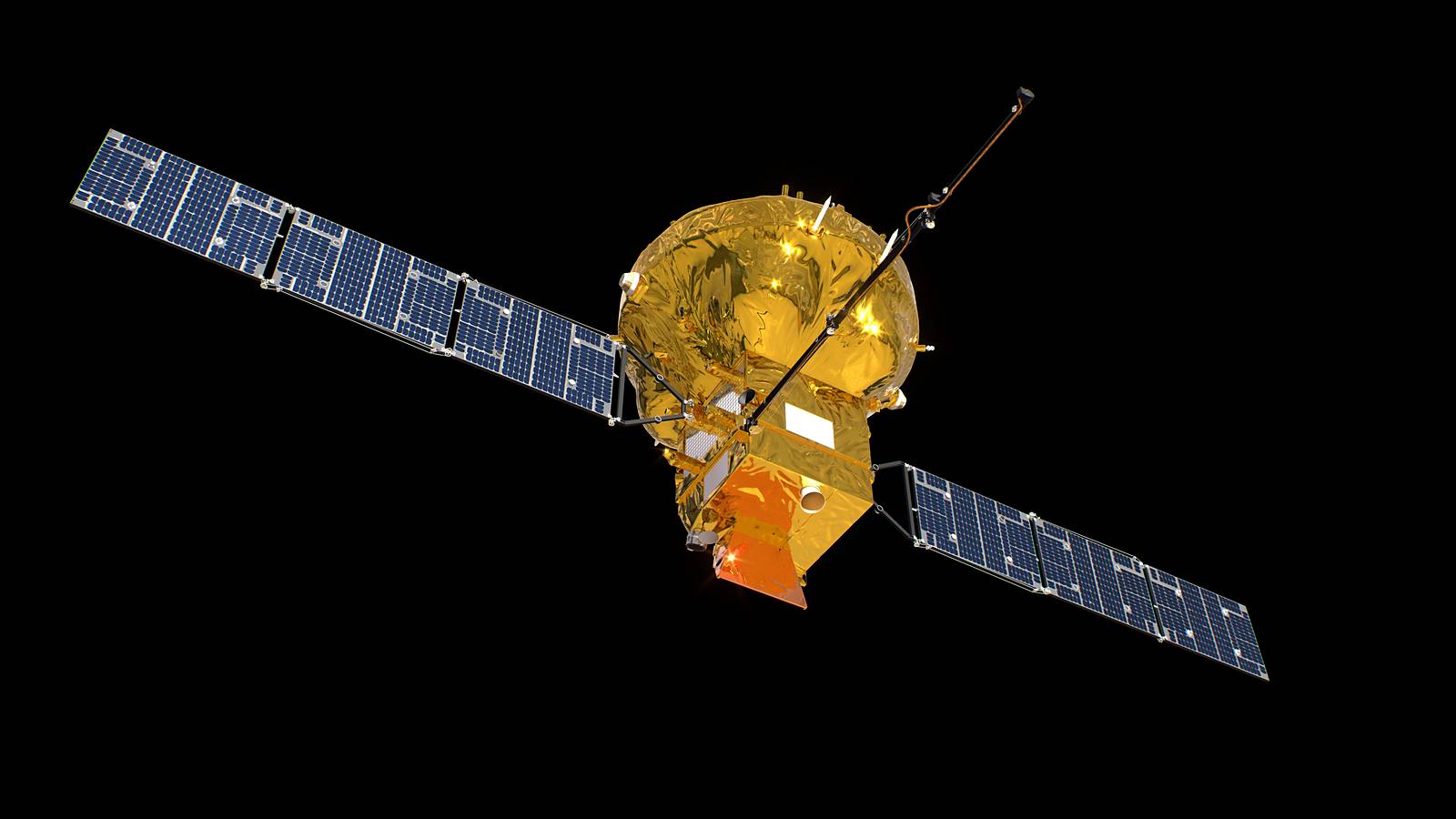
The stack that flew for nearly eight years was never a single science craft. MTM carried power and solar-electric propulsion through the cruise. MPO and Mio rode above it, with Mio sheltered by the Magnetospheric Orbiter Sunshield and Interface Structure — MOSIF. On 3 September the Mission Control Team at ESA's European Space Operations Centre ran the separation sequence after a go call timed around 11:03 BST / 12:03 CEST on ESA's live updates. Roll call completed, go for separation — then the transfer module was released.
Without MTM, the remaining composite flies a ballistic approach using MPO's chemical propulsion. Solar-electric thrusters on the transfer module had already been switched off permanently in the final cruise arcs, ending the blue glow that marked years of xenon thrusting. That shutdown was a prerequisite for the separation choreography. Orbit insertion is still weeks away. Separation is the starting gun, not the finish tape.
Timeline as ESA's arrival graphic and Space.com's 3 September report lay it out. 21 November 2026: Mercury orbit insertion into a polar orbit for the still-stacked MPO–Mio composite. 9–10 December 2026: Mio separates onto its highly elliptical polar orbit. 16 December 2026: MPO jettisons MOSIF. 10 March 2027: MPO reaches its own lower polar science orbit. 6 April 2027: science phase begins. Exact dates can still move for operational reasons; ESA updated the public graphic in July 2026 with that caveat.
Sousa's "new mission" line is the operations truth under the headlines. Cruise navigation and electric thrusting are over. Chemical propulsion, orbit shaping and the dual-orbiter deployment sequence are the job now. Montagnon's six-months point warns readers against thinking November insertion ends the drama. Sixteen manoeuvres to lower and reshape the orbit show up in Space.com's account of the post-insertion plan. Arrival is a campaign.
Why Mercury is hard sits in the mission's history without needing invention. BepiColombo launched in October 2018. A solar-panel power shortfall in April 2024 reduced thrust authority; engineers rebuilt the trajectory and delayed arrival from a December 2025 aim into November 2026. Six Mercury flybys and a long electric-braking profile were always part of getting a stack into orbit around a planet deep in the Sun's gravity well. The 3 September separation closes the cruise chapter of that recovery.
Two agencies, two orbiters, one arrival. ESA leads MPO — the planetary orbiter aimed at surface, interior and close-in planetary science. JAXA contributes Mio — the magnetospheric orbiter aimed at the magnetic environment. Flying both at once is the mission's unique claim: first dual-orbiter Mercury mission. Complementary orbits after December are how the science phase gets both a near planet mapper and a wide-swinging magnetospheric probe.
This piece stays on the six-month arrival arc and the Sousa/Montagnon quotes. A companion focuses Mio's polar ellipse and the magnetospheric science goals. Same timeline sources — ESA updates and Space.com — different lead noun.
What happens operationally between September and November is navigation and readiness, not sightseeing. MPO must keep Mio healthy until spin-ejection in December. MOSIF keeps shielding Mio until it is no longer needed. Ground stations and the ESOC team stay in a high-tempo ops posture Montagnon flagged in the livestream remarks Space.com carried. Continuous activities means checkouts, trajectory tweaks and rehearsals for insertion burns.
Insertion on 21 November captures the composite into a roughly 60-hour-class polar orbit on ESA's planning language, before the December Mio release lowers the shared plan into specialised paths. MPO's later March 2027 orbit is the tighter polar path for mapping. Mio keeps the long ellipse that lets it sample different regions of Mercury's magnetosphere. Readers who only remember Earth-orbit deployments need that Mercury-specific sequencing explained: you do not drop both craft into identical circles on day one.
Kilometres and hours for orbits when ESA publishes them; clock times in BST/CEST as ESA listed the go call; months counted plainly from September separation to April science. No imperial habit for this European–Japanese mission story.
Quotes to keep intact in sense if not in every filler word: Sousa on a new mission starting with separation; Montagnon on six months of continuous activities and arrival not being a single big manoeuvre. Those two lines are why this piece exists beside a pure timeline graphic. Space.com's 3 September dispatch is the secondary spine that put both voices in the same public frame as the ESA live blog.
Risks remain real and unnamed as drama. Operational date slips are allowed in ESA's own caption notes. Hardware that has already flown eight years can still surprise. Reporting the plan is not the same as guaranteeing March 2027 and April 2027 land on the day. The plan is still the news because the separation executed on schedule in the September window.
Cruise heritage worth one sober paragraph: Earth and Venus flybys, repeated Mercury gravity assists, and the long electric thrust arcs that bled heliocentric energy until the ballistic arrival phase could begin. None of that cruise work is science-phase mapping. It was the price of admission. Paying it successfully is why Sousa could call 3 September a beginning rather than an ending.
Six months to Mercury orbit, counting from the September separation through November insertion and into the December–March deployment season. MTM is gone. MPO and Mio fly on. Sousa and Montagnon set the tone. ESA and Space.com sourced the spine. Science waits for April 2027 if the campaign holds.
BepiColombo is arriving in stages. That sentence is the whole story. Separation on 3 September. Insertion 21 November. Mio in December. MOSIF off mid-December. MPO polar orbit in March. Science in April. Six months of work between the first verb and the last. Keep the stages labelled and the quotes attributed, and the arrival campaign stays readable for anyone who is not sitting a console at ESOC.
The paper
Comments
No notes on this story yet.
Sign in to comment