
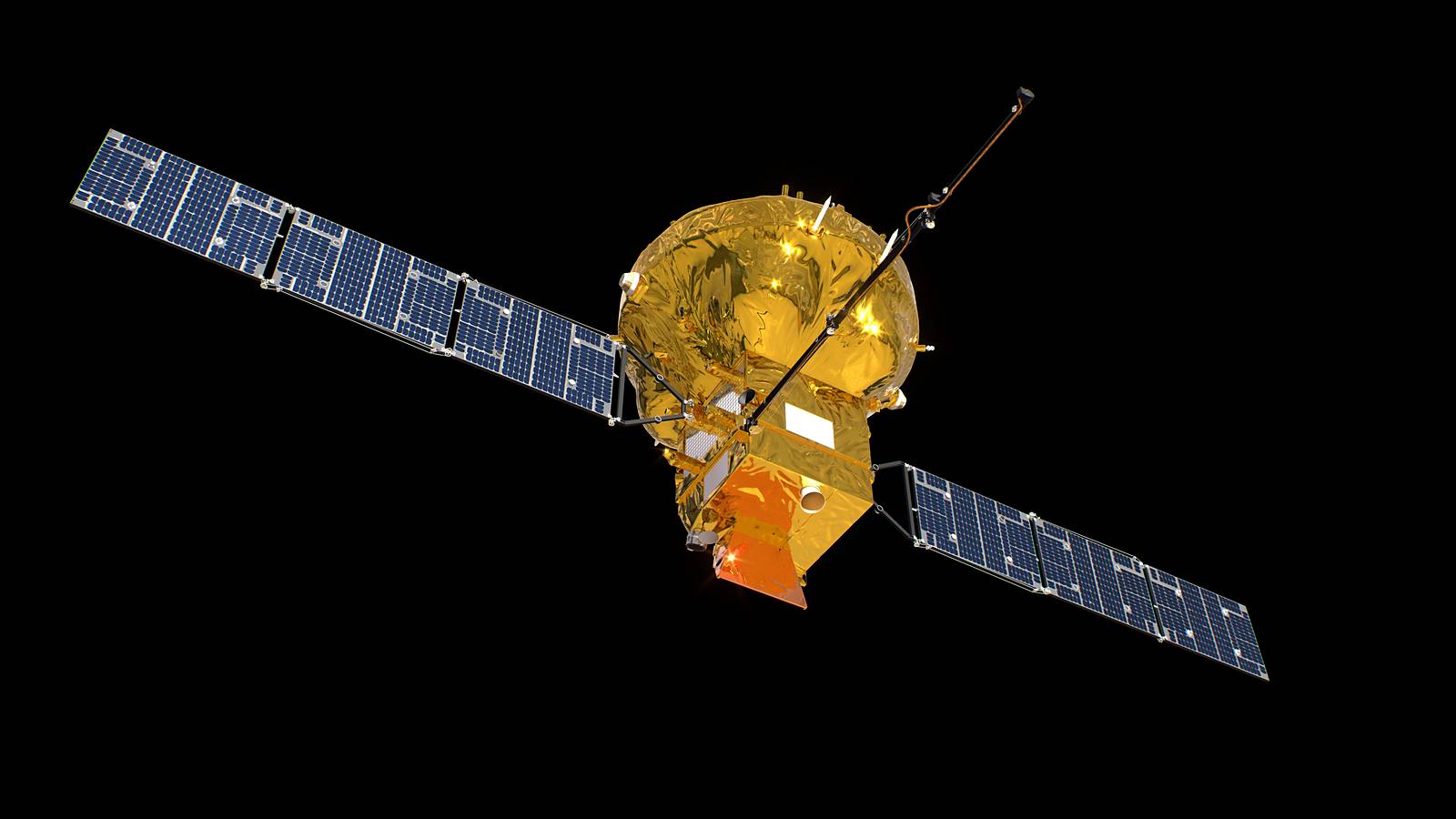
JAXA's Mio is the magnetospheric half of BepiColombo: after Mercury orbit insertion on 21 November 2026 it is due to separate around 9–10 December into a highly elliptical polar orbit while ESA's MPO continues toward a lower polar mapping path by 10 March 2027.
Together the two craft are meant to study ice in polar craters, Mercury's magnetic field and hollows among other goals. MOSIF, Mio's sunshield, is scheduled for jettison on 16 December. ESA and Space.com carry the shared timeline.
Mio's full name in mission language is the Mercury Magnetospheric Orbiter. It rides to Mercury stacked with MPO, protected by MOSIF — the Magnetospheric Orbiter Sunshield and Interface Structure — because the cruise toward the inner Solar System is brutal on a spinner that needs thermal care. Spin-ejection is how Mio leaves MPO in December. Until then, MPO supplies power and data resources to its Japanese partner after the Mercury Transfer Module has already gone.
Why an elliptical polar orbit for Mio is the physics of magnetospheres. Mercury's magnetic field is offset and weak compared with Earth's, and the solar wind closer to the Sun hits hard. A long ellipse lets Mio climb through different regions of the magnetosphere — dayside, nightside, flanks — on successive passes. MPO's tighter polar orbit later in the sequence is optimised for surface and near-planet remote sensing. Complementary orbits are the point of flying two agencies' craft instead of one.
Science goals that belong in a Mio-led piece: magnetic field structure and dynamics; interaction with the solar wind; plasma environment; and how that environment connects to surface processes. Hollows — bright, irregular depressions first clearly seen by NASA's MESSENGER — sit among the surface mysteries MPO will image at high resolution while Mio watches the charged-particle weather above. Polar crater ice is another joint story. Radar and neutron work from prior missions suggested water ice in permanently shadowed craters; BepiColombo's dual perspective is designed to connect exosphere, magnetosphere and surface cold traps more tightly than a single orbiter could.
Timeline anchors, repeated cleanly for readers who land here first. MTM separation: 3 September 2026. Orbit insertion: 21 November 2026. Mio separation: about 9–10 December 2026. MOSIF jettison: 16 December 2026. MPO final polar orbit: 10 March 2027. Science phase: 6 April 2027. ESA's public arrival graphic carries the operational caveat that dates may move.
Montagnon's six-month continuous-activities warning applies as much to Mio's deployment as to MPO's descent. After November capture, the composite still has to reach Mio's release orbit before spin-ejection. After Mio is free, MPO must shed MOSIF and burn down to its own altitude. Commissioning instruments on both craft fills the gap into April. Magnetospheric science does not begin the morning after separation; it begins when the science phase gate opens.
JAXA's role deserves a clear sentence in European coverage that sometimes folds both craft into "the ESA mission." BepiColombo is ESA-led in collaboration with JAXA. Mio is Japan's orbiter. MPO is Europe's. The stacked cruise was a joint engineering product including the European-built MOSIF shroud shaped to clear Mio during spin-up. Credit both agencies when you describe the December split.
Hollows science is a good example of why dual orbits help. MPO can resolve hollow morphology, distribution and spectral hints at volatile loss. Mio can sample the charged environment that may relate to space weathering and particle precipitation. Neither dataset alone tells the full hollows story. The mission was designed so those datasets overlap in time during the nominal science phase.
Ice in craters likewise needs more than a camera. Thermal extremes at Mercury's poles, permanently shadowed floors and possible volatile sources are multi-instrument problems. MPO's payload suite is the close-in geochemistry and imaging hammer. Mio's particle and field instruments are the space-weather context. April 2027 is when that combined campaign is scheduled to start in earnest if commissioning stays on track.
The companion arrival piece leads on MTM separation, Sousa's new-mission quote and the campaign arc. This one leads on Mio's ellipse, magnetospheric purpose and the complementary-orbit design. Same ESA and Space.com spine. Different protagonist. Readers can hold both without confusing the leads.
Operational colour without invention. Mio must be healthy at release — spun, powered, communicating. MOSIF's mid-December jettison clears MPO for its altitude campaign. Ground teams at ESOC and JAXA's operations centres share the December week as a high-attention window. Public updates will thicken as each gate approaches; this September piece is the preview while the composite is still on the ballistic approach after MTM departure.
Orbital periods when ESA publishes them — insertion-class orbits on the order of tens of hours, later MPO orbits much shorter on the planning graphics. Distances in kilometres. No casual miles for Mercury altitude stories. Clock the December separation window as a range, not a fake precise minute ESA has not set in public for the spin-ejection instant.
Risk language stays sober. Spin-ejection at Mercury is a one-shot mechanical and dynamical event planned for years. Sunshield jettison is another. Both have been rehearsed on the ground and in cruise checkouts to the extent the programme allows, but flight is flight. Reporting the plan is still the job while the hardware closes in.
Mio gets the polar ellipse. MPO takes the lower polar road months later. Magnetic field, hollows and polar ice sit among the questions both were built to attack together. Insertion in November. Mio free in December. MOSIF gone mid-month. Science in April 2027 if the gates hold. That's the magnetospheric story for a dual-orbiter arrival.
Readers following only MESSENGER memories need one bridge sentence. MESSENGER mapped Mercury from orbit and found the magnetic field, hollows and ice hints that set today's questions. BepiColombo's answer is two specialised orbiters instead of one, arriving in 2026–2027 after a cruise that outlasted several replans. Mio is the wide-ranging magnetospheric eye in that answer, and the polar ellipse is how it sees.
ESA and JAXA did not build duplicate craft. They built neighbours with different vantage points. The polar ellipse is Mio's neighbourhood. December is when it moves in, if the November capture and the early-December release orbit work as designed. Until then, Mio stays stacked, shielded and quiet beside MPO on the road into Mercury's gravity.
The paper
Comments
No notes on this story yet.
Sign in to comment