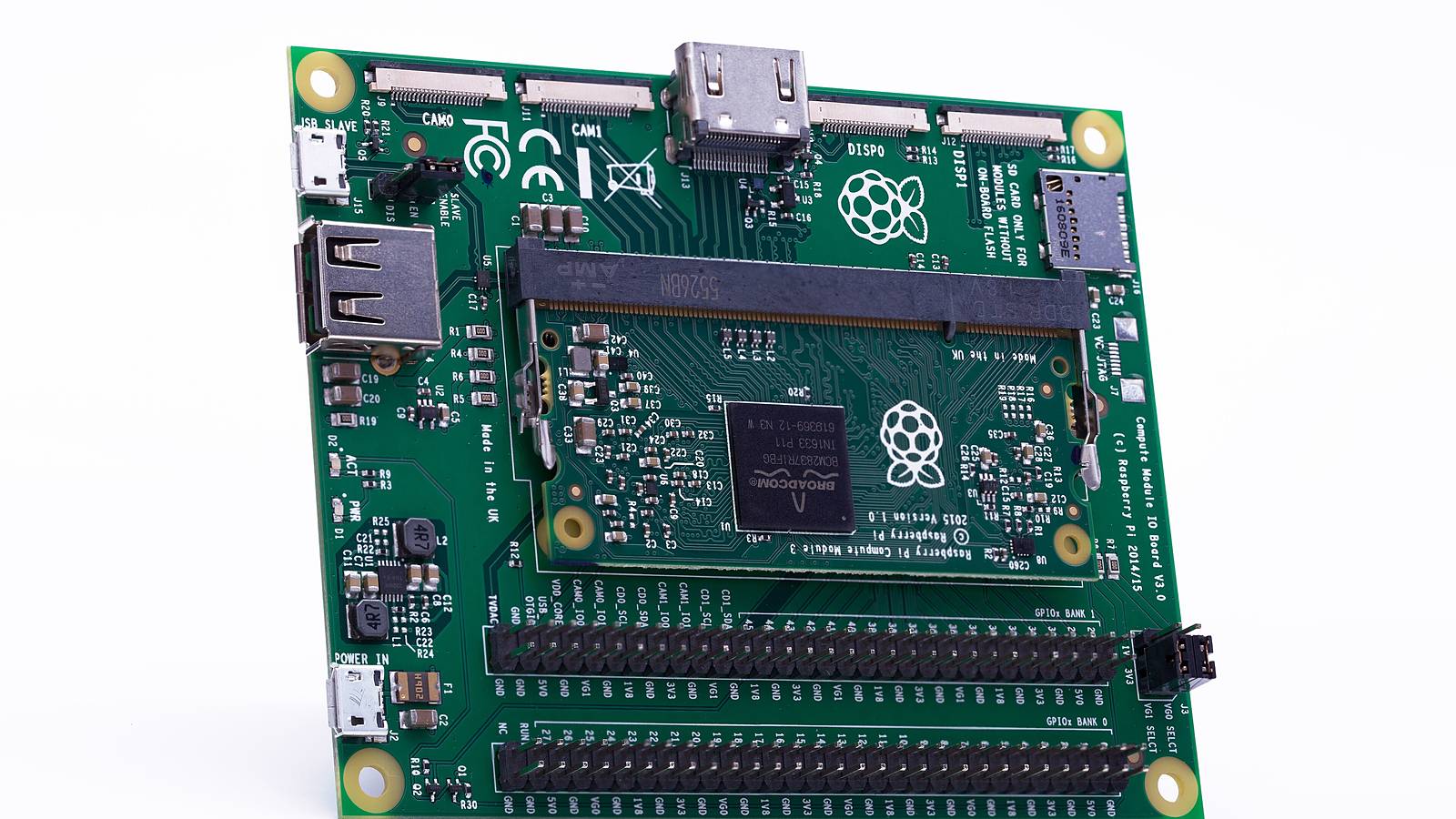

Raspberry Pi's Smart Display Module is on sale now for US$30. The adapter board puts a Raspberry Pi Compute Module 5 inside any screen built to Intel's Smart Display Module standard. That means a sign, kiosk or projector can run off a Pi with no separate media player, cable or power brick.
Raspberry Pi announced the launch on 29 September, eight months after it first showed the board. You can get it from the company's Approved Resellers worldwide, and the Compute Module 5 is sold separately.
A computer that slots into the screen
The idea's simple. Lots of commercial displays have a slot in the back for a small computer card built to Intel's Smart Display Module, or SDM, specification. Slide a compatible card in and the screen powers it, sends it video, audio and data, and lets it control the display. Nothing hangs off the back.
Raspberry Pi's version is an adapter board for the Compute Module 5, the stripped-down, solder-free form of the Raspberry Pi 5 that's aimed at businesses. You mount the CM5 on the board, fit the heatsink and slot the whole thing into the display. The company first showed it in January, ahead of a demonstration on Sharp's stand at Integrated Systems Europe in Barcelona. It said then that customers could install it themselves "without any specialist tools".
The board was developed with Sharp Display Solutions Europe. Raspberry Pi says it works with any display or device that supports products built to the Intel SDM specification. It's also compatible with the many content management systems that already support the Raspberry Pi 5 or the CM5.
What's on the board
Raspberry Pi's product documentation says the module puts an HDMI 2.0 port, a gigabit Ethernet socket, a USB 3.0 Type-A port and a USB-C port on the outside of the host display. The USB-C port only works in device mode, and it's there for programming the CM5 after it's installed. The HDMI port can drive a second, independent video stream, so one module can feed two screens.
Inside, there's an M.2 M-key PCIe socket that takes 2230, 2242, 2260 and 2280 cards, for extra storage or an AI accelerator. Raspberry Pi mentions pairing it with a Hailo processor. There's also a 22-way camera and display connector, a holder for a CR2032 real-time clock battery, a boot mode switch, an external power button that restarts the CM5 without touching the display, and an LED for power and storage status. And there's room for the Raspberry Pi Antenna Kit if you're using a wireless CM5.
That M.2 slot is the part Raspberry Pi is keenest on. In January it pitched the module for AI-powered signage, saying an accelerator lets users "run analytics and AI-driven applications locally, privately, and in real time, without reliance on cloud-based services". Put simply, the screen does that work itself, on the spot, rather than sending camera footage off to a data centre.
The documentation gives the board's size as 193 by 125 by 25 mm. On its own it weighs about 146 g. Put together with a CM5, heatsink and screws, it's about 225 g. There's no fan. A passive heatsink that fits inside the SDM form factor keeps it cool.
Raspberry Pi says the module handles 4K video playback and is built to run around the clock without stopping. That's exactly what signage needs: airport flight information screens, wayfinding, and retail and corporate displays. Paired with projectors that support Intel SDM, the company says, it can run exhibits and immersive installations too. And if you buy the module from Sharp, the documentation notes, the CM5 comes already set up and installed under the heatsink.
Tested in the field
Raspberry Pi quoted one early tester. Media Looper, a managed digital signage service for small businesses, ran the module with a Sharp display for three months.
"It does everything our Raspberry Pi 5 does, with no cable, power supply, or bracket for a customer to disturb. We would deploy it as our default for any customer whose display has an SDM slot," founder Jon McIntosh said in the launch post.
That's the real-world win. A Pi taped or bracketed to the back of a screen, with its own power supply, is easy to knock loose, unplug or walk off with. A card inside the screen isn't. Raspberry Pi said in January that its technology already powers hundreds of thousands of screens worldwide, and this gives those customers a tidier way to do it.
It's not really a home product, though. A reader asked in the comments under the launch post whether there were compatible displays for home use. Simon Burgess, who works at Raspberry Pi, replied there that the module "is designed for displays for the professional/business market", and added that it'd be great if consumer display makers built in an SDM slot. Commercial signage panels are built for heavy duty cycles and usually cost more than a TV.
The price, and the week's other news
At US$30, the module came in a bit above what Raspberry Pi first expected. In February, replying to a reader in the comments under the January announcement post, Burgess wrote that the company expected it to be "circa $25" plus local taxes. CNX Software, which wrote up the launch, reported that the module will stay available until at least January 2036. That matters to businesses planning signage fleets that run for years.
The launch landed in the same week as some less welcome news. On 1 October, Raspberry Pi raised the price of its 2 GB boards by US$12.50, to US$67.50 for the Raspberry Pi 4 and US$77.50 for the Raspberry Pi 5. Eben Upton blamed memory costs that have "risen very steeply over the past two years". The 2 GB versions of the Compute Module 4 and Compute Module 5 weren't affected, and Upton said the company looks forward to reversing its price rises when memory prices come down.
If you'd rather build your own screen-and-Pi project at home, our guide to the Maker Monday cyberdeck is a good place to start. For businesses with an SDM-ready display on the wall, it's now a US$30 card plus a CM5, and it slides straight in.

The paper
Comments
No notes on this story yet.
Sign in to comment