
Tuesday put two "if" apologies on the public record. Pauline Hanson told reporters in a Parliament House corridor that if she'd offended people by calling Indigenous Australians primitive, yes, she would apologise for that. She also said that if Anthony Albanese had taken offence at her remarks about his late mother Maryanne and public housing, well, she was sorry for that. Neither line was an absolute sorry. Both arrived after Monday's cross-party pile-on, and after a News24 interview earlier the same day that still sounded like a foot-in-mouth defence more than a climb-down.
Monday's file ended with a clean line: if Hanson apologises, you'll hear. This is that hearing. Tuesday's lead is the qualified apology itself — what she said, what she refused to walk back, and who answered her.
Start with the tape that forced the week. In September 2025 Hanson sat on the Jamie J podcast — also called the JJ Podcast — with Jaimee Rodgers. News24 put the clip back into circulation on Monday 14 September 2026. Within hours the long quotes were everywhere.
Hanson was asked about schoolchildren learning Indigenous history. She called that teaching a "complete waste of time." Then she went further. "And I'll say it on your program, what the hell have they done in this country? You know, supposedly 60,000 years, they'd never invented the wheel," she said. "There was nothing there. What are we actually holding up? A few, you know, rock paintings." Then the line that drove the reaction: "Sorry they're the most primitive race on Earth and we're supposed to be holding them up and saying what they've achieved. They've achieved nothing."
On Monday, Indigenous Australians Minister Malarndirri McCarthy stood outside Parliament House and called the remarks "totally outrageous, completely racist." She demanded an absolute apology. Greens leader Larissa Waters called them "vile." Opposition Indigenous Australians spokesperson Julian Leeser said they "belittled" the country. All four Indigenous senators put distance between themselves and the language. Hanson had reposted the clip on X and told people to "be the judge." Monday evening coverage did not report an apology.
Tuesday morning she was still in the fight. Then the corridor changed the shape of the day.
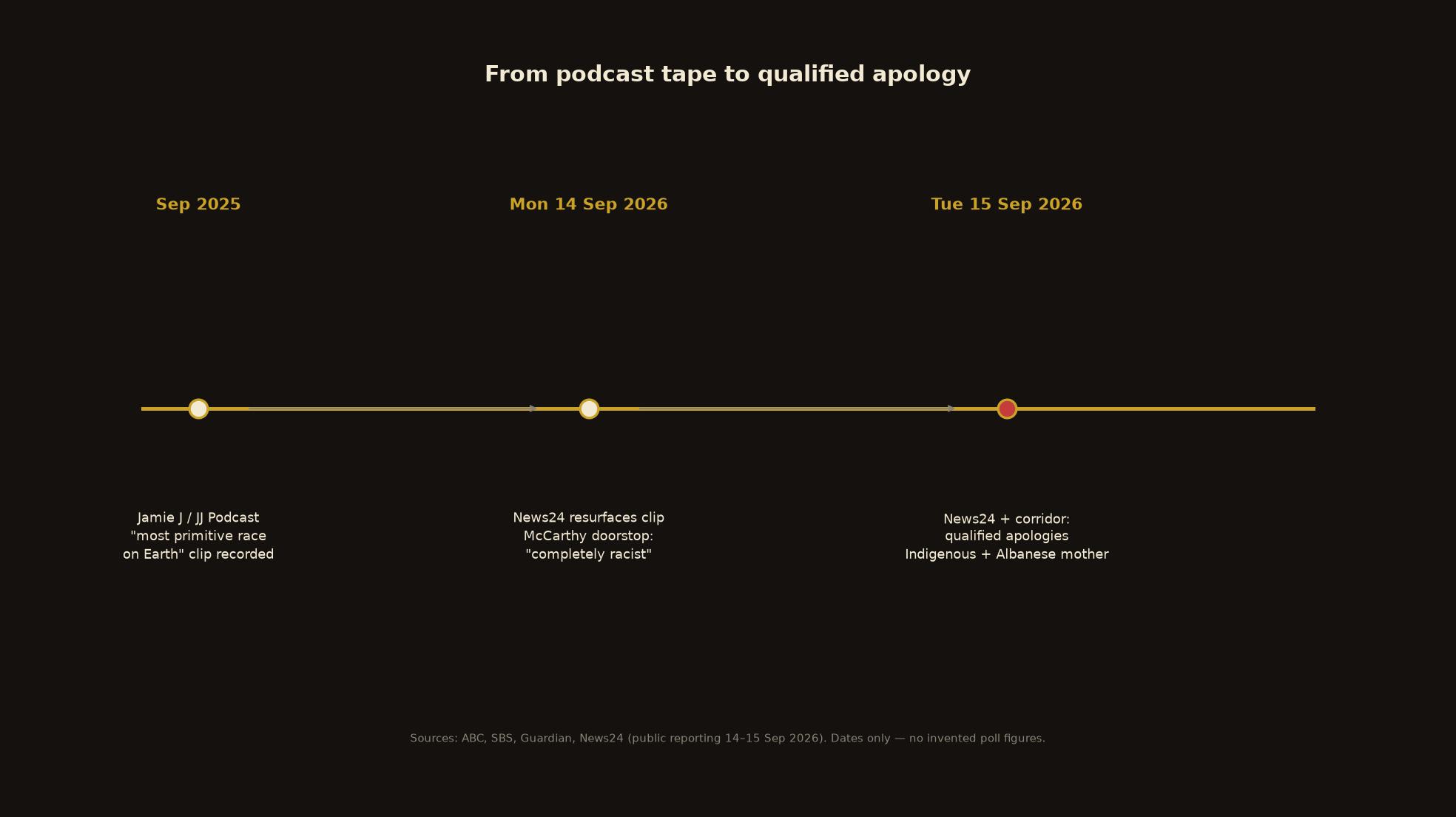
News24's Kieran Gilbert had her first. Hanson told him she regretted saying what she said because she did not want to upset people. "That's not my intentions," she said. "That wasn't my intention to hurt people." She said her intentions were to pull people together. She also reached for a settlement-era reframe. "If we go back to the time of settlement in Australia, they were primitive compared to the settlers that came out here from England," she said. "But I'm not talking those terms now. It's not about now."
She called herself not the most eloquent speaker. She said she had always put her foot in her mouth. She talked about people digging up dirt. Early Tuesday coverage said that on News24 she had still refused a full apology and doubled down before the later corridor exchange. The Guardian's live desk put the same sequence in order: News24 first, then about ten minutes later a press-gallery corridor climb-down that sounded more like an "if" apology.
That corridor is where the headline lines landed. "If I've offended people by using that, yes, I will apologise for that," she told reporters. "But I will not back away from what needs to be discussed," she added. She kept the audit-and-accountability talk. She talked about "third world conditions" and abuse. "Stop telling lies and stop the victimisation all the time," she said. She also said schools were teaching Aboriginal languages that would not give kids a job, and that people had to be realistic.
Read those sentences together and you get the shape of the day. She would apologise for the word if it offended. She would not drop the argument she says sits under the word. That is why coverage called it qualified, partial, or a footballer's apology. Madeleine King, a senior government minister, told the ABC that "sorry if I caused offence is not really an apology." She called the Indigenous remarks outrageous and disgusting, and said walking back into the building and acting as if the words had not been said was gaslighting. On the mother remarks, King called a "pseudo apology" pathetic.
The second apology sat beside the first. Over the weekend Albanese had defended his late mother after Hanson's public-housing remarks resurfaced. Maryanne Albanese lived for decades in housing commission. She had severe rheumatoid arthritis. She died in 2002 at 65. Albanese has talked for years about growing up in public housing in Sydney's inner west. Hanson had told Karl Stefanovic earlier in 2026 that housing commission should not be somewhere people live for thirty or forty years, and that Albanese had said his mother lived in the same house she was born in for sixty-five years. She called his repeated references "pathetic" on that podcast.
On Sunday the prime minister answered hard. He said he was stunned. He described a woman of great character who cleaned offices overnight and cared for a baby by day. He said she came down the stairs on her bum some mornings because she could not stand fully. She had scarlet fever as a child and could not finish schooling. Rheumatoid arthritis left her unable to use a knife and fork for a long stretch. "If Pauline Hanson wants to criticise me, then that's fine, but my mother was way out of Pauline Hanson's league, way out of it," he said. He called her generous and kind. He said he was proud of his upbringing.
Tuesday, in the corridor, Hanson was asked if she regretted those comments. "I don't think my comments were derogatory towards his mother at all," she said. "I was referring to house commission at that time. So if he's taken offence to it, well, I'm sorry for that." First she said the comments were not distasteful toward Albanese's mother. After a second ask, she landed the conditional sorry. The structure matched the Indigenous line: deny the sting, then attach an "if" to the apology.
You do not need invented emotion to see why that second thread travelled. A dead woman, a disability history on the public record, and a party leader talking about length of tenancy as if the tenancy itself were the offence. Albanese's Sunday defence was a son naming what his mother lived through. Hanson's Tuesday answer did not withdraw the housing-commission argument. It said sorry if he took offence.
Go back one more step on the mother comments, because Tuesday's "if" apology sits on top of a longer record than a single corridor answer. Hanson made the housing-commission remarks on The Karl Stefanovic Show earlier in 2026. They came back into circulation over the weekend of 12–13 September. By Sunday Albanese was answering on camera. By Monday Barnaby Joyce was dug in on Sunrise. By Tuesday Hanson was in the corridor attaching sorry-if to offence. That is a four-day arc on one thread, running beside the one-day arc on the Jamie J clip.
Nat Barr on Sunrise pressed Joyce on Monday about whether Hanson should apologise once the disability facts were clear. Joyce said he had listened to the comments and that Hanson had not called Maryanne a bad woman or accused her of theft. He said the question put to Hanson was about public housing, and he stood by what she said. Asked again whether she should apologise, he said that was really a question for Pauline to answer. Tuesday, Pauline answered with the conditional line. Joyce's Monday stand and Hanson's Tuesday sorry-if can both be true in the same week. They point in different directions.
McCarthy was back on the record Tuesday morning before the corridor. She told the ABC that the rare unity across party lines "speaks volumes" as to why Hanson should apologise. "What [she] said is deeply hurtful. It's completely wrong," McCarthy said. "Those comments were completely baseless. They harm. They dehumanise First Nations people in Australia." She said the Senate could act, and that she was personally calling on Hanson because it mattered.
Jacinta Nampijinpa Price, the Northern Territory Liberal senator Hanson has previously backed, rebuked her again on Tuesday. On 2GB she said making Australia better was about working together rather than tearing people down on race. "When you say 'the most primitive race on Earth,' you are speaking about a race of people," Price said. "I don't care what excuses are being made. She did absolutely demonstrate wilful ignorance because there's a hell of a lot more to Australia's first people than simply what her remarks suggest." She also rejected excuses about tone and inflection. She did not care what excuses were being made about how the remarks were meant.
Andrew Hastie told the ABC he was pleased to see Hanson apologise for language he "unequivocally" repudiates. "I just can't see how you justify that comment, which is why I'm glad she's apologised for it," he said. "I believe that every single person, human being, has innate worth and dignity." Liberal MP Andrew Bragg welcomed the retraction and said teeing off on minority interests was part of One Nation's long business model. "There are no winners from that sort of attack," Bragg said. Opposition Leader Angus Taylor said her comments did not even meet a basic test of decency.
Hastie's Tuesday welcome matters because he has been in open conflict with One Nation through the same week. He can repudiate the primitive language and still fight Hanson on other fights. A Liberal frontbencher who has been punching at One Nation still found room to say every human being has innate worth and dignity. That is useful texture for readers who think the week was only about faction fights.
Price's Tuesday rebuke matters for a different reason. She is not a Labor minister. She has shared stage time and political oxygen with Hanson on Indigenous policy fights before. When she says the remarks show wilful ignorance, and that tone and inflection matter, she closes a door Hanson might have hoped would stay open. Condemnation came from all four Indigenous senators. That unity is what McCarthy called a volume signal.
The Australian Human Rights Commission put out a Tuesday statement. Aboriginal and Torres Strait Islander Social Justice Commissioner Katie Kiss said Australia prides itself on fairness, dignity and respect, and that Hanson's comments "utterly contradict these values and have no place in the national conversation." "Such commentary is a tactic to divide us at a time when we need to come together," Kiss said. "In fact, people have come together over the past 24 hours, across the political spectrum, to criticise the Senator's comments. For that, I am heartened. But the harm caused should not be underestimated."
Kiss went on: First Peoples are custodians of the world's oldest continuing cultures. Their knowledge, leadership, creativity and survival enrich the country. Elders share lived experience so people can learn. Public discussion of history and identity, she said, must be grounded in respect and truth-telling. Race Discrimination Commissioner Giridharan Sivaraman said denigrating First Peoples lessens everyone, and that when public figures use language that dehumanises whole groups, real harm follows. He pointed to a National Anti-Racism Framework recommendation for anti-racism training for parliamentarians. "Racism has no place in Australia, least of all in our halls of power," he said.
Indigenous author and human rights activist Thomas Mayo answered the knowledge claim directly. "Many Australians have learnt that Aboriginal and Torres Strait Islander peoples built sophisticated systems of law, governance, culture, trade, and land management over tens of thousands of years," he said. "We have survived invasion, dispossession and every attempt to erase us. We are still here and will always remain in the rich tapestry of Australian identity."
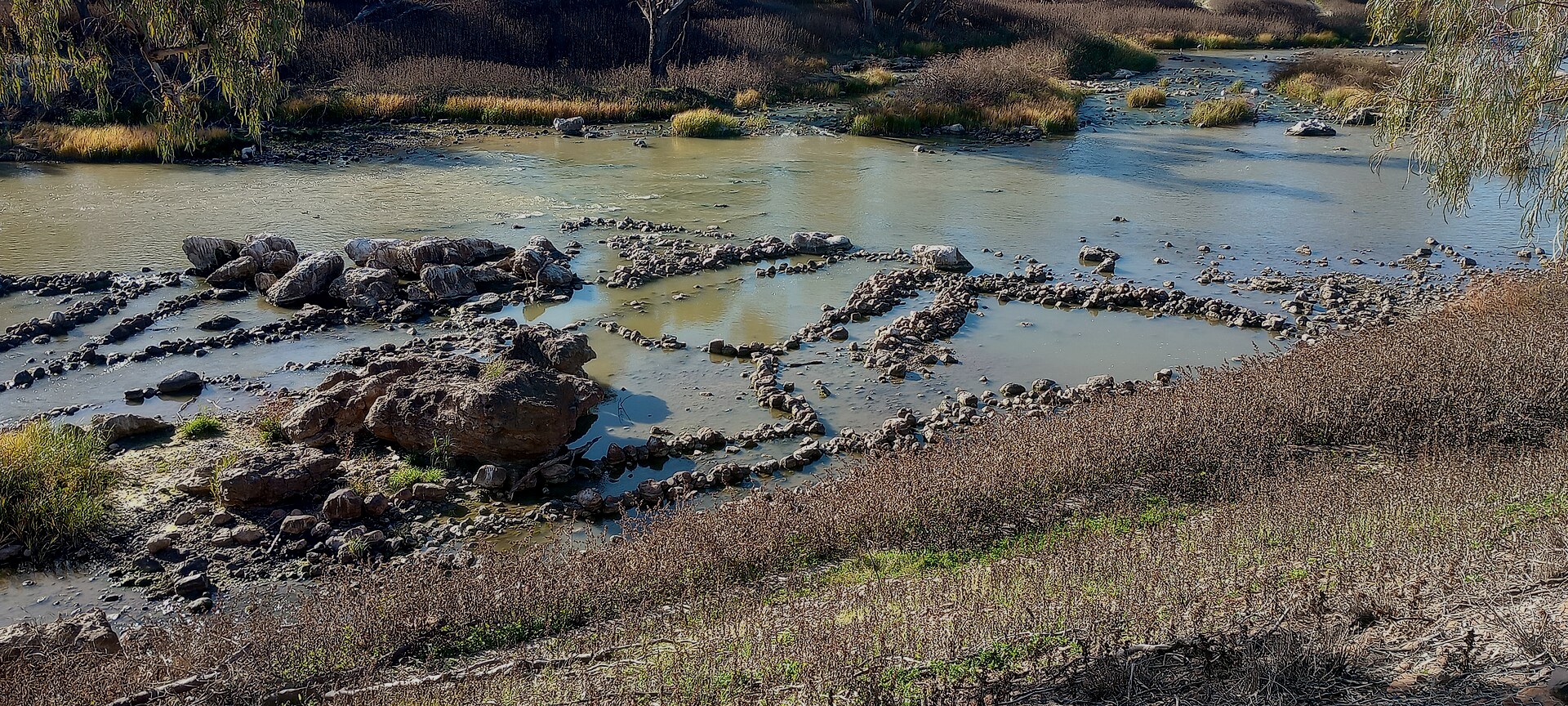
That is the factual counterweight to "they've achieved nothing." You do not need a lecture. You need the public record of fish traps, fire regimes, trade routes, languages, and law. Brewarrina's fish traps are one physical site people keep using because you can photograph stone channels in a river and ask how "nothing" fits. Fire-stick farming, songlines as navigation and law, and trade in ochre and pituri are the same category of answer. Hanson did not rebut those examples on Tuesday. She apologised for offence around a word.
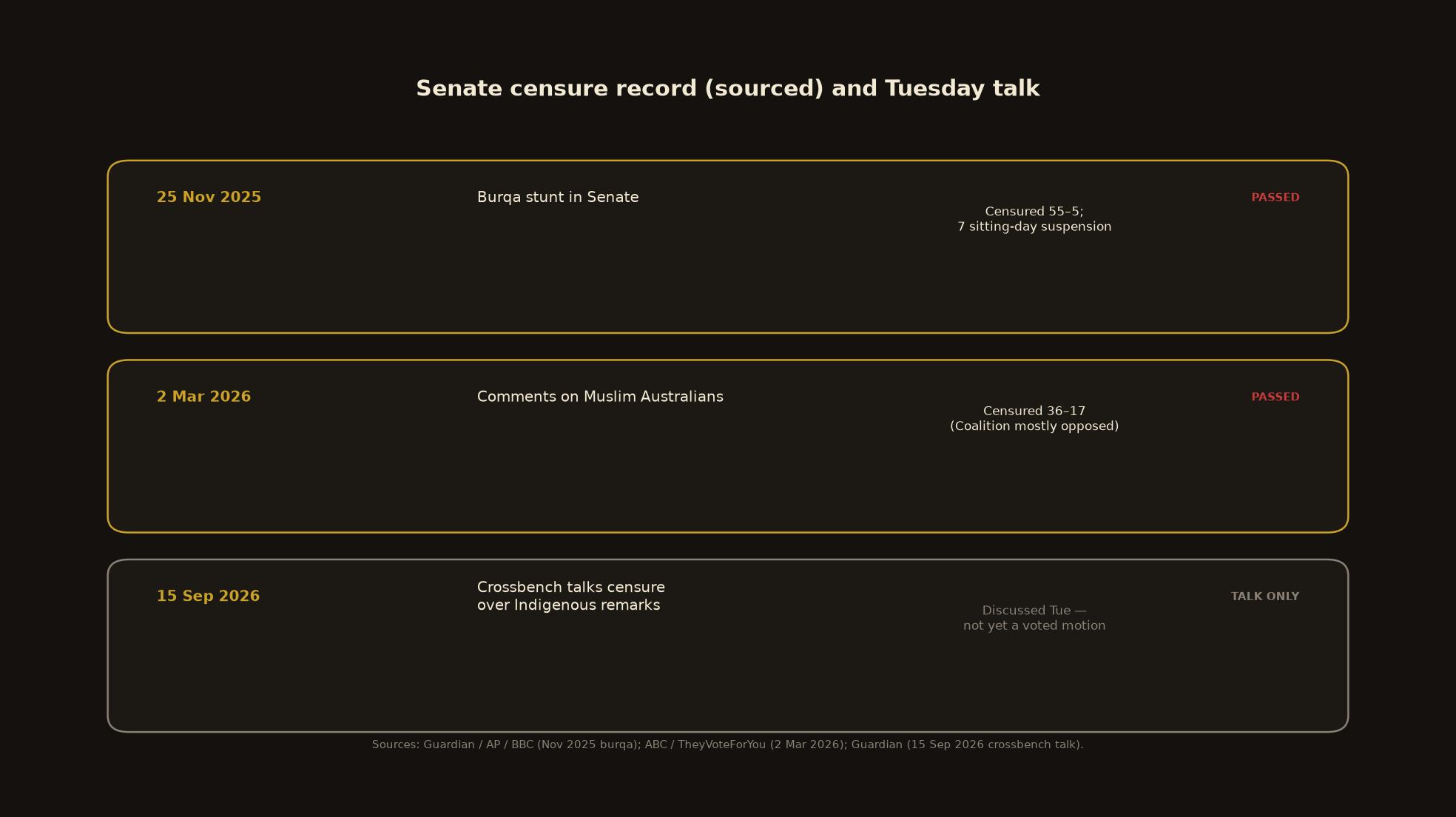
Crossbench senators said on Tuesday that there were discussions about moving a censure motion over the Indigenous remarks. Some questioned what a censure would achieve. That talk sits against a short recent record. On 25 November 2025 the Senate censured Hanson 55–5 over her burqa stunt in the chamber and suspended her for seven sitting days. The motion said the stunt was intended to vilify and mock people on the basis of religion and was disrespectful to Muslim Australians. On 2 March 2026 the Senate censured her again, 36–17, over inflammatory and divisive comments seeking to vilify Muslim Australians. Most Coalition senators opposed that second censure. Liberal senators Paul Scarr and Andrew McLachlan crossed the floor to support it. Hanson was absent for that vote.
Censure does not jail anyone. It does not fine anyone. It is the chamber saying, on the record, that the conduct fails the standard. Tuesday's talk was talk. If the Senate marks the Indigenous remarks, you'll hear. No vote has been taken yet.
Keep the censure numbers honest. Fifty-five to five in November 2025 was overwhelming. Thirty-six to seventeen in March 2026 was real but narrower, with most of the Coalition opposed to using censure for that speech fight. Tuesday's crossbench discussions sit closer to the second pattern than the first if they become a motion: an argument about whether the Senate should mark outside commentary again. Some crossbenchers already questioned the point of another censure. That scepticism is part of the Tuesday file. It is not a prediction of the count.
Hanson tried to hold two audiences at once. To Gilbert and to the corridor she said she did not want people upset. To the same cameras she said she would not back away from what needs to be discussed. She said she saw division in Australia. She said she had always advocated that Australians be treated equally on a needs basis, not about race, and that until that happened the country would not move on from the past. She said a lot of Aboriginal people supported her because they felt used as pawns. Those claims are her politics. They are not a fact-check of the podcast sentence that said First Nations people had achieved nothing.
Listen again to the News24 hour for what she tried to repair before the corridor. She said she put her foot in her mouth. She said she was not the most eloquent speaker. She regretted saying it because she did not want to upset people. She insisted the settlement-era comparison was about then, not now. She said her intentions were to pull people together. Those lines are remorse about delivery and timing. They are not a withdrawal of the curriculum fight, the wheel claim, the rock-paintings line, or the "achieved nothing" ranking. When she later said she would apologise if she had offended people by using "that," the "that" was the word. The rest of the podcast argument stayed standing in her telling.
She also said schools were teaching Aboriginal languages that would not give kids a job. "We're teaching [kids] Aboriginal languages that no longer is going to give them a job. We're not going to give them any future. We have to be realistic," she said. That sentence is a policy claim about schooling and employment. It can be debated with labour-market data and with language-revival outcomes. It is not the same sentence as "most primitive race on Earth." Bundling them together is how she keeps the politics while offering the "if" on the slur. Separating them is how McCarthy, Kiss and Mayo answered her.
King's gaslighting charge is a political judgment, not a clinical diagnosis. Hear what she meant in ordinary English. She said Hanson says outrageous things about Indigenous Australians, then walks back into the building and talks as if she did not say them. The gap between the podcast tape and the corridor "if" is what King was naming. Bragg's "business model" line names a different gap: the electoral incentive to tee off on minority targets, then manage the blowback. Both critiques sat on the Tuesday record beside Hanson's own words.
The "footballer's apology" label is useful because most readers have heard one. A player says sorry if anyone was offended by a tackle or a spray. The structure protects the speaker from admitting the act was wrong. Hanson's Tuesday lines fit that shape. She regrets upsetting people. She apologises if people were offended by the word. She does not say: I was wrong to call Indigenous Australians the most primitive race on Earth, and I withdraw it. That missing sentence is the story as much as the sentences she spoke.
Compare that missing sentence with McCarthy's Monday ask. Absolute apology meant owning the racism charge and withdrawing the ranking. Tuesday delivered a conditional on offence. Whether that is enough for McCarthy personally is for her to say. Whether it is enough for First Nations constituents in Queensland is for them to say at the ballot box and in their own words. Tuesday's spoken product did not match Monday's asked product.
Hold Monday and Tuesday against each other for a moment. Monday was the country answering a year-old clip. McCarthy's transcript is still online. Cross-party condemnation was unusually loud. Tuesday was Hanson answering the answer. She moved. She did not move far. She shifted from "be the judge" to "if I've offended people." She kept the settlement-era comparison in the News24 hour. She kept the audit talk in the corridor. She kept the housing-commission argument while attaching sorry-if to Albanese's offence.
Context from the same week belongs in the background, not the lead. One Nation had been fighting Liberals over migration numbers and over a cartoon that branded Andrew Hastie a traitor. Hanson had been attacking Albanese's mother story before the Jamie J clip resurfaced. Those fights help explain why the week felt crowded. They are not why Tuesday's corridor mattered. Tuesday mattered because the apology question from Monday finally got a spoken answer, and because that answer was two conditional sentences with a long list of things she would not drop.
What did she apologise for, exactly? On Indigenous Australians: the offence of using "primitive," if people were offended. Not the claim about achievement. Not the curriculum fight. Not the funding audit demand. On Albanese's mother: the offence he took, if he took it. Not the housing-commission duration argument. Not the "pathetic" framing of his story. That is the gap between a word-level sorry and a full walk-back. Readers can hear it without a seminar.
McCarthy's Monday ask was for an absolute apology. Tuesday's product was not absolute. King said so out loud. Price rejected the excuses. Kiss and Sivaraman put the human-rights frame on paper. Mayo answered the history claim. Hastie and Bragg took Liberal distance from the language even while the Coalition remains split, in recent months, on how often censure should be used for speech outside the chamber.
Hanson is not a new character in Australian politics. She has been saying hard things about race, migration and culture for three decades. What is newer is the poll position One Nation has held through 2026 and the way every resurfaced clip now lands as a national story rather than a fringe tape. The news file under that analysis is simpler. A year-old podcast said First Nations people were the most primitive race on Earth and had achieved nothing. Monday condemned it. Tuesday offered two "if" apologies and kept the fight.
Hanson has been suspended and censured before and returned to the same microphone style. That history is why Tuesday reads as a form story, not a career-ending collapse. She can regret, reframe, and reopen the funding argument in the same afternoon. She has done versions of that loop for years. What changed in 2026 is the size of the audience every time the loop runs. Poll position turns a corridor exchange into national lead copy.
Two clocks ran on Tuesday. One was the News24 interview clock, where regret and settlement-era reframing led, and full apology language lagged. The other was the corridor clock, where reporters asked the apology question straight and got the "if I've offended people" line plus the mother sorry-if. About ten minutes sat between those clocks. Morning defence. Midday conditional.
Inside the corridor quotes, notice the pivot words. "By using that" points at the adjective. "What needs to be discussed" points at funding, conditions, accountability, victimisation, and languages-in-schools. "House commission at that time" points at tenure policy. "If he's taken offence" points at Albanese's reaction rather than at Maryanne's life. Each pivot keeps a political project alive while offering a soft edge. That is craft. It is also why King and Kiss did not treat the soft edge as the whole story.
Albanese's "way out of Pauline Hanson's league" line will travel for years because it is short and sharp. It is also specific. He did not say Hanson cannot criticise him. He said criticise him, leave his mother alone, and recognise that Maryanne's character sat beyond Hanson's reach. Tuesday's sorry-if does not erase that Sunday sentence. Both remain on the record.
For the Indigenous file, Mayo's "we are still here" and Kiss's "harm should not be underestimated" will travel in a different register. They answer dehumanising language with presence and with a warning about what ranked language does in a country that already carries invasion and exclusion in its bones. You can put those lines beside Hanson's regret lines without writing a morality play. The juxtaposition is the journalism.
For First Nations families who heard Monday's clip, Tuesday's corridor will land differently depending on whether they hear the "if" or the "I will not back away." Both sentences were spoken. Both are on the record. What was said into microphones is the record.
For Albanese, the mother thread is personal and political at once. He put Maryanne's illness, work and character on the Sunday record. Hanson answered on Tuesday by saying she did not think her comments were derogatory, then attaching sorry-if to his offence. The two statements can sit in the same paragraph without a novelist joining them. A son defended his mother. A senator said sorry if he took offence.
What about ordinary voters who back Hanson on borders or on energy and feel this file is a pile-on? Fair question. Reporting a qualified apology is not the same as telling those voters they are wrong about coal or migration. It is reporting what their party leader said on a podcast, what she said on News24, what she said in a corridor, and what named opponents and commissioners said back.
One Nation wants to talk funding audits and "third world conditions" in remote communities. Labor wants to talk racism and dehumanisation when the language of primitivity returns. The Coalition wants distance from the slur while keeping room to attack Labor on outcomes. The Greens want the vile label in the lead. The AHRC wants the human-rights frame. All of those incentives were visible on Tuesday. The incentives are in the quotes.
Where does that leave the Senate? Crossbench talk is not a vote. Prior censures show the chamber can mark her when it chooses. McCarthy left room for the Senate to act while making her own call personal and public. If a motion is moved, the count will be news. Until then, Tuesday's news is the apology form itself.
Where does that leave One Nation's argument about funding and outcomes? Hanson wants an audit, accountability, and a needs-not-race frame. Those are political claims she is entitled to keep making. They do not require ranking a people as the most primitive race on Earth. That is the cut several Indigenous senators and the human-rights commissioners made. You can debate Closing the Gap numbers without that sentence. Tuesday's "if" apology did not retire the sentence's politics. It tried to retire the offence while keeping the politics.
Where does that leave the mother fight? Public housing tenure is a policy debate Australia has every year. Using a disabled woman's decades in a commission house as a stick against her son's biography is a different act. Albanese named that difference on Sunday. Hanson's Tuesday answer stayed inside the housing-policy frame and offered sorry-if on offence. Readers can decide whether that meets the moment. Both sets of words sit in the same clear light.
Here is the spine in plain English. Year-old podcast. Monday condemnation. Tuesday News24 regret and reframe. Tuesday corridor: if I've offended people, I apologise for that, but I will not back away. Tuesday corridor again: not derogatory about his mother, sorry if he took offence. McCarthy says unity speaks volumes. Kiss says harm should not be underestimated. King says sorry-if is not really an apology. Price says wilful ignorance. Hastie says innate worth. That is the spine. The rest is context.
One last clarity pass on what this is not. It is not a claim that Hanson never cares about remote disadvantage. It is not a claim that every One Nation voter endorses the primitive ranking. It is not a claim that public housing tenure rules are beyond debate. It is not a claim that a Senate censure is already locked. It is a report that on 15 September 2026 she offered two qualified apologies after a day of pressure, kept her policy fights, and left Monday's demand for an absolute apology only partly answered.
The Indigenous thread has its own longer record inside a shorter news cycle. The podcast is a year old. The resurfacing is Monday. The apology form is Tuesday. Inside that twenty-four-hour political window you still get McCarthy's absolute demand, Waters on "vile," Leeser on "belittled," Price on wilful ignorance and tone, and then Tuesday's AHRC statement plus King's gaslighting charge. That is a lot of named people for one clip. It is also why Hanson could not leave Monday unanswered forever.
Monday into Tuesday, the country did not only hear politicians. Indigenous leaders on Monday expressed disappointment over the "primitive" label and called the claims false and ignorant. Mayo's answer on Tuesday sat in that line. So did Kiss and Sivaraman. The point is not that every Australian agreed on every policy. The point is that the ranking itself drew a rare shared rejection.
Hanson insisted on Tuesday she was trying to be a voice for Australians who want equality based on need, not race. "I will not back down from raising the issues that need to be talked about and debated in this nation, and I will continue to do that," she said. She also said she did not want to get people offside. Those two aims sat in tension all day. The corridor "if" was her attempt to ease the offside problem without dropping the debate she wants.
New Daily called the corridor a cave after an earlier refusal. ABC led on the qualified apologies as the day's product. Guardian live stressed the about-turn after News24. All three readings can be true because the day had a sequence. She started the morning defending and reframing. She ended the midday exchange with two conditional apologies and a promise not to back away.
Look at the mother fight through ordinary fairness, not through party colours. Public housing exists to give people a roof when the private market will not. Some tenancies are short. Some last decades because health, income, or disability make private rent hard. Maryanne Albanese's life, as her son told it, was marked by illness and work and care. Using the length of that tenancy as a political cudgel is what sparked the Sunday defence. Hanson's Tuesday line tried to put the cudgel back on "house commission" policy and away from the woman. Listeners can decide if that split holds.
Joyce's Sunrise stand showed One Nation's early-week preference: keep the housing-policy frame, refuse to personalise an apology demand, wait for Hanson herself. When Hanson spoke, she still kept the housing-policy frame. She added sorry-if. That addition is real. It is also small next to Albanese's Sunday portrait of a woman coming down the stairs on her bum because her joints would not hold.
On the Indigenous side, the settlement-era reframe did similar work. Hanson told Gilbert the comparison was about the time of settlement, not about now. McCarthy, Price, Kiss and Mayo rejected the idea that a historical comparison excuses a present-tense ranking of a living people as the most primitive race on Earth who have achieved nothing. The podcast language was present tense in its insult even when Hanson later tried to push it into the past.
"Sorry they're the most primitive race on Earth" was not spoken as a careful history seminar. It was spoken as a dismissal of curriculum and of achievement. Tuesday's "I'm not talking those terms now" tried to relocate the insult. The corridor "if I've offended people by using that" tried to localise the apology to a word. The funding-and-audit talk tried to keep the political engine running. Three moves. One afternoon.
Bragg said there are no winners from that sort of attack. Hastie said he could not see how you justify the comment. Taylor said it failed a basic test of decency. King said sorry-if is not really an apology. Those are Liberal and Labor voices, not a single faction script. When Price joins them from the Indigenous Liberal side, the rejection map gets wider than a left-right cartoon.
Still, Hanson retains a base that hears any apology demand as elite pile-on. She spoke to that base when she talked about dirt being dug up and about Aboriginal people who feel used as pawns. She spoke to a wider audience when she said she regretted upsetting people and would apologise if she had offended them. Dual messaging is not new in politics. Tuesday made the dual track audible in consecutive hours.
The AHRC statement matters because it is not a party room. Kiss and Sivaraman spoke as commissioners charged with social justice and race discrimination. Their language — divide, dehumanise, halls of power — puts the remarks in a rights frame rather than a tactical frame. Sivaraman's call for anti-racism training for parliamentarians will annoy people who think Parliament already knows how to behave. It will comfort people who think the week proved the opposite. Both reactions can be reported without pretending training alone fixes speech.
Mayo's line about surviving invasion and dispossession and remaining in the tapestry of Australian identity is the other rights-frame answer. It does not ask Hanson for a funding spreadsheet. It answers the claim of nothing with the fact of continuity. Continuity is not a vibe. Continuity is languages still spoken, law still practised, country still cared for, and people still here after every attempt to erase them.
If a censure motion comes, the November and March votes will be the comparison points. November was a chamber stunt with a near-unanimous rebuke. March was a speech fight with a Coalition split. An Indigenous-remarks censure would sit closer to March in subject matter and closer to November in moral heat, depending on who drafts the text. Until someone moves it, that is speculation about tone, not news about a count.
For readers who only catch the evening wrap: Hanson offered two qualified apologies on Tuesday 15 September 2026. One was for offence caused by calling Indigenous Australians primitive, if people were offended, while refusing to back away from her funding and accountability politics. The other was for offence Albanese took over remarks about his late mother's decades in public housing, while denying those remarks were derogatory. Monday had demanded absolute. Tuesday delivered conditional. The gap is the story.
A year ago the podcast room heard the primitive line and the tape rolled. On Monday the country heard it again. On Tuesday Hanson said she regretted upsetting people, apologised if she'd offended them by using that word, and said she would not back away from what she wants discussed. She said she did not think her mother comments were derogatory, and that if Albanese had taken offence she was sorry for that. Those are the Tuesday facts. They answer Monday's open question without closing the argument Hanson wants to keep running.
If the Senate censures her again, you'll hear. If she later offers an absolute apology without the "if," you'll hear. If she does not, the corridor quotes and the News24 regret lines remain the public record of 15 September 2026. McCarthy already said the remarks dehumanise. Kiss already said the harm should not be underestimated. Hanson already said she will not back away. That is enough for one Tuesday file.
The paper
Comments
No notes on this story yet.
Sign in to comment