
Chris Bowen walked into a Labor think-tank dinner in Haymarket on Friday night and said Pauline Hanson doesn't like the Australia she claims to love.
Here's what landed. On Friday, 18 September 2026, the Climate Change and Energy Minister delivered the John Curtin Research Centre's 2026 Curtin Oration at Hay St Market by Doltone House, 9–13 Hay Street, Haymarket. Paul Sakkal at the Sydney Morning Herald published from an advance copy of the speech on Saturday, 19 September. Bowen's line was blunt. "You can't claim to be a patriotic Australian when you don't actually like the country we have become," he told the room.
That is the new file. Not One Nation's Monday migration plan — that already sits on the desk as a separate piece. Not the joint staffing presser Hanson held with Fatima Payman and Dai Le on Thursday. Not the Indigenous-culture row, the Hastie "traitor" fight, or the Albanese-mother public-housing remarks that Labor hardheads now treat as background. Friday's speech was Bowen turning Hanson's own patriotism brand against her, and tying Labor's renewable and critical-minerals agenda to what he called progressive patriotism.
You should hear the sequence clean. Thursday in Canberra was migration and staffing. Friday night in Sydney was patriotism and nation-building. Saturday morning was Sakkal's SMH write-up. Albanese was already heading toward a United Nations gathering in New York on tech rules and AI investment. That is the same-week shape. The oration is the centre of this story.
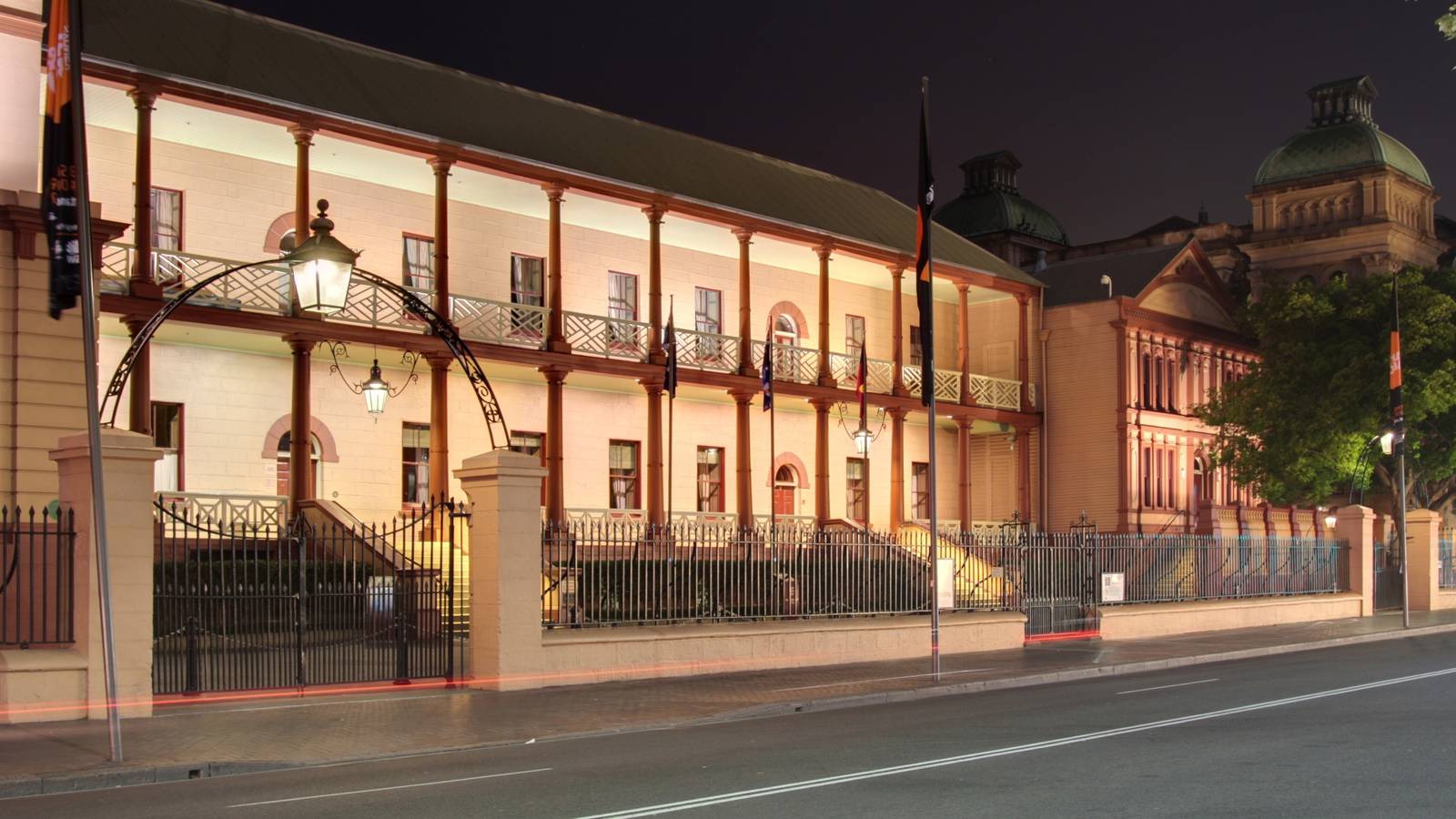
The John Curtin Research Centre billed the night as the culmination of its Stronger Australia Programme. Doors ran 6–11 p.m. The venue sat in Haymarket's hospitality strip — Hay St Market by Doltone House — not Parliament House, not a Canberra press gallery room. Bowen was speaking to a Labor-aligned audience under Curtin's name. That matters for tone. This was not a doorstop. It was a set-piece.
Sakkal's Saturday piece framed the speech as Labor ramping up its attack on Hanson while One Nation's primary vote sits shock-close to Labor's. Bowen, whose climate agenda already makes him a favourite target for conservatives, chose the patriotism ground rather than another energy numbers day. Labor and Coalition figures have, at times, avoided arguments they feared would rankle Hanson's base. Bowen did not avoid it on Friday.
He put Hanson's patriotism in three words first: exclusive, and angry. Then he filled them in. He said that brand "demonises some Australians in order to energise and legitimise their own sense of being Australian."
He went further on who gets to love the country. "It seeks to reserve the right to love our country to themselves and deny the right to love Australia to those who don't look like, or pray like, themselves," Bowen said.
Then the smaller-Australia frame. "It's small patriotism which seeks a more inward-looking Australia. A smaller conception of what it is to be Australian. It involves shrinking in a fear of globalism, the World Economic Forum, the United Nations and other conspiracy-theory laden concepts of a scary world."
That last sentence is the speech's geopolitical hinge. Bowen was not only talking culture. He was talking trade, alliances, and who Australia stays open to. He was also talking to voters who hear "globalism" as a threat word and "United Nations" as someone else's project. He named those fears as conspiracy-laden and called the patriotism built on them small.
He tied the patriotism test to Indigenous culture next. "I don't believe you can truly call yourself an Australian patriot if you describe the Indigenous culture of our country as primitive," Bowen said. That line points straight at Hanson's recent Indigenous-culture controversy without restaging the whole earlier file. The point for Friday was the patriotism claim, not a second Indigenous-policy hearing.
Then western Sydney names. Bowen said it is people like Anh Do and Usman Khawaja — raised in western Sydney — who are, rightfully, among Australia's most celebrated authors and sportsmen. He was placing migrant success stories inside the definition of the country he says Hanson rejects. For a minister who holds McMahon, that is not abstract colour. It is seat talk.
Against Hanson's "exclusive" frame, Bowen talked up Albanese's "progressive patriotism" slogan. He made it concrete. "Progressive patriots want a stronger, more influential Australia," he said. "An Australia with more sovereign supply chains, more value added to our natural resources and more of our natural advantages in renewable energy harnessed and put to use."
Then the cultural-cringe line that closes the economic case. "It's cultural cringe and fundamentally unpatriotic to want your country to be less influential in the world."
Read that against Bowen's day job. Climate Change and Energy is not a soft portfolio in this argument. He is saying renewables, critical minerals, and value-adding are patriotic projects — nation-building in the Curtin sense — not lifestyle preferences. Sakkal noted Albanese jetting to the UN in New York to talk tech regulation and chase AI investment as the speech's international backdrop. Bowen's Friday case was: stay open, stay influential, build the supply chains here.
Now the numbers Sakkal put under the politics. Labor is not, in the SMH framing, in full panic about One Nation's rise. Across an average of all polls, One Nation sits on a 27 per cent primary. Labor sits on 28 per cent. Labor would still win an election if one were held today on those figures. But Labor's primary has been in slow, steady decline for months, and Sakkal called that territory perilous.
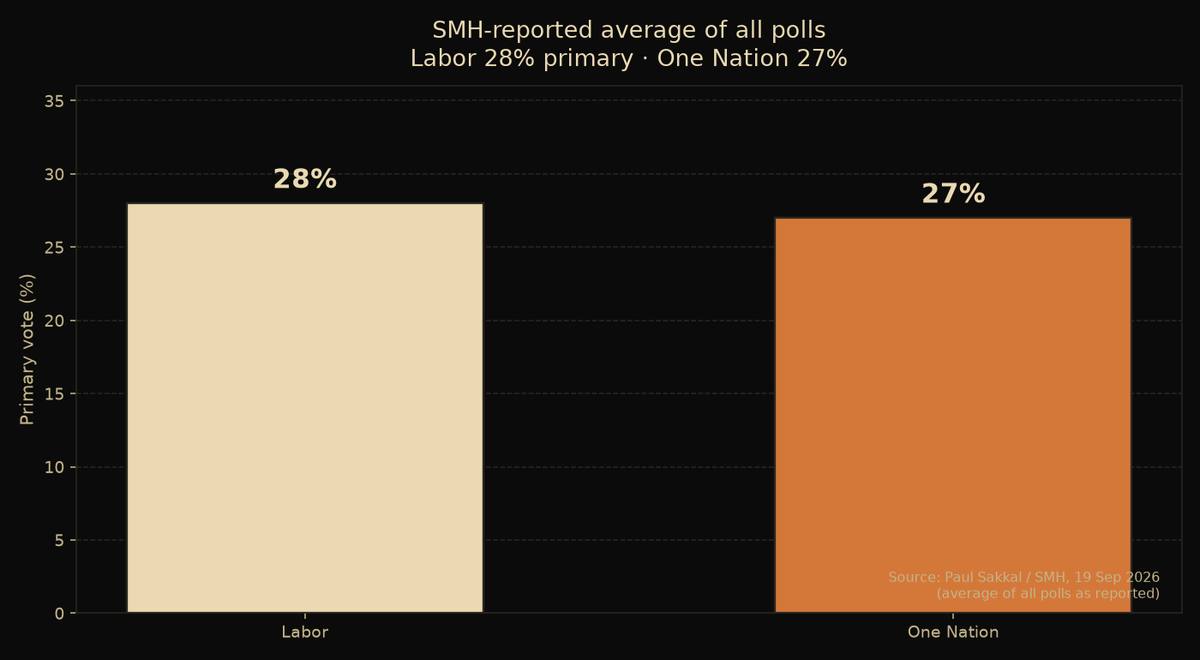
Those are not invented pollster-by-pollster readings. They are the SMH-reported average as published Saturday. Treat them that way. The gap is one point on the primary. The two-party and seat maths still favour Labor today, on Sakkal's account. The political problem is the drift.
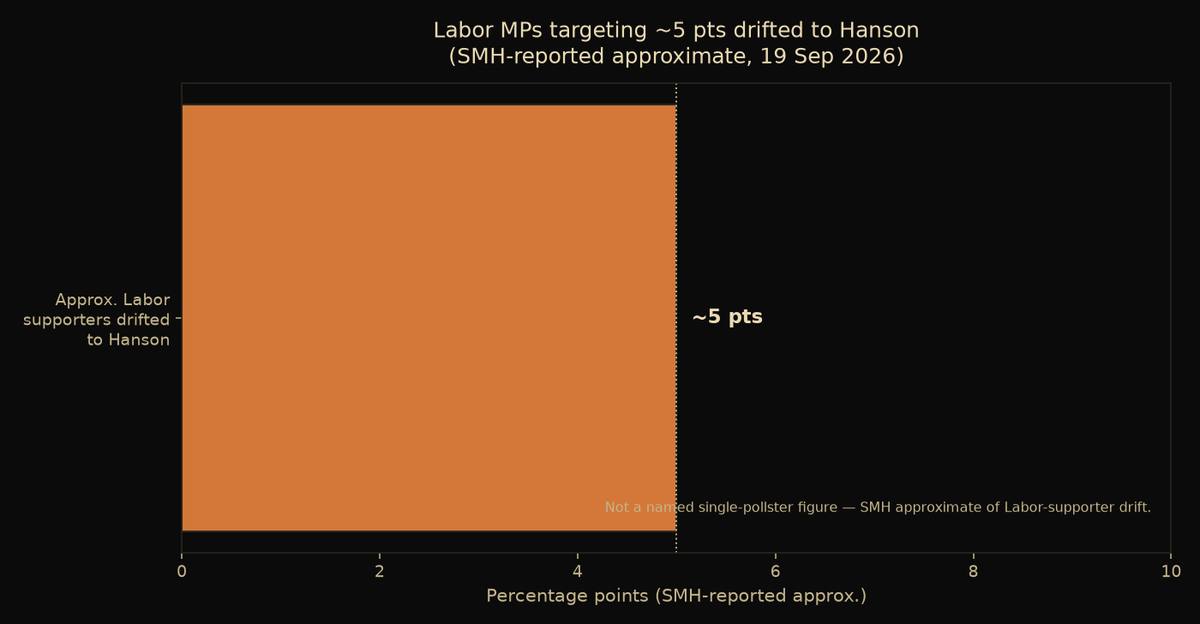
Labor MPs, Sakkal wrote, want to neutralise migration first — Home Affairs Minister Tony Burke tried that on Thursday — then move to fresh cost-of-living relief next year. The target is winning back approximately five percentage points of Labor supporters who have drifted to Hanson.
There is a base problem under the attack line. A survey of 1,000 One Nation voters by Labor-aligned figures Bruce Hawker and John Utting found Hanson still adored by her base despite harsher critiques. Albanese and Labor were uniformly disliked by those surveyed. Sakkal's own gloss is the risk: Bowen's arguments may not carry weight with Hanson's supporters, and could bolster her claim that she is unfairly pilloried.
So Friday's speech works on two audiences at once. Soft Labor-to-Hanson drift voters who might flinch at "exclusive" and "angry." And One Nation's own base, who may hear a Labor climate minister attacking their leader and dig in. The Hawker-Utting work is Labor-aligned. It does not claim to be a neutral national sample. It does tell you why hardheads can believe a strident line is needed and still fear it hardens the other side.
Why now? Sakkal reports Labor hardheads believe recent Hanson controversies have altered the dynamic and opened space for a more strident line. He names three: criticism of Indigenous culture; One Nation labelling Liberal MP Andrew Hastie a traitor; and questioning Anthony Albanese's late mother's use of public housing.
Those fights already have their own files on this desk. They sit here only as the hardheads' cited opening. The Indigenous-culture row produced McCarthy's "racist" frame and Hanson's later qualified "if I've offended people" lines. The Hastie fight was a Coalition-facing loyalty brawl. The mother-and-housing remarks dragged a private family history into the public square. Hardheads, on Sakkal's reporting, read that run of controversy as permission to stop tiptoeing.
Bowen's choice of patriotism as the weapon is the Friday novelty. Not another climate modelling day. Not another wholesale migration press conference. A claim about who gets to love Australia, delivered under Curtin's name.
Seat context matters for why Bowen is the messenger. He holds McMahon, a working-class western Sydney division covering suburbs such as Fairfield, Smithfield, Wetherill Park, Canley Vale and Merrylands. The electorate is heavily multicultural — Assyrian, Chaldean, Iraqi, Vietnamese, Italian, Maltese and Lebanese communities among them. Sakkal's point was simple: One Nation could poll well in a seat like that on cost-of-living and migration heat, but migrant communities may be uncomfortable with Hanson's positions on migration and race. Bowen's western-Sydney Anh Do and Khawaja references land differently there than they would in a regional Coalition stronghold.
That is the local bind. A Labor climate minister attacks One Nation's patriotism in a seat where One Nation can bite, while speaking for communities that may not want Hanson's race-and-migration frame. Friday's speech tries to hold both edges.
Thursday's midweek migration push is the other half of Labor's same-week timing. On 17 September 2026 — Citizenship Day — Tony Burke spoke at the National Press Club on immigration reform. The ministerial transcript is on the Home Affairs site. Burke opened on citizenship ceremonies as "the most joyful and most patriotic events that we have," where a new citizen pledges and the country answers "welcome home."
He rejected the melting-pot metaphor. "Some countries describe themselves as a melting pot. It's not a term I ever use of Australia," Burke said. He preferred an orchestra: different instruments, harmony, not one dissolved shape. That is Labor's midweek patriotism language — softer than Bowen's Friday attack lines, aimed at migration confidence rather than Hanson by name.
Burke discharged what he called absurd claims. Australia, he said, is not dealing with mass migration in the sense some debate implies. Pre-pandemic Intergenerational Report projections for 2030–31 had Australia's population higher; Burke said the country will be 700,000 people smaller than that pre-pandemic projection when that point arrives. On net overseas migration, he said fresh numbers put NOM 47 per cent below the post-pandemic peak, tracking with — or a little below — Budget forecasts.
He went after the yoga-teachers-versus-construction-workers riff. Construction workers brought in had tripled, he said — from about 4,500 to just shy of 15,000 last financial year — while yoga teachers brought in under this government numbered zero. The India-deal yoga listing, he said, came from the previous government. That is Burke's Thursday style: drown a viral claim in departmental figures.
Then the reform headings: who arrives, who stays, who leaves. Points-test redesign with Treasury so housing trades can score like university qualifications. Ministerial Direction 119 priorities for construction, agriculture, fisheries, resources and teaching. Working-holiday ballots for years two and three — 45,000 and 5,000 respectively, against last year's higher qualifiers. No-further-stay on visitor visas. Student progression only up the qualification scale. Migration-agent sanctions for non-meritorious claims. A return toward pre-2015 overstayer compliance with more officers and beds.
Burke insisted the work started last year and was largely formalised by February 2026 — not, he said, a panic rewrite for the present climate. He also said the package is not as comprehensive as he wants because some levers need legislation. For this Bowen file, Thursday matters as Labor's migration-neutralisation attempt the day before the patriotism oration. One Nation's Monday 14 September plan to cut more than 750,000 temporary visa holders and unlawful non-citizens over three years already has its own story. It is the prior pressure Burke was answering. It is not refiled here.
The same Thursday also put Hanson in a Canberra press conference with Payman and Le on personal-adviser staffing under the MOP(S) Act. That joint presser is a separate published file. It sits in the same-week timeline as proof that Hanson was already on the front foot in Canberra while Bowen prepared Friday's Sydney speech. Labor's week was Burke on migration by day and Bowen on patriotism by night. Hanson's week was the 750k migration plan still echoing from Monday, a staffing unity stunt on Thursday, and — as of this filing — no clear public reply found to Bowen's Curtin Oration itself.
Bowen invoked John Curtin's wartime history to argue for an open, liberal strategic stance he says One Nation would put at risk. The centre that hosted him carries Curtin's name for a reason. Curtin's December 1941 Herald article "The task ahead" is still the canonical wartime patriotism text. "Without any inhibitions of any kind, I make it quite clear that Australia looks to America, free of any pangs as to our traditional links or kinship with the United Kingdom," Curtin wrote on 27 December 1941.
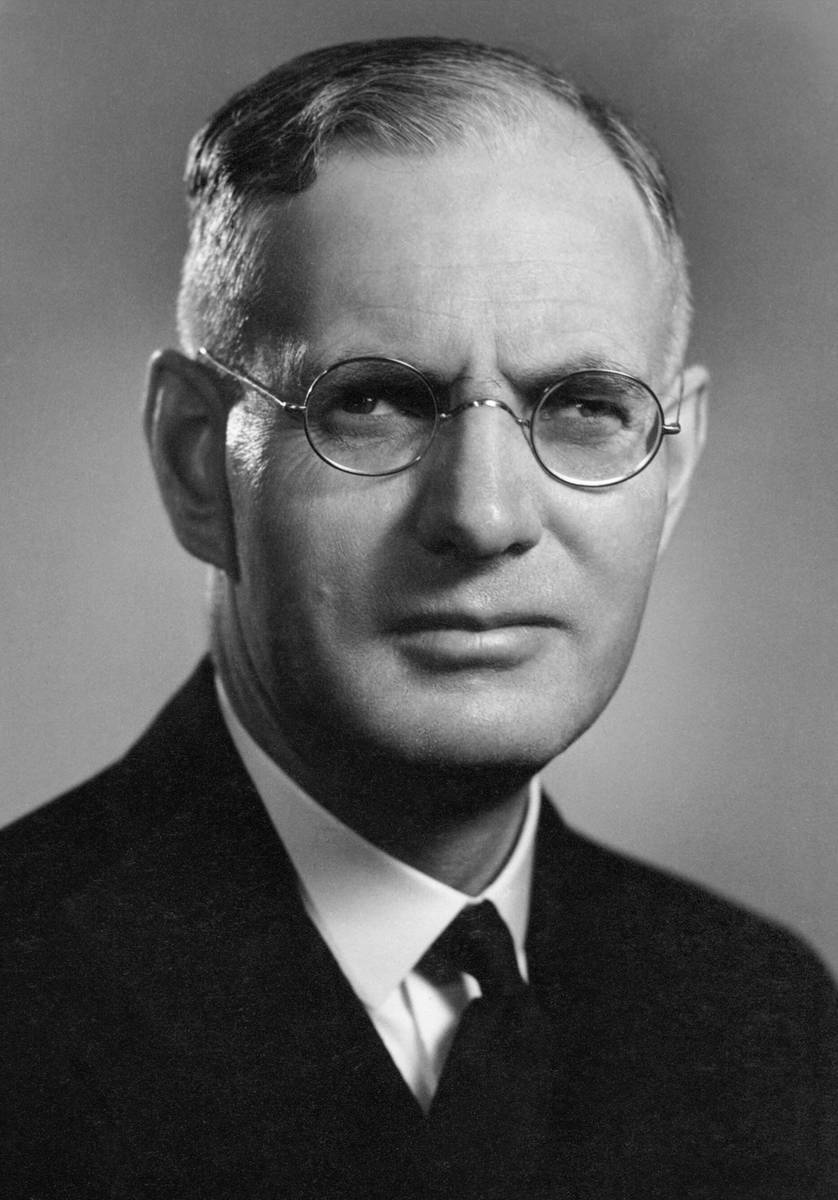
Curtin's patriotism was not a retreat into a smaller map. It was a demand that Australia face a Pacific war on a war footing, reshape daily life, and choose the alliances that could hold the continent. "I make it clear that the experiment undertaken was never intended as one to awaken Australian patriotism or sense of duty. Those qualities have been ever-present," Curtin wrote — the problem was dormant talent and missing direction, not missing love of country. "All Australia is the stake in this war. All Australia must stand together to hold that stake."
Bowen's Friday move was to drag that outward-facing Curtin memory into a 2026 fight about One Nation, renewables, and who counts as Australian. Whether that historical borrow persuades anyone outside a Labor dinner is a separate question. The borrow itself is on the record via Sakkal's advance-copy reporting: Curtin as strategic warrant for staying open and influential.
Sakkal placed Albanese's New York UN trip — tech regulations, AI investment — beside Bowen's economic patriotism. The PM abroad selling rules and capital; the energy minister at home defining love of country as sovereign supply chains and renewable advantage. That is coordinated messaging whether or not the diaries were plotted as a single package. It also hands One Nation a familiar counter: Labor talks patriotism while the prime minister works the multilateral room Hanson campaigns against.
Listen for what the speech, as reported, did not do. Sakkal's piece does not give a full paragraph-by-paragraph transcript. It gives the attack lines, the progressive-patriotism economic case, the poll frame, the Hawker-Utting warning, and the hardheads' controversy list. It does not, in the published extract, stage a point-by-point rebuttal of One Nation's Monday migration numbers. Burke had carried migration on Thursday. Bowen carried identity and nation-building on Friday.
It also does not invent Hanson at the lectern answering back. As of this filing, no clear Hanson or One Nation primary-source response to this specific Curtin Oration turned up with a reliable URL. If she answers later, that is a new story. Do not write a reply that is not on the record.
On the video record: searches for an official full YouTube of the 2026 Curtin Oration did not turn up a reliable complete upload of Bowen's speech. The centre's social channels posted event colour. Separate Bowen energy speeches from other 2026 forums exist on YouTube and are not this oration. This article's youtubeId stays null until a clean official oration video appears.
A short word on how to read the SMH average. "Average of all polls" is a journalist's blend, not a single Essential or Newspoll release. Sakkal did not, in the Saturday piece, publish the individual pollster series behind the 28 and 27. So the honest presentation is: SMH-reported average, Labor 28, One Nation 27, Labor still winning today, about five points of former Labor support drifted toward Hanson. Anything finer would be invention.
Primary vote is also not seats. A party can sit near 27 per cent nationally and still convert poorly under preferential voting, or convert dangerously in selected outer-suburban and regional contests. Sakkal's "would still win today" line is the present two-party comfort. The peril he names is the slow primary bleed and the Labor-to-Hanson slice inside it.
Put the week on a single rail. Monday, 14 September: One Nation's 750,000-over-three-years temporary-migration cut plan lands (already filed). Thursday, 17 September: Burke's National Press Club immigration reform speech on Citizenship Day; same day, Hanson-Payman-Le staffing presser in Canberra. Friday, 18 September: Bowen delivers the Curtin Oration in Haymarket, 6–11 p.m., Hay St Market by Doltone House. Saturday, 19 September: Sakkal's SMH piece from the advance speech copy. Through the same window: Albanese toward UN New York on tech and AI.
That is why Friday's patriotism speech reads as escalation rather than a one-off dinner toast. Migration softener midweek. Identity hardener on Friday. Cost-of-living relief flagged for next year as the later clawback tool.
Does Bowen's line work? The Hawker-Utting survey says the One Nation base may not care what a Labor energy minister thinks about patriotism. Soft Labor drift voters might. McMahon's migrant communities might. Coalition voters who disliked the Hastie "traitor" episode might notice Labor finally swinging hard. Or they might see a government on 28 per cent primary picking a culture fight while power bills and rents still set the kitchen-table agenda.
Bowen's personal brand is part of the wager. Sakkal notes his green agenda has made him a figure of derision among conservatives. Putting him on patriotism means Labor is using a minister One Nation already loves to hate. That can clarify the contrast. It can also let Hanson say the attack proves the point.
Progressive patriotism as slogan has Albanese's imprint. Bowen's Friday job was to flesh it with sovereign supply chains, value-added resources, and renewable advantage — and to say wanting less global influence is cultural cringe. That is an economic patriotism. It asks voters to hear a wind farm and a critical-minerals plant as flags, not as culture-war props. Whether that translation holds outside a Curtin Centre dinner is the test Labor has now put on itself.
Three things to watch from here, without padding. One: any on-record Hanson or One Nation reply that quotes the Curtin Oration directly. Two: whether Labor's next cost-of-living package arrives with the same patriotism wrapping, or returns to pure hip-pocket language. Three: whether McMahon and similar western Sydney seats show One Nation primaries that match Sakkal's warning, or whether migrant-community pushback caps the rise.
None of those are predictions. They are the open edges of Friday's file.
Expand the Burke Citizenship Day frame one notch further, because it is Labor's midweek patriotism language in the minister's own words. Burke closed the Press Club speech on the pledge itself: "From this time forward" — some say "under God," half do not — "I pledge my loyalty to Australia and its people whose democratic beliefs I share, whose rights and liberties I respect, and whose laws I will uphold and obey." The Commonwealth's answer, he said, should be "welcome home." That is the soft patriotism Bowen hardened twenty-four hours later.
Burke also put housing beside migration without blaming immigration for the shortage. Since the Hawke years, he said, Australia's population rose about 75 per cent while the number of homes rose about 100 per cent. Household size fell from 2.9 people to 2.5. Every 0.1 drop, he said, means finding roughly another 450,000 homes. His claim on Thursday was that immigration must soften enough for housing supply to catch up, not that migrants caused the crisis. That is the technocratic midweek case. Bowen's Friday case was cultural and strategic. Labor ran both in one week.
On backpackers, Burke gave a concrete NOM figure: last year's contribution of working holiday makers to net overseas migration was 48,000. He used it to kill the idea that some visa classes sit outside NOM. UK backpacker numbers, he said, sat near 17,000 when the free-trade deal was signed, against a previous peak around 35,000, and now sit just shy of 80,000 — which is why UK WHM processing stays slow while regional-requirement streams return toward normal pace. Those are Thursday's dials. They are the migration machine Bowen did not re-litigate on Friday because Burke had already opened the casing.
Visa hopping got a careful split. Burke said the student-to-graduate-to-sponsor-to-permanent path can be the system working at its best. The problem path is the person who will never qualify for permanence, jumps visa to visa, uses appeals, and eventually becomes too embedded — citizen children, local ties — for removal to feel tidy. Disingenuous protection claims from countries where more than 85 per cent of applications fail, he said, make up 80 per cent of that caseload. He wants legislation for parts of that fix. Again: Thursday detail, Friday patriotism. Same government, two registers.
Return to Bowen's "small patriotism" sentence and sit with the named fears. He listed globalism, the World Economic Forum, the United Nations, and "other conspiracy-theory laden concepts of a scary world." That is a direct swing at the online and rally vocabulary One Nation's ecosystem often shares with broader populist media. Bowen is saying those fear objects produce a patriotism that shrinks Australia's conception of itself. Supporters of Hanson will say those institutions do constrain sovereignty. Bowen's Friday wager is that naming the fear as conspiracy-laden peels soft voters away. The Hawker-Utting work says the hard base will hear persecution instead.
The Anh Do and Usman Khawaja pairing deserves a plain beat. Do is a comedian, author, artist — a Vietnamese-Australian public figure whose memoir and television work made western Sydney's refugee-to-celebrity arc mainstream. Khawaja is an Australian Test cricketer, also raised in western Sydney, one of the country's most visible Muslim sportsmen. Bowen placing them inside "most celebrated authors and sportsmen" is an argument that modern Australia's face is already theirs. It is also seat geography: McMahon and neighbouring western Sydney seats live that demography daily. A patriotism that "don't look like, or pray like" excludes is, in Bowen's telling, a patriotism that excludes the suburb he represents.
Critical minerals and sovereign supply chains are not decoration in Bowen's mouth. Australia's policy debate for several years has tied lithium, rare earths, nickel, and processing capacity to alliance politics and industrial policy. Bowen's Friday claim is that wanting Australia less central to those chains is unpatriotic cultural cringe. One Nation's energy politics have often run the other way — coal extension, scepticism of the renewables build, attacks on Bowen's portfolio personally. The Curtin Oration tried to flip the moral charge: the renewables build as love of country, the retreat from influence as the unpatriotic move.
Sakkal's "not in full panic mode" line is doing quiet work. It tells Labor MPs and readers that the government still believes it wins a hypothetical election tomorrow, even at 28 versus 27 on the primary average. Panic would look like a leadership spill story or a junked energy target. What Friday looks like instead is a messaging escalation inside a still-governing party. The perilous part is the slow bleed and the five-point Labor-to-Hanson slice. That is a repair job, not a last-night job — unless the primary keeps sliding.
How does preferential voting shape the scare? In Australia's House, a high One Nation primary can exhaust or preference in ways that hurt Labor in some seats and hurt the Coalition in others, depending on how-to-vote cards and voter habit. Sakkal's Saturday piece did not map seat-by-seat preference flows. So stay honest: the national primary average is close; Labor would still win today on the SMH account; the contested slice is former Labor support now parking with Hanson. Everything else is model territory this file does not invent.
The Hastie "traitor" controversy sits in the hardheads' list because it showed One Nation willing to brand a Liberal defence figure in loyalty language. For Labor, that episode is useful evidence that Hanson's circle will punch sideways into the Coalition, not only upward at Albanese. For the Coalition, it was an internal wound. Bowen's Friday speech does not need to re-litigate Hastie's words. It only needs the public memory that One Nation's patriotism talk has already been used as a loyalty weapon against other conservatives. Labor hardheads, per Sakkal, read that as space.
The Albanese mother and public-housing remarks sit on the list for a different reason: they tested whether Hanson would police her own tone when a private family history entered the fight. The later qualified apologies — "if I've offended people" — are their own story. Hardheads citing that run are saying the electorate has seen Hanson under pressure and that Labor can now risk a sharper patriotism contrast without being the first to escalate. Whether that reading is right is politics. That they hold it is the Sakkal report.
Venue geography one more time, because Haymarket is not a neutral backdrop. The suburb sits on Gadigal land in central Sydney's southern CBD fringe — markets, Chinese and Southeast Asian business strips, student traffic, theatre crowds, Doltone House function rooms. A Labor minister defining exclusive patriotism as denying love of country to people who "don't look like, or pray like" themselves, while speaking a short walk from Dixon Street's arches, is making the setting part of the argument even if he never names the street. The still used here is Dixon Street itself: subject-true place, not a staged crowd.
What about the Coalition in this frame? Sakkal notes Labor and Coalition figures have sometimes avoided arguments that might rankle Hanson's base. Bowen's speech is Labor breaking that avoidance on patriotism. It does not, in the SMH extract, draft a Coalition patriotism counter. The opposition's problem remains preference maths and how hard to go at Hanson without bleeding primary votes. This file stays on Bowen's oration. The Coalition's answering speech, if it comes, is another day.
Cost-of-living relief "next year" is the third leg Sakkal names after migration neutralisation. Friday's patriotism talk does not cut power bills. Labor's own sequencing, as reported, is: stop the migration bleed politically, then buy back hip-pocket trust with relief measures in the following year, while using identity language to stop the moral frame belonging only to Hanson. That is a multi-quarter project described in one Saturday newspaper story. Bowen's oration is one night inside it.
A note on advance copies. Sakkal wrote from an advance copy of Bowen's speech. That is normal for set-piece orations. It means the quotes are the speech Labor wanted on the record, not a hot-mic fragment. It also means as-delivered ad-libs, if any, are not in the SMH extract unless noted. This article sticks to the published advance-copy quotations and Sakkal's reported context. No invented room colour. No invented applause lines.
John Curtin Research Centre events are Labor-movement intellectual infrastructure — essays, dinners, orations — not government departments. Hosting Bowen for the 2026 Curtin Oration puts a Cabinet minister inside a factional and theoretical tradition that claims Curtin's wartime nation-building for contemporary social-democratic politics. Stronger Australia as programme title already telegraphs the theme Bowen then spoke. The patriotism clash with Hanson is the news; the centre's branding is the intentional stage.
Metric plainness on the poll gap: one percentage point between 28 and 27 is inside ordinary poll noise for many single surveys, which is why the "average of all polls" phrasing matters. A blended average sitting that close for weeks is a political fact even when any one poll wobbles. Sakkal's peril language attaches to Labor's months-long primary decline, not to a single spike. One Nation at 27 per cent primary as an averaged fact would have been unthinkable in many earlier parliamentary terms. That is the shock inside the calm "not full panic" sentence.
Bowen's "country we have become" phrase is doing the philosophical work. It accepts demographic and cultural change as already constitutive of Australia, then makes acceptance of that change a patriotism test. Hanson's politics often treat the same change as loss. Those are incompatible love stories about the same map. Friday's speech did not pretend they can be split-the-difference reconciled. It picked a side and called the other side's patriotism small, angry, and exclusive.
If you only remember three quotes from the oration as SMH reported them, make them these. One: "You can't claim to be a patriotic Australian when you don't actually like the country we have become." Two: the deny-the-right-to-love line about those who "don't look like, or pray like, themselves." Three: "It's cultural cringe and fundamentally unpatriotic to want your country to be less influential in the world." Identity, inclusion, power. That is the triad.
And if you only remember one caution, make it Hawker and Utting's: Hanson adored, Labor disliked, among 1,000 One Nation voters surveyed by Labor-aligned hands. Bowen's Friday night can be right on Labor's own terms and still thicken Hanson's martyr narrative on hers. Both things can be true in the same week. The edition that ships this story does not have to pick a winner. It has to put the speech, the polls, the same-week Burke migration push, and the missing Hanson reply on the record without refiling the older One Nation fights as if they were new.
One more sourced beat on Curtin's wartime frame, because Bowen reached for it and the centre's name demands the primary text. Curtin's 27 December 1941 article treated the Pacific war as a new war, not a subordinate theatre, and demanded Australia place every citizen on a war footing. "I demand that Australians everywhere realise that Australia is now inside the firing lines," he wrote. The patriotism Curtin described was mobilisation and alliance choice under threat of invasion, not a culture-war sorting hat. Bowen's 2026 use of Curtin is analogical: openness and influence as national defence by other means. Analogies can illuminate. They can also over-claim. The primary texts are Sakkal for Bowen and the Herald article for Curtin. Readers can test the fit themselves.
On the JCRC night itself, public materials described tickets and the Stronger Australia Programme culmination ahead of 18 September. Post-event coverage confirmed Bowen spoke. The SMH Saturday article is the best primary for the patriotism quotations. Bowen's ministerial speeches pages, as checked for this filing, did not surface a separate full oration transcript beside Sakkal's advance-copy quotes. If a full transcript lands later on a government or centre URL, update the sources note. Until then, the SMH extract is the citation spine.
Bowen's McMahon biography is part of why Labor put him on this message. He grew up in Smithfield and Fairfield. The seat's Assyrian, Chaldean and Iraqi communities are not a footnote in his local work. When he says patriotism that excludes people who pray differently is small patriotism, he is talking about neighbours and parish calendars his office already knows. That does not make the national argument automatically persuasive. It does explain why the messenger is not a random Cabinet name drawn from a safe inner-city seat.
Renewables as patriotism will draw the obvious One Nation counter even without a formal reply to this oration: that Bowen's energy transition raises household costs and that calling bill pain unpatriotic is elite framing. Sakkal's piece already flags Bowen as a conservative derision target. Friday's speech leans into that fight rather than ducking it. The political question is whether soft Labor drift voters hear "sovereign supply chains" as jobs and pride, or as another lecture from the climate minister they already blame for power prices.
Keep the older One Nation files in their lanes. Secret Harbour was a WA by-election result. The 750k plan was Monday's migration stock cut. McCarthy and the Indigenous-culture remarks were a separate racism-frame fight. The qualified apologies were Tuesday corridor language. Hastie was a Coalition loyalty brawl. The Payman-Le staffing presser was Thursday's procedural unity stunt. This Friday file is Bowen's Curtin Oration on patriotism. Background cites only. No refile.
Bowen's Friday sentence still sits at the centre. "You can't claim to be a patriotic Australian when you don't actually like the country we have become." Hanson has built a career telling voters the country has gone wrong. Bowen spent a Curtin Oration saying that complaint disqualifies the patriotism claim. The polls say the argument is no longer theoretical. One point separates the primaries in the SMH average. Labor still wins today. The fight is over the next five points — and over who gets to say they love Australia without flinching at the Australia that exists.
The paper
Comments
No notes on this story yet.
Sign in to comment