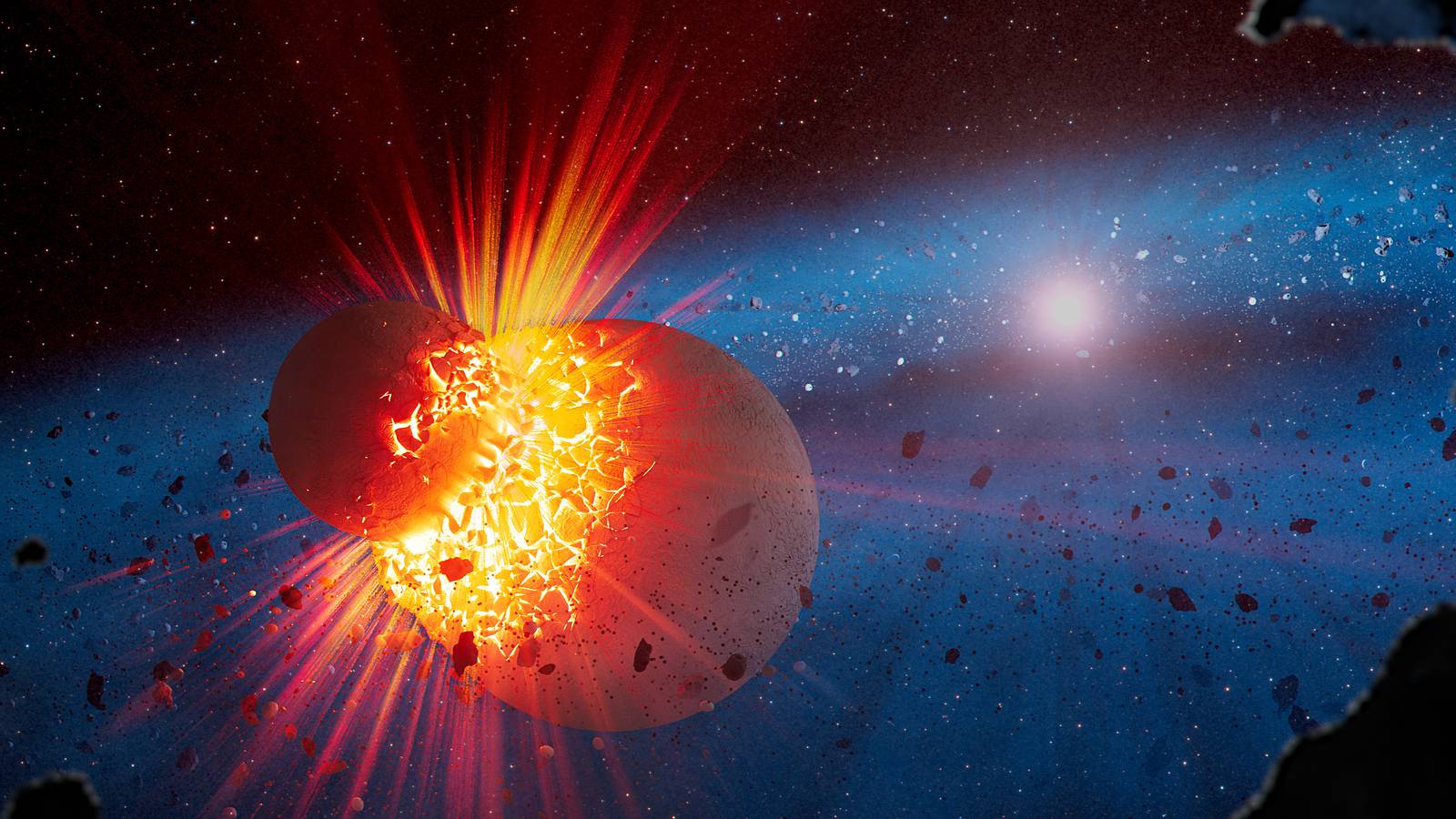

NASA's James Webb Space Telescope has given astronomers their best look yet at a rare kind of young star system where rocky worlds are smashing into each other. In a release on 1 October, NASA said a team led by Kate Su of the Space Science Institute in Boulder, Colorado, studied 21 of these "extreme debris disks" and sorted them by the minerals in their dust.
What came out is a rough way to tell a big collision from a smaller one. About one-third of the disks look like the aftermath of high-energy impacts between Mars-sized bodies. That's the same kind of crash scientists think made our own Moon.
What an extreme debris disk is
Young stars start out wrapped in gas-rich discs, and that's where planets form. As a system gets older, that gives way to a thinner, gas-poor debris disk made mostly of dust. NASA's retired Spitzer Space Telescope found that some debris disks are odd. They hold unusually large amounts of warm dust close to the star, in the zone where rocky planets like Earth orbit in our solar system. Astronomers called this subclass extreme debris disks.
They're rare. NASA says theory predicts we should see plenty of them, but only about 1% of young stars show signs of this phase in the data collected so far. That made it hard to study them as a group.
Su's team got around that by pooling data. Their sample of 21 disks includes five from Spitzer's archive and 16 observed with Webb. Of the Webb targets, 12 were newly observed and four were follow-ups on systems Spitzer had already flagged.
"This is the first time we have gathered enough systems to truly understand this subclass that we call extreme debris disks," Su said in NASA's release. "Before Webb, we had limited information. We knew that they are weird and very different from the typical cold debris disks that we know, like Vega and Fomalhaut. Now that we have more data, we can pin down what these disks represent for planet formation and evolution."
Reading the minerals in the dust
The team used mid-infrared spectra from Webb and Spitzer. Those split the dust's light into fingerprints of what it's made of. NASA says that confirmed three shared traits. The dust grains are smaller than in protoplanetary or ordinary debris disks, the warm dust is packed in tight, and the brightness changes in irregular ways.
The paper, accepted for publication in The Astrophysical Journal, goes a bit further. Its abstract says the grains are mostly smaller than a micrometre and have been heated and changed, with high levels of silica and crystalline silicates. The authors conclude that the dust in these systems comes from large collisions between Moon-sized and Mars-sized bodies.
The key split is silica. NASA's release uses everyday examples to explain it. Volcanic glass such as obsidian is a silica-rich material on Earth. The silica-poor mineral forsterite turns up as the green sand on some Hawaiian beaches.
Agnes Kospal of Konkoly Observatory in Budapest, one of the coauthors, said: "To just see their mid-infrared emission and beautiful spectral features with Webb, which allowed us to identify their compositions, was the most exciting thing for me. We have no other way to study these planetary embryos directly because they are too small."
Big crashes, small crashes
About one-third of the sample is silica-rich. The team reads that as a sign of high-energy impacts between Mars-sized bodies, violent enough to vaporise a big share of the material. The other two-thirds are silica-poor. That points to smaller events, such as grazing collisions between Moon-sized objects.
Age matters too. NASA says silica-rich disks turn up only around stars younger than 300 million years. Silica-poor disks show up across a wide range of ages, and they often flicker more in infrared brightness. The team thinks that flicker comes from fresh debris changing quickly as orbits shift and more impacts happen.
That fits with what simulations say about how planets get built. Rocky planets like Earth should form within the first few hundred million years of a solar system's life. That lines up with the ages of the silica-rich disks seen so far.
What it says about Earth and the Moon
The link to home is why this result matters beyond the specialists. Scientists think that early in the solar system's history, a Mars-sized object called Theia hit the young Earth and blasted vaporised rock into space. Some of that material came together to form the Moon. NASA's release notes estimates that Earth and the Moon formed about 100 million years after the Sun.
So the silica-rich disks may be showing other stars going through their own Moon-making era. According to NASA, our solar system may have had more than one extreme debris disk phase.
The silica-poor disks could tie into a different chapter. NASA says that if the older silica-poor disks and their random brightness swings really do reflect unstable orbits, that would be broadly consistent with the Late Heavy Bombardment hypothesis. In that picture, the giant planets moved long distances, knocked smaller bodies off course and set off a wave of collisions.
"How rocky planets formed and giant planets evolved are part of the broader story of the solar system's formation. It's all one story," Su said. "Our work on extreme debris disks helps us bring together the big picture of what we currently understand."
What the team wants next
The researchers are upfront about what they don't know. Attila Moor of Konkoly Observatory, another coauthor, said: "Of course, there's many things we still don't know about these disks. We expect no silica-rich systems among older extreme debris disks. We only have three disks in our sample that fit that age criteria, so it'll be nice to observe more of these systems to confirm our hypothesis."
Three is a small number to hang a pattern on, and the team says as much. Still, 21 systems is the biggest set of these disks studied together, and it hands future observers a clear test. If more older systems turn up and they're all silica-poor, the picture holds.
It's the second time in a few weeks Webb has helped piece together how our neighbourhood was built. In September, Hubble and Webb's first joint survey beyond Neptune looked at the smallest icy bodies out there, which carry their own record of the solar system's early days. And NASA's newest infrared eye, the Nancy Grace Roman Space Telescope, is on its way to its orbit about 1.5 million km from Earth.
Webb is an international programme led by NASA with the European Space Agency and the Canadian Space Agency. NASA's release includes an artist's concept of an extreme debris disk and an illustration of how disk make-up changes over time. Both are credited to NASA, ESA, CSA and Joseph Olmsted of STScI.
The paper
Comments
No notes on this story yet.
Sign in to comment