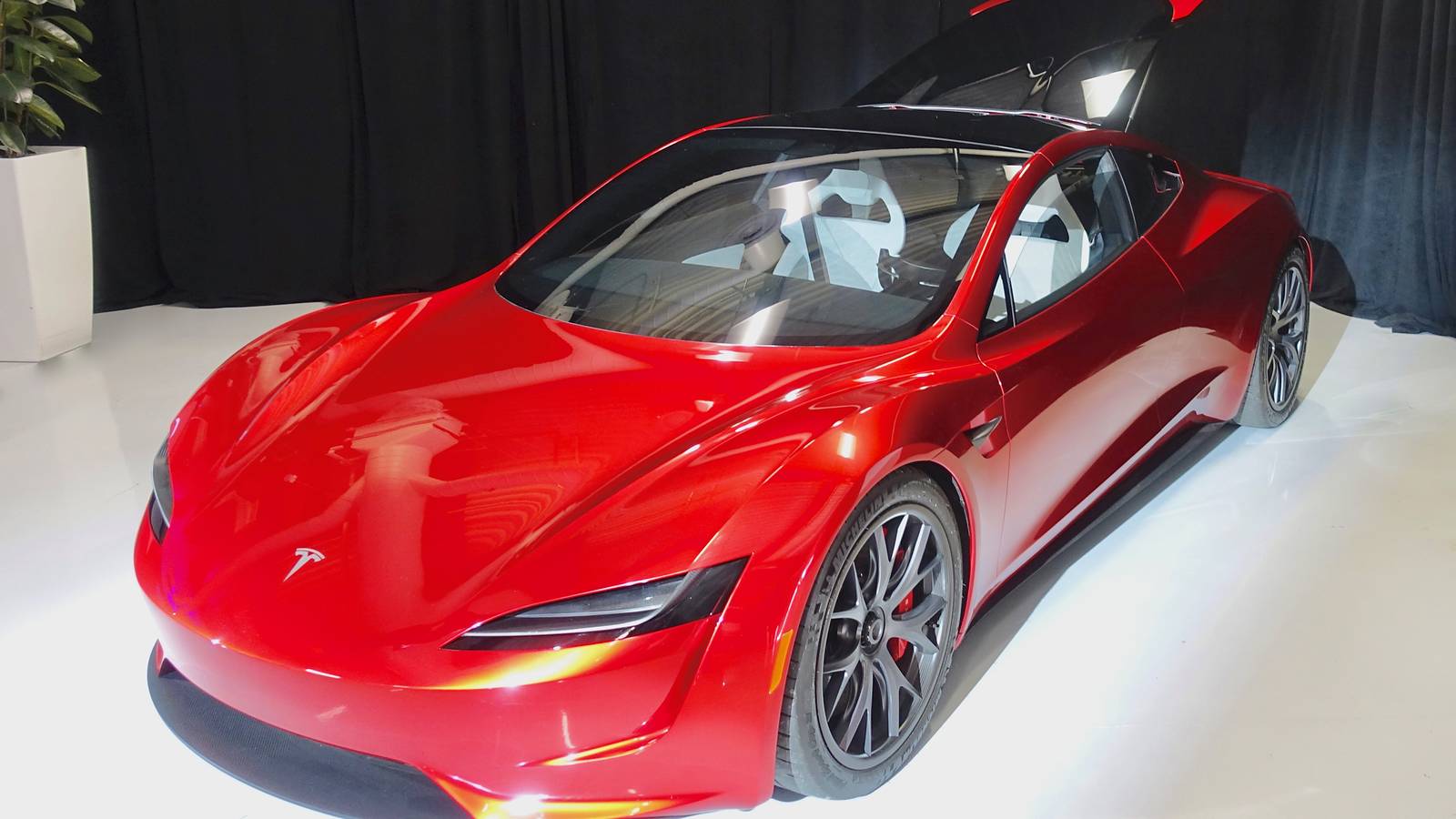

Tesla's pushed back the reveal of its next-generation Roadster to Thursday 15 October, two weeks after the original date of 1 October. The reason it gave was the forecast. "We've been tracking the weather closely with local meteorologists, but given the severe conditions predicted & because this event can only be held outdoors, we've made the difficult decision to reschedule," Tesla posted on X on Monday 28 September US time, Electrek reported.
"New date is October 15," the post went on. "Additional details to follow." Elon Musk then added a line of his own, according to Tesla Oracle: "Due to high winds, the new Roadster demo is postponed by 2 weeks."
Why the weather matters this time
Most car reveals happen on a stage. Tesla says this one can't. Where it'll actually be held, and what'll happen there, is still unconfirmed. Electrek reported that the event is expected at SpaceX's rocket test site in McGregor, Texas, near Waco. It also reported that the plan is to make the Roadster hover using a cold-gas thruster package built by SpaceX, with nobody in the car and spectators kept several hundred metres back. Tesla hasn't confirmed any of that.
The forecast for 1 October really did look rough. Electrek checked Open-Meteo data for McGregor on Monday afternoon and found an 82% chance of rain on Thursday, with thunderstorms, gusts of around 48 km/h and more than 100 mm of rain. The same data had the storm clearing by the weekend, with no measurable rain forecast from 5 to 7 October.
So does a storm that's gone in two or three days need a two-week delay? Electrek doubted it. Teslarati saw it differently. In a piece on 1 October, it argued that wind could upset a high-speed run or an acceleration demo, not just a hover, and that after nine years, waiting for good conditions made sense. Both of those are opinion. What's actually on the record is Tesla's post and Musk's line about high winds.
How we got to 15 October
Tesla first showed the second-generation Roadster as a prototype in November 2017. Back then it said production would start in 2020. That came and went.
The car came back into view this year. On 14 September, Tesla posted a graphic on its official account showing the date "10.01", Charge News Canada reported, and the Roadster web page switched to a countdown. Ten days later, at the Semi production launch in Sparks, Nevada, Tesla teased the Roadster again, as we reported.
Monday's announcement cut it fine. Teslarati noted that Tesla posted the change on Monday, and Musk followed with his comment about high winds less than 24 hours later.
Electrek has kept a running list of earlier targets for the demo. It was meant to happen by the end of 2025, then on 1 April 2026, then late April, then August, then 1 October. Tesla's production guidance, according to Electrek, is still "2027 or 2028".
Charge News, citing The Information, reported that the long wait goes back to a 2022 decision inside Tesla's design studio. Two teams worked on rival ideas. One was based on a stretched Model S Plaid, the other was built around a carbon-fibre tub. Musk picked the carbon-fibre route and told staff to "do it correctly or not at all", according to that reporting. Tesla hasn't commented on it.
A car with SpaceX ties from the start
The original Roadster was Tesla's first car. It was based on the Lotus Elise and went on sale in 2008. Production stopped in 2012 after roughly 2,450 were built. Musk's own Roadster flew as the dummy payload on the first Falcon Heavy launch in February 2018, and it's still circling the Sun.
The thruster idea isn't new either. Musk's talked for years about a SpaceX option package for the new car, and Tesla Oracle reported that the thrusters are meant to cut the Roadster's 0 to 97 km/h time to around one second. Musk has suggested they could sit behind the number plate, which, as Tesla Oracle pointed out, would mean the plate has to flip out of the way. Whether any of that makes it into a road-legal car is a different question from whether it works on a test site.
That's why the venue matters, if Electrek's right about it. A remotely operated car lifting off on cold-gas thrusters in front of a crowd is closer to a rocket test than a product launch. Electrek said the demo would run with no one inside, which would fit a site built for testing SpaceX engines.
What Tesla has promised before
The 2017 prototype came with big claims. Tesla said it'd hit 100 km/h in under two seconds and go more than 965 km on a charge, Charge News noted. Musk later said a SpaceX package would make it quicker still. None of those numbers has been confirmed for a production car, and 15 October is the first chance to see which ones survive.
Musk himself has sounded careful about the demo. Electrek reported that he told staff it "will be hard to pull off and could go wrong". That's a second-hand account, though, and Tesla hasn't confirmed he said it.
Reservations are open again. Electrek and Tesla Oracle both put the reservation at US$50,000, with US$250,000 for the Founders Series. In Germany, electrive reported that buyers pay an initial €4,000 deposit, then a mandatory bank transfer of €39,000 within ten days.
Questions for 15 October
There's a lot Tesla still hasn't said. It hasn't confirmed the venue, a price for the production car, final specs or a delivery date. Electrek also raised a regulatory point, noting that features like the thruster system could struggle to get road approval in the EU.
For buyers who've had money down for years, those details matter far more than any hover. Tesla says "additional details" will follow before the new date.
The rest of Tesla's October is busy. Third-quarter production and delivery figures were due on Friday 2 October US time, full quarterly results follow later in the month, and the Roadster now lands in the middle of it all, on a Thursday exactly two weeks after its first date.
If the weather holds this time, 15 October will be the first public look at the production Roadster in almost nine years.
The paper
Comments
No notes on this story yet.
Sign in to comment