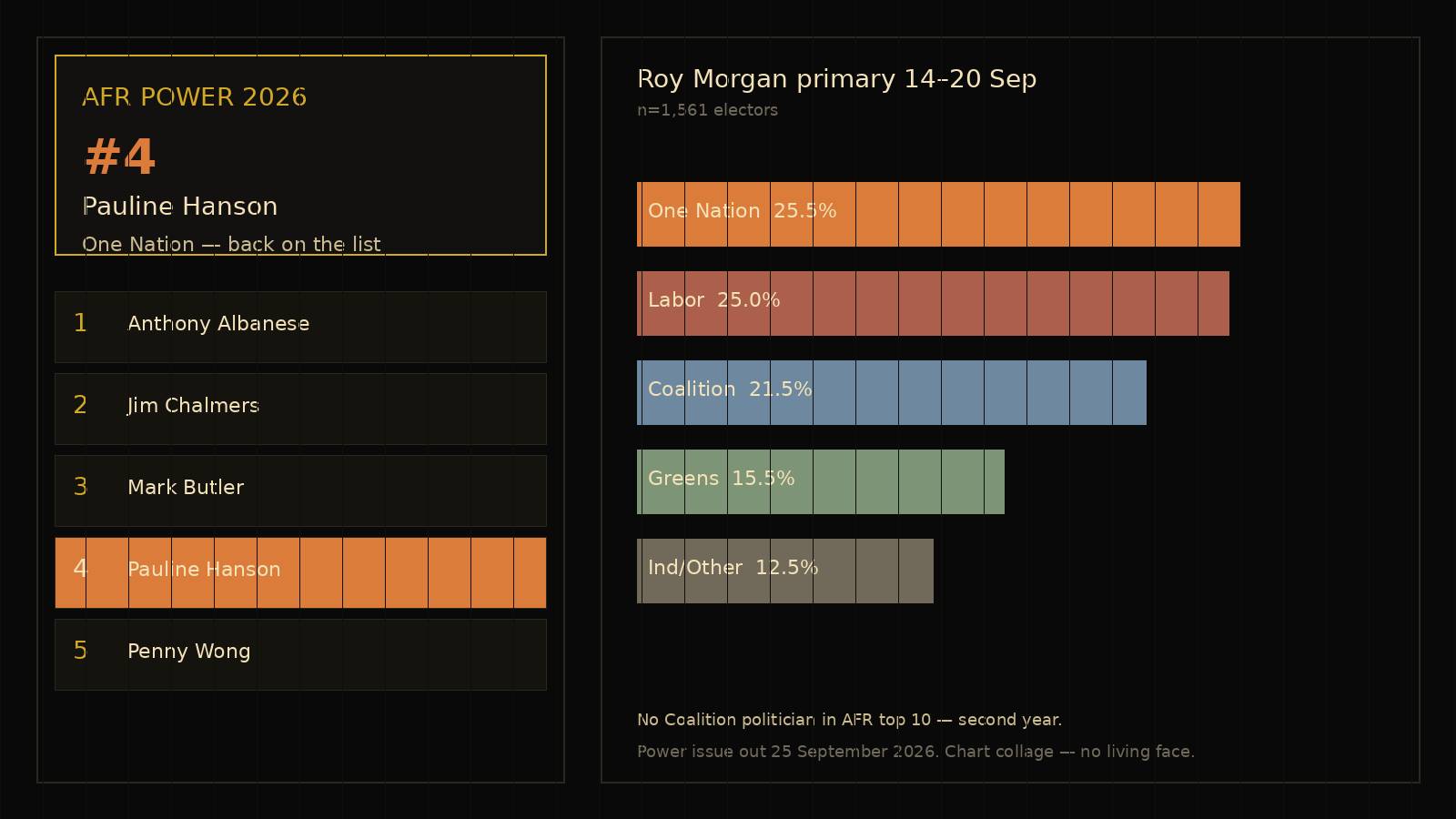

Pauline Hanson is fourth on the Australian Financial Review's Power list this year. She wasn't on it last year. She's back, and the panel put her behind only the Prime Minister, the Treasurer, and the Health Minister.
Here's the short version of Tuesday's file. Coverage dated Tuesday, 23 September 2026, put Hanson at No.4 on AFR Magazine's annual Power ranking. Anthony Albanese sat at No.1 for a second year. Jim Chalmers was No.2. Mark Butler was No.3. Hanson came next. The Power issue itself is out on 25 September 2026. Nine's Tilli Andrew carried the same top-line ranking the same morning, and the AFR's own politics write-up framed her return as a signal that the country's power map has shifted.
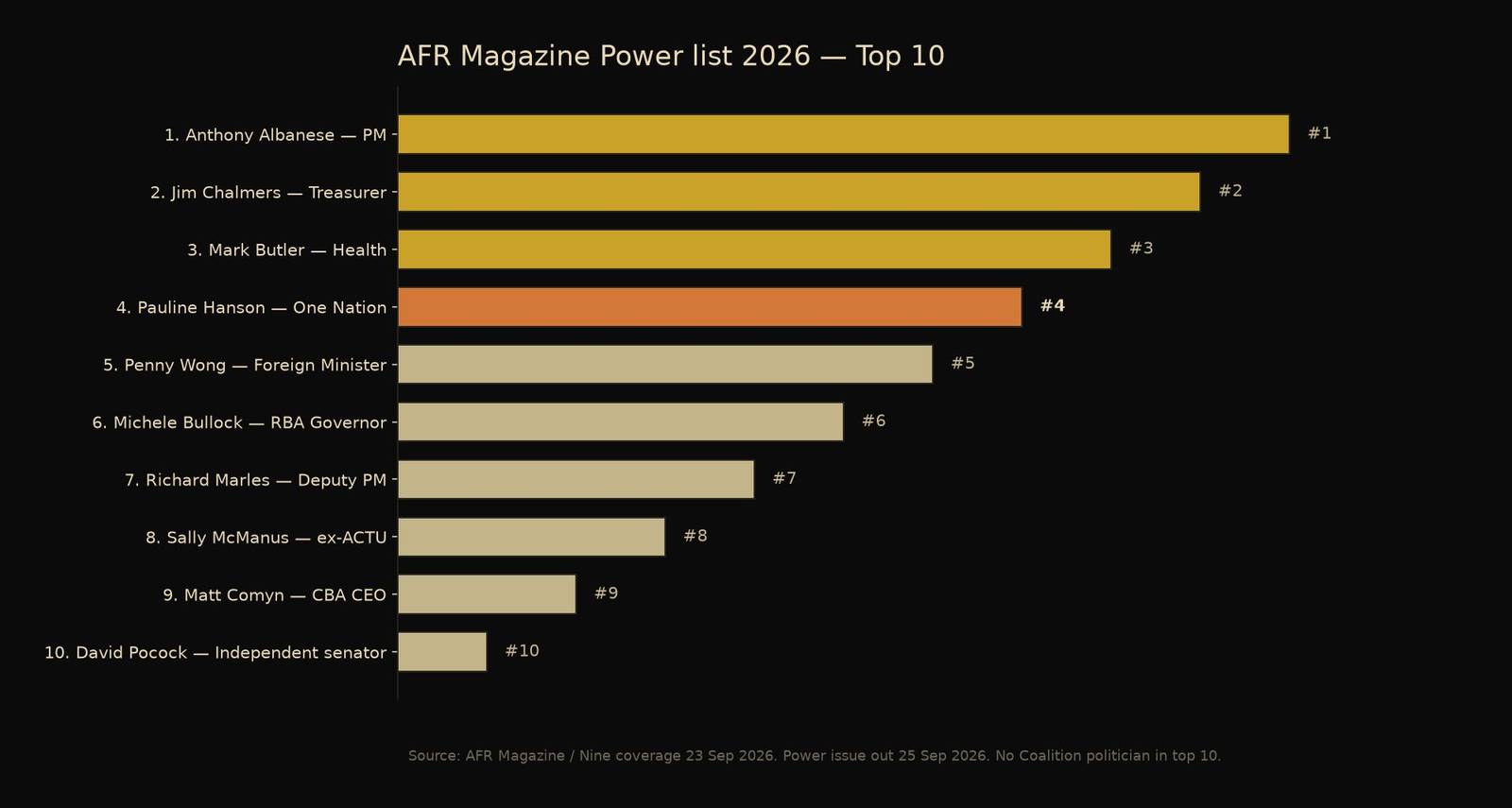
The rest of the top 10, as Nine and the AFR printed it, ran like this. Foreign Minister Penny Wong at five. Reserve Bank governor Michele Bullock at six. Deputy Prime Minister Richard Marles at seven. Former ACTU secretary Sally McManus at eight. Commonwealth Bank chief executive Matt Comyn at nine. Independent senator David Pocock at ten. No Coalition politician made the top 10. That's the second year running without one.
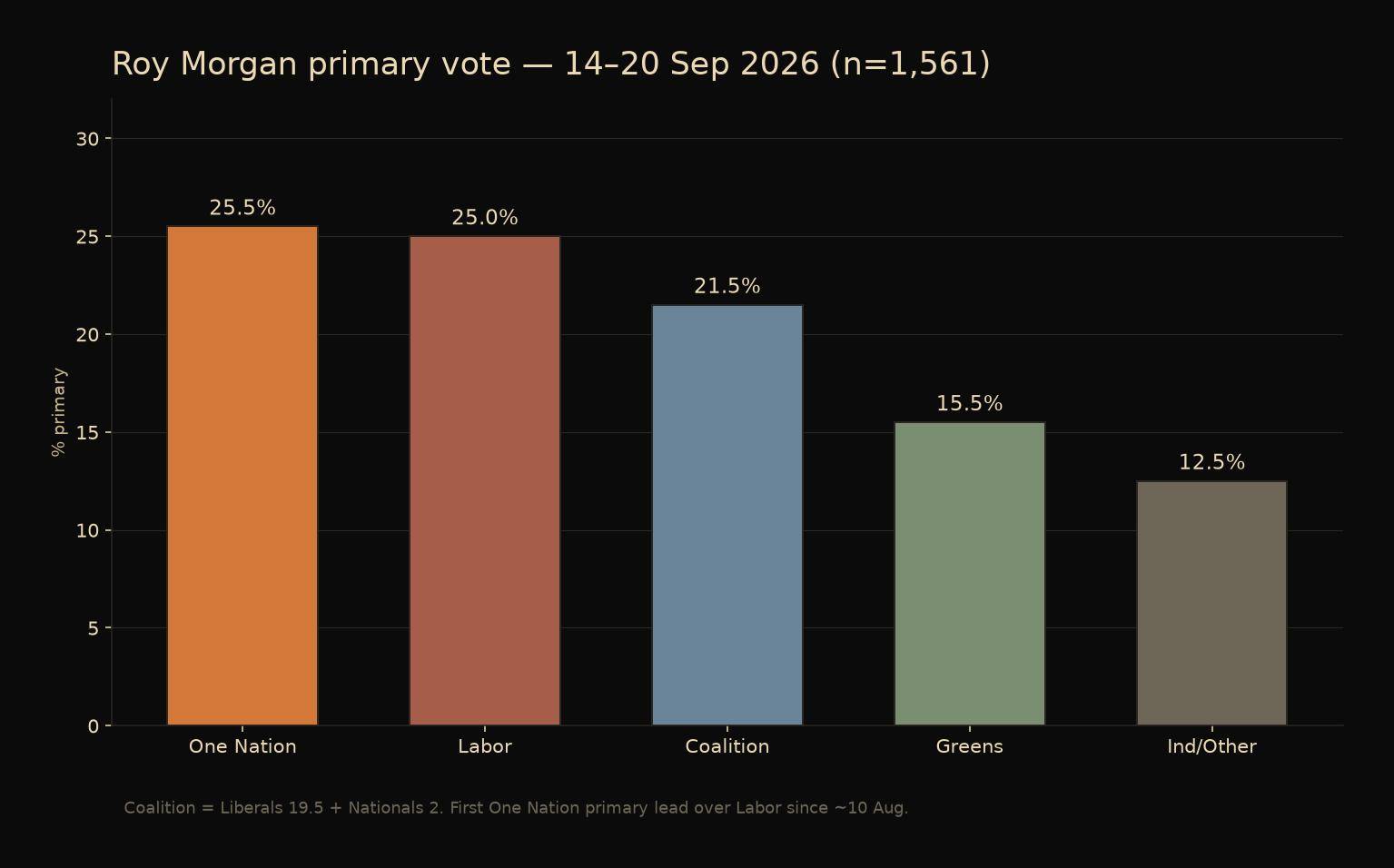
You can argue with a magazine ranking. Plenty of people will. What you can't argue with, on the same week's tape, is the polling that sat under the panel's reasoning. Roy Morgan interviewed 1,561 electors from 14 to 20 September 2026. One Nation's primary vote sat at 25.5 per cent, up half a point. Labor sat at 25 per cent, unchanged. The Coalition sat at 21.5 per cent — Liberals 19.5, Nationals 2. The Greens were on 15.5. Independents and other parties were on 12.5. It was the first time One Nation had led Labor on the primary since about 10 August — six weeks earlier.
The AFR panel, as Nine summarised it, pointed to Hanson's influence on the national debate and to One Nation's polling surge. The magazine called her a "political survivor." She's 72. She first appeared on the inaugural 2001 Power list at No.5, behind John Howard, Peter Costello, Kim Beazley, and Rupert Murdoch. Twenty-five years later she's No.4, and the Coalition isn't in the room.
This is the Power list, the numbers under it, and what those numbers do and don't buy you under preferential voting.
What the list actually said
AFR Magazine's Power issue is an annual panel product. It is not a poll. It is not a ballot. It is a ranked judgment by people the paper asks to weigh institutional office, public reach, and the capacity to move other powerful people. On Tuesday the paper and its syndication partners put the top 10 into the open ahead of the Friday magazine drop.
Albanese at No.1 is continuity. Nine noted he topped the list for a second consecutive year. Chalmers at No.2 keeps the Treasury brief in the second chair. Butler at No.3 is the Health portfolio sitting above Foreign Affairs, which is the part that will make some Canberra readers blink. Wong at No.5 is still inside the ministry's first tier on this ranking. Bullock at No.6 is the Reserve Bank's rate-setting power in human form. Marles at No.7 keeps the deputy prime ministership on the board. McManus at No.8 is labour-movement power without a current ACTU title in the Nine rundown — "former ACTU secretary" is how that outlet labelled her. Comyn at No.9 is major-bank corporate power. Pocock at No.10 is an independent senator with crossbench weight.
Hanson at No.4 sits between Butler and Wong. That is the placement that drove the headlines. She holds no ministry. She does not run a bank or a central bank. She leads a party that, on Roy Morgan's latest weekly, leads Labor on the primary and still trails Labor on two-party preferred. The panel's stated reasons, as Nine carried them, were influence on the national debate and the polling surge. "Political survivor" was the phrase attached to the return.
The AFR's longer politics piece, by Andrew Cornell, opened on the 2001 inaugural list and on Hanson's No.5 then. Panellist Robert Manne, in that first issue, was quoted as saying she had "transformed this country in a most peculiar way." Cornell's 2026 framing was that a quarter-century later the list itself had shifted toward what the paper called algorithm-driven populism and away from some of the older institutional brokers. The sociology is arguable. The ranking is the dated fact: No.4 in 2026, absent in 2025, No.5 in 2001.
No Coalition name in the top 10 for a second year is its own fact. It sits beside the primary numbers where the Liberal–National Coalition is third on Roy Morgan and, on mid-September Newspoll as William Bowe at Poll Bludger summarised The Australian's report, on 19 per cent. Power lists and vote shares are different instruments. This week they pointed in a similar direction for the Coalition's federal brand.
Roy Morgan's week, in the numbers
Roy Morgan published the 14–20 September week on 21 September 2026. Sample: 1,561 electors, Australia-wide. Primary vote: One Nation 25.5 per cent (up 0.5), ALP 25 per cent (unchanged), L-NP Coalition 21.5 per cent (unchanged), with Liberals 19.5 (up 0.5) and Nationals 2 (down 0.5), Greens 15.5 (down 0.5), Independents/Other 12.5 (unchanged). Undecided in the note: 5.5 per cent of those surveyed couldn't say who they would vote for, down one point.
Morgan's own headline stressed two things at once. One Nation took the primary lead in a week when both One Nation and Labor announced immigration policies. And the ALP still held what Morgan called an election-winning two-party preferred lead against either One Nation or the Coalition.
On preferences allocated between Labor and One Nation — Coalition, Greens, Independent, and Other supporters dialled into that contest — Morgan estimated ALP 54 per cent (down 0.5) ahead of One Nation 46 per cent (up 0.5).
On Labor versus the L-NP, respondent-allocated two-party preferred was ALP 53 (down 2) to L-NP 47 (up 2). On 2025 Federal Election preference flows, the same contest was ALP 52 (down 1) to L-NP 48 (up 1).
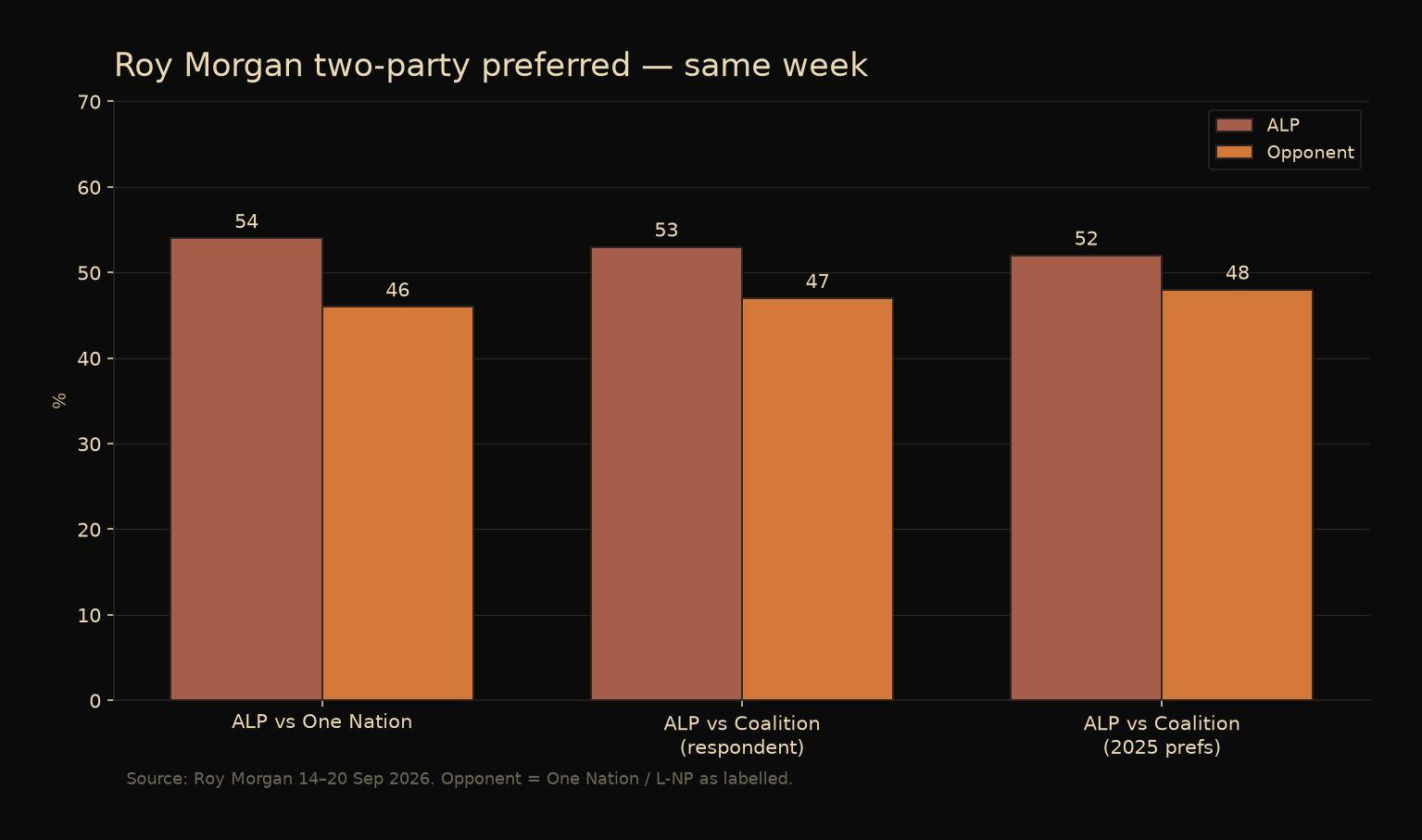
That is the hinge. A primary lead is real. A 2PP deficit against Labor is also real. Australia's House is elected on preferences. Morgan's own text said many electorates are shaping as ALP–One Nation contests, and that the next election will also throw up ALP–Coalition, One Nation–Coalition, and three-cornered fights involving Greens, teal independents, and minor parties such as Katter's Australian Party. The poll does not invent seat results. It does say the map is more complicated than a two-party cartoon.
Direction of the country landed hard in the same release. Sixty-five per cent of electors said Australia is going in the wrong direction, up one point. Twenty-one per cent said the right direction, down two. Among One Nation supporters, 95 per cent said wrong direction. Among Coalition supporters, 77 per cent. Other party supporters 68, Greens 60, Independents 63. Among ALP supporters, 30 per cent said wrong direction and 51 per cent said right direction. That split is why a primary lead for One Nation can sit next to a Labor 2PP lead without the country looking calm.
Morgan also noted the week's policy tape. One Nation had announced a plan for "net negative" immigration over three years and a cut described as reducing Australia's migrant intake by 750,000. Immigration Minister Tony Burke followed with a National Press Club address outlining Labor's path to 225,000 net migration, including cuts to temporary holiday visas, more deportations of illegal overstayers, tighter rules on international students bringing family, and elevating construction workers to the same priority as university-degree applicants. This desk has already filed the One Nation migration plan under its own slug. The short version here is attribution only: the plan is on the record, Labor answered with its own net figure, and Morgan's sample sat in that same week.
Newspoll and YouGov, with the dates on
Roy Morgan is not the only book in September. Treat the others with their dates and their outlets.
Newspoll, as reported by The Australian and written up by William Bowe at Poll Bludger on 20–21 September 2026, had One Nation on 30 per cent of the primary, Labor on 27 (down two), the Coalition on 19, and the Greens on 13. Fieldwork was Monday to Thursday from a sample of 1,244. Albanese's approval was 35 (down two) and disapproval 62 (up three). Hanson's approval was 44 (down three) and disapproval 51 (up three) — Bowe's note on the personal ratings was that recent bad press had left a mark on her numbers even as the party primary held. Angus Taylor's net rating improved from minus 17 to minus 15, with approval 35 and disapproval 50. Preferred prime minister, head-to-head, had Albanese's lead narrowed to 42–41 over Taylor. The three-way measure had Albanese 44, Hanson 32, Taylor 24.
Nine's Yashee Sharma also carried the mid-September Newspoll as Labor near a record low on the primary. Those Newspoll primaries already ran in this paper's confidence-and-supply file. They sit here again as companion tape to the Power list, not as a fresh exclusive.
YouGov's News24 Pulse, as Poll Bludger summarised on 23 September 2026, had Labor steady on 26, One Nation down three to 27, the Coalition up three to 21, and the Greens up two to 14. Labor's two-party leads were 55–45 over One Nation and 52–48 over the Coalition. Fieldwork ran from the previous Tuesday to that Tuesday on a sample of 1,471. Albanese's approval was 33 and disapproval 62 on that book. Taylor was 36 approve and 48 disapprove. Preferred PM: Albanese 41–37 over Taylor, and 50–38 on the other pairing Poll Bludger listed.
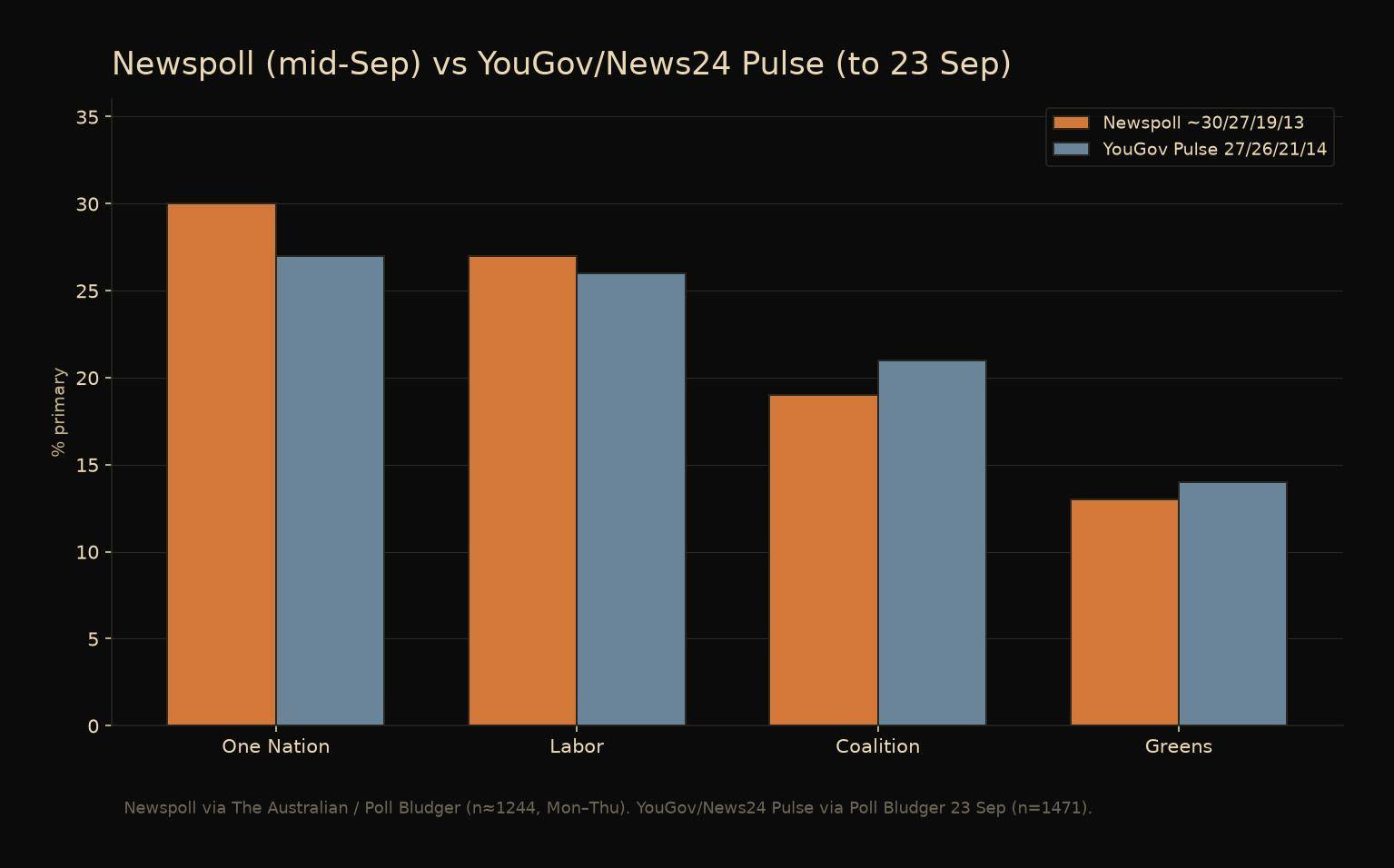
Put the three primary books next to each other and you get a band, not a single digit. One Nation in the high twenties to 30. Labor in the mid-to-high twenties. Coalition around 19 to 21.5. Greens in the low-to-mid teens. Every serious pollster still has Labor ahead on two-party preferred against One Nation and against the Coalition. The argument in the press gallery is not "Labor has lost the 2PP." The argument is that the primary order has scrambled, that One Nation is no longer a fringe share, and that a Power panel just ranked the party's leader fourth in the country.
Seats Nine put on the 2026 tally
Nine's Power-list piece included a hard line on wins already banked in 2026. Quote the wording carefully, because this desk is not inventing seat names. "In 2026 so far, Pauline Hanson's One Nation has won five state lower house seats, three state upper house seats, and one federal lower house seat." That is Nine's sentence. It is the public tally they attached to the ranking. It does not, in that paragraph, name the seats. This story will not invent them.
What the sentence does do is move the story off polling theory and onto contested ballots. Primaries are samples. Seats are outcomes. A party that is winning lower-house contests at state level and has taken a federal lower-house seat in the same calendar year is not waiting for a magazine to tell it that it matters. The magazine is catching up to a year that already moved.
Why "power" is the word this week
Power lists love drama. The useful question is narrower: who can force other people to change what they say, spend, or vote for?
On that test, Hanson's week is not only a foil stamp on a magazine. It is a primary lead on a weekly national poll, a cluster of other pollsters showing One Nation first or second on the primary, a Labor government answering on migration with its own net target, and a political class arguing — sometimes in public — about how the Coalition relates to One Nation if neither side can govern alone. This desk has already filed Alex Antic's South Australian Liberal presidency win and Barnaby Joyce's confidence-and-supply remarks under a separate slug. One short context line is enough here: Liberals and One Nation figures are already talking, on the record, about understandings that would once have been unspeakable in polite Coalition company. That talk is part of why a Power panel can put Hanson at four while leaving every Coalition politician outside the top ten.
Migration is the policy centre of gravity One Nation chose for mid-September. The party's Monday 14 September plan — net-negative over three years, a cut of more than 750,000 temporary visa holders and unlawful non-citizens on the party's published arithmetic, then a 130,000 annual ceiling — is already on this site under its own headline. Burke's Press Club reply with a 225,000 net migration path is the government half of the same week. Morgan explicitly tied its interviewing week to those announcements. The Power list did not invent the migration fight. It ranked a politician who has spent three decades making migration and identity fights expensive for everyone else.
Butler at No.3 is a reminder that institutional portfolios still count on this list. Health is money, regulation, and workforce. Wong at No.5 is foreign policy in a year when the Prime Minister has been on the road. Bullock at No.6 is interest rates. Comyn at No.9 is the largest listed bank. Pocock at No.10 is the crossbench's capacity to amend or block. Hanson at No.4 is the outlier shape: party leader without a ministry, with a primary share the majors used to treat as someone else's problem.
Survivor, not newcomer
The "political survivor" label only works if you remember the timeline. Hanson won Oxley as a disendorsed Liberal in 1996, founded One Nation, blew up, spent years outside the House, returned to the Senate, and kept finding a microphone when parties that had written her off preferred she stay quiet. The 2001 Power list had her at five when she held no conventional office. The 2025 list left her off. The 2026 list put her at four.
Cornell's AFR piece leaned on that arc. The inaugural panel saw someone shifting the thinking of people who did hold office. Manne's "most peculiar way" line is still the quote the paper reaches for when it wants to say the country changed around her even when she lost. Nine's Tuesday piece compressed the same idea into the survivor phrase and the polling surge. Neither outlet claimed she runs the Commonwealth. Both claimed she moves the debate the Commonwealth then has to answer.
Personal ratings complicate the victory lap. Newspoll's mid-September book had her approval down and disapproval up even as One Nation's primary held at 30. That is a split you see with polarising leaders: the party's vote can harden while the leader's personal net softens on a bad press fortnight. Bowe flagged recent bad press as the likely dent. This story is not re-litigating those earlier corridors. A Power ranking and a personal approval score are not the same instrument.
What the Coalition's absence means on the page
Two years without a Coalition politician in the AFR top 10 is a verdict on brand weight, not a prediction of seats. The Liberal and National parties still hold Opposition status, shadow portfolios, and a primary share in the high teens to low twenties depending on the poll. They do not, on this panel's judgment, currently field an individual who outranks Hanson, Wong, Bullock, Marles, McManus, Comyn, or Pocock.
Read that next to Taylor's preferred-PM numbers closing on Albanese in Newspoll while the Coalition primary stays weak, and you get the Opposition's present bind. Closing a head-to-head gap against a disliked Prime Minister is not the same as rebuilding a primary that can finish first in enough seats. One Nation's primary is eating the space where a Coalition recovery would normally grow. That is why confidence-and-supply talk keeps surfacing, and why a magazine can rank Hanson above every Liberal and National.
Labor's position is the mirror image. It leads on 2PP in Morgan, Newspoll's broader context, and YouGov Pulse. Its primary is soft enough that One Nation can lead it on first preferences in more than one book. Albanese remains No.1 on the Power list and preferred PM on the pollsters' head-to-heads, with approval ratings that look like a government under strain. Winning the last election does not freeze the Power ranking. It does keep the government in possession of the departments Butler, Wong, and Marles run — which is why those names still populate the top ten beside Hanson.
How to read a primary lead under preferences
Read only the primary and One Nation looks like the story of the month. Read only two-party preferred and Labor looks insulated. Neither reading is complete on its own.
Preferential voting means a party can lead the primary and still lose the seat if preferences lock behind someone else. It also means a party can run third on the primary and still win if it makes the final pair and harvests enough flows. Morgan's explicit warning is that the next federal election will not be one kind of contest in every division. ALP–One Nation in some places. ALP–Coalition in others. One Nation–Coalition in others again. Greens and independents in the mix. That is not a pundit flourish. It is the pollster describing why a single national 2PP number is a blunt tool in a fragmented primary field.
For Hanson, the Power-list ranking is a claim about agenda power more than about a locked path to The Lodge. For Albanese, No.1 is still the office that signs the appointments and flies the overseas schedule. For Chalmers and Butler, the ranking is portfolio gravity. For Bullock and Comyn, it is economic institutions. For Pocock, it is the Senate maths. The list is a collage. Hanson's square is the one that changed colour this year.
What this story is not
It is not another Secret Harbour by-election story. It is not another full migration-plan feature beyond the short attribution above. It is not another Antic presidency or Joyce confidence-and-supply write-up beyond one context sentence. Those stories sit under their own headlines. This one is the Power list and the September polling band that made Hanson's placement make sense to the panel.
It is also not a prediction that One Nation forms government, that Labor collapses, or that the Coalition recovers next month. None of the pollsters quoted here said those things in the releases used for this story. Morgan said Labor would win a majority against either One Nation or the Coalition if an election were held now, on its 2PP estimates. That sentence sits in the same release as the primary lead. Both belong in the same story.
The Friday magazine and the Tuesday leak of the ranking
The Power issue is dated to hit on 25 September 2026. The ranking news moved on 23 September through AFR politics pages and Nine's Australia news wire. That is normal for a magazine package: the list is too big to keep sealed until the print drop, so the top line travels early, and the full issue follows.
Myriam Robin's AFR write-up of the Power dinner at Grill Americano in Sydney described the silver-foiled 2026 edition landing on tables and the mixed reactions — laughter, tutting, silence. Hanson was among the political names in that orbit of coverage. Dinner colour is not the ranked list. The list is the story.
Robin and Cornell's package language — "new order," traditional power under pressure, populism rising — is the paper's editorial frame. A reader can accept the ranking numbers without buying every metaphor. The load-bearing facts remain: No.4 for Hanson, No.1 for Albanese, no Coalition politician in the top ten, Power issue out 25 September.
Albanese at one, again
Albanese's second straight year at No.1 is the continuity line in a list otherwise sold as rupture. He still holds the office that chairs Cabinet, picks the ministry, and sets the overseas schedule. Morgan's own release, written before the Power-list coverage landed, flagged the Prime Minister's United States trip — Silicon Valley meetings including Apple chief executive Tim Cook, and the launch of Australia's campaign for a United Nations Security Council seat in New York — as the kind of week that can move a weekly poll. That is Morgan talking about next week's sample, not about the Power panel. It still tells you what kind of power No.1 is supposed to measure: the capacity to put Australia on someone else's calendar.
The personal ratings sit awkwardly beside that institutional rank. Newspoll's mid-September book had him on 35 approve and 62 disapprove. YouGov Pulse had him on 33 and 62. Preferred prime minister scores still favour him over Taylor on both books, and over Hanson on the three-way measure Newspoll printed. A Prime Minister can be disliked and still outrank everyone on a power list because the list is not a popularity contest. It is closer to a map of who can make other institutions move. On that map, the Lodge still sits at the top even when the primary vote is soft.
Chalmers at No.2 is the Budget and the Treasurer's public argument about inflation, spending, and surplus politics. Butler at No.3 is Health in a system that eats a huge share of Commonwealth outlays and state capacity. When a Power panel puts the Health Minister above the Foreign Minister, it is saying domestic service delivery and system cost currently outweigh diplomacy in its weighting. Wong at No.5 still clears the rest of the ministry on this list. The ordering inside Labor's top ranks is itself a story about what the panel thinks is hard power in 2026.
Bullock, Comyn, McManus, Pocock
Four names in the top ten are not sitting in the current Albanese ministry. Michele Bullock at No.6 is the Reserve Bank governor. Rate decisions move mortgages, rents, business credit, and the political temperature around any government. Matt Comyn at No.9 is the Commonwealth Bank chief executive — major-bank balance-sheet power, branch and app reach, and a private-sector platform that can matter more to household cashflow than a minor ministry. Sally McManus at No.8, labelled by Nine as former ACTU secretary, is organised labour's residual punch on wages campaigns and industrial relations politics even when the title on the door has changed. David Pocock at No.10 is an independent senator whose vote can decide amendments when the government's Senate numbers are tight.
Those four matter for reading Hanson's No.4. She is not the only non-minister on the list. She is the highest-ranked politician who is neither in government nor in an independent crossbench seat in the House. The panel put a party leader with a surging primary above the RBA governor, above the biggest bank CEO, and above a high-profile independent senator. That is the judgment that will be argued about in every newsroom that covers the issue on Friday.
Marles at No.7 keeps Defence and the deputy prime ministership inside the top ten. AUKUS, force posture, and the US alliance sit in that portfolio's shadow even when a Power card does not spell them out. The list does not publish a full essay under every name in the early syndication copy. It publishes a rank. The rank says Marles still clears McManus, Comyn, and Pocock on the panel's weighting.
Margin of error, without the fog
Morgan publishes a margin-of-error table with its releases. For a sample near 1,000, a percentage estimate around 40–60 per cent carries about ±3.0 points at 95 per cent confidence on the simple table; around 25 or 75 per cent, about ±2.7. Design effects from weighting and stratification can widen that. The 14–20 September sample is 1,561, larger than 1,000, so the simple table's error band narrows, but it does not disappear.
What does that mean for a 25.5 to 25.0 primary lead? It means the lead is real as a point estimate and thin as a gap. Half a point is inside a serious sample's noise. Morgan still printed it as a lead, and still noted it as the first One Nation primary lead over Labor since 10 August. Both statements can be true: the ranking order on the page is One Nation then Labor, and the gap is not a landslide. Newspoll's 30–27 and YouGov's 27–26 are different instruments with their own samples. They agree on the shape — One Nation first or level-first, Labor close behind, Coalition third — more than they agree on a single digit.
Two-party preferred gaps are wider. Morgan's 54–46 against One Nation and 53–47 / 52–48 against the Coalition are not half-point curiosities. They are the reason Labor can look wounded on the primary and still competitive on the measure that decides most House seats under present preference habits. If preference habits change — if Coalition voters, Greens voters, or independents start flowing differently — those 2PP numbers move. Morgan prints both respondent-allocated and last-election flows for the Coalition contest for exactly that reason.
Wrong track, right office
The 65 per cent "wrong direction" finding is the mood music under every ranking this week. When nineteen in twenty One Nation voters say the country is on the wrong track, a primary surge has a grievance engine. When more than three in four Coalition voters say the same, the Opposition's soft primary is not a contented conservative bloc waiting patiently. When only ALP voters, as a group, still tilt toward "right direction" in Morgan's split, the government's coalition of the willing is narrower than its 2PP.
Power lists do not poll mood. They still sit on top of it. A politician who can speak fluent wrong-track politics will look more powerful to a panel in a 65 per cent wrong-track country than she did in a calmer year. That is one way to read Hanson's jump from off-list to No.4 without pretending the panel published its ballots.
Immigration week, already filed elsewhere
Morgan's release is unusually explicit about the policy tape inside the sample window. One Nation's net-negative plan and the 750,000 reduction language landed first. Burke's Press Club speech with a 225,000 net migration target landed after. The government's measures, as Morgan summarised them, included fewer temporary holiday visas, more enforcement against illegal overstayers, limits on international students bringing family, and construction workers lifted to the same priority as degree holders.
The One Nation plan in full already sits under its own Gold Standard headline on the 750,000 cut. This Power-list story is not a second migration feature. It only needs enough of that plan to show why a Power panel, looking at September, could not ignore the politician who dragged migration back to the centre of the argument and then watched her primary tick up half a point in Morgan's next weekly.
Labor's counter is also part of the power story. A government that answers with its own net figure is acknowledging the ground has moved. Whether 225,000 is enough to blunt One Nation's attack is a political judgment for voters, not a fact this desk can invent. The dated fact is that both sides put numbers on the table in the same week Morgan was in the field.
How Nine's seat line changes the tone
Polling is cheap to argue with. Seats are not. Nine's line — five state lower-house wins, three state upper-house wins, one federal lower-house win for One Nation in 2026 so far — is why the Power-list coverage reads less like a nostalgia award for a 1990s brand and more like a mid-decade reckoning. Nine's wording stays as Nine wrote it. No seat names get added that the Nine paragraph did not supply.
State lower-house seats are where parties learn local campaign machinery: booths, preferences, candidate quality, how to survive a major-party squeeze. Upper-house seats are where proportional maths can reward a rising primary faster than the lower house does. A federal lower-house seat is the hardest of the three on Nine's list, and the one that changes how Canberra producers book panels. Taken together, the tally is the operational half of the "polling surge" phrase the AFR panel used.
Survivor maths
Survivor only works with the timeline attached. 1996: Oxley, disendorsed, still elected. Late 1990s: One Nation's first explosion and collapse. Long wilderness. Senate return. Repeated declarations from opponents that she was finished. 2001: No.5 on the first AFR Power list without a conventional office. 2025: off the list. 2026: No.4, with a primary that leads Labor on Morgan and leads or matches Labor on the other September books cited here.
Survival is not the same as majority government. It is the same as remaining a veto player on the national argument — someone other parties must answer even when they would rather talk about something else. The Power panel's job, on its own terms, is to spot those veto players. This year it spotted Hanson again, and ranked her above the Foreign Minister.
The Coalition's two-year absence from the top ten is the other half of the survivor story. A party family that once supplied Howard and Costello at No.1 and No.2 on the inaugural list now cannot place a single politician inside the ten. That is not Hanson's achievement alone. It is also the Coalition's failure to produce a figure the panel rates as nationally decisive. Taylor can close a preferred-PM gap in Newspoll and still not crack a list that has room for a bank CEO and a former union secretary.
What Friday's issue will add
Friday's Power issue will carry longer profiles, panel notes, and the silver-foil magazine Robin described at the Sydney dinner. Some rankings that look odd in a ten-name list make more sense with the panel's written reasons underneath. Some will still look odd. The dated public coverage used here is Nine's ranking rundown and the AFR politics framing from 23 September, Morgan's 21 September release, and Poll Bludger's Newspoll and YouGov write-ups.
If Friday's issue changes a load-bearing fact — a different rank, a different top-ten membership, a panel quote that contradicts Tuesday's copy — the record should be updated. As of now, Tuesday's public tape is consistent across Nine and the AFR on the top ten names and order used here.
Putting the week in one place
Tuesday 23 September 2026: AFR and Nine put Hanson at four on the Power list. Friday 25 September: the Power issue is out. The polling under the ranking, depending which book you open, shows One Nation on 25.5 (Morgan, 14–20 Sep), about 30 (Newspoll, mid-Sep), or 27 (YouGov Pulse, to 23 Sep). Labor sits at 25, 27, or 26 on those same books. The Coalition sits at 21.5, 19, or 21. Labor leads on 2PP in each serious measure cited here. Sixty-five per cent of Morgan's sample says the country is on the wrong track. Nine says One Nation has already won five state lower-house seats, three state upper-house seats, and one federal lower-house seat in 2026. The migration fight is live. The confidence-and-supply argument is live on another slug. The Power panel looked at that landscape and wrote Hanson's name in the fourth box.
She's fourth on the list. The primary says her party can lead a national sample. The preferences say Labor can still win the argument that decides seats. Both things were true on the same September tape. The magazine noticed.
The paper
Comments
No notes on this story yet.
Sign in to comment