
NASA has chosen three new science payloads to fly to the Moon and do the groundwork for its planned Moon Base. The agency announced the picks on 30 September through its PRISM programme, short for Payloads and Research Investigations on the Surface of the Moon.
One will listen for moonquakes and watch for falling micrometeoroids near the lunar south pole. One will check whether a deep pit leads into an underground lava tube that could shelter astronauts. The third will measure ice hidden in tiny cold traps, which NASA wants to turn into a usable resource.
Science goes first
The three payload suites will reach the surface on commercial landers through NASA's CLPS (Commercial Lunar Payload Services) initiative, as part of the agency's Moon Base Program. NASA says they'll help researchers understand lunar resources, map natural shelters and size up environmental hazards, all before crews arrive to stay.
Nicky Fox, associate administrator of NASA's Science Mission Directorate, put it this way in the release: "NASA Science is building the ultimate interplanetary survival guide to ensure that science goes first to the lunar surface to provide our future astronaut crews with the vital information, resources, and safety precautions needed ahead of time to survive the night on the Moon."
She added: "These PRISM selections will directly help NASA minimize risks to our astronauts while maximizing our agency goals as we set up humanity's first lunar outpost in preparation for sending the first astronauts to Mars."
The release didn't give launch dates, landing sites beyond the Marius Hills pit, or how much the awards are worth.
A weather station for the south pole
The first suite is the Lunar Environment Monitoring Station-South Pole, or LEMS-SP. NASA calls it an autonomous, long-term environmental and hazard monitoring station.
It's got three jobs. It'll keep an eye on falling micrometeoroids, the tiny, fast particles that pepper the airless surface. It'll track volatiles, which are materials that easily turn into gas, as they drift up into the Moon's extremely thin outer layer of gases. And it carries a short-period seismometer to pick up seismic events. NASA says that could give it the hazard assessments needed to keep Moon Base hardware physically safe.
The principal investigator is Dr Mehdi Benna of the University of Maryland, Baltimore County.
Is there a cave under Marius Hills?
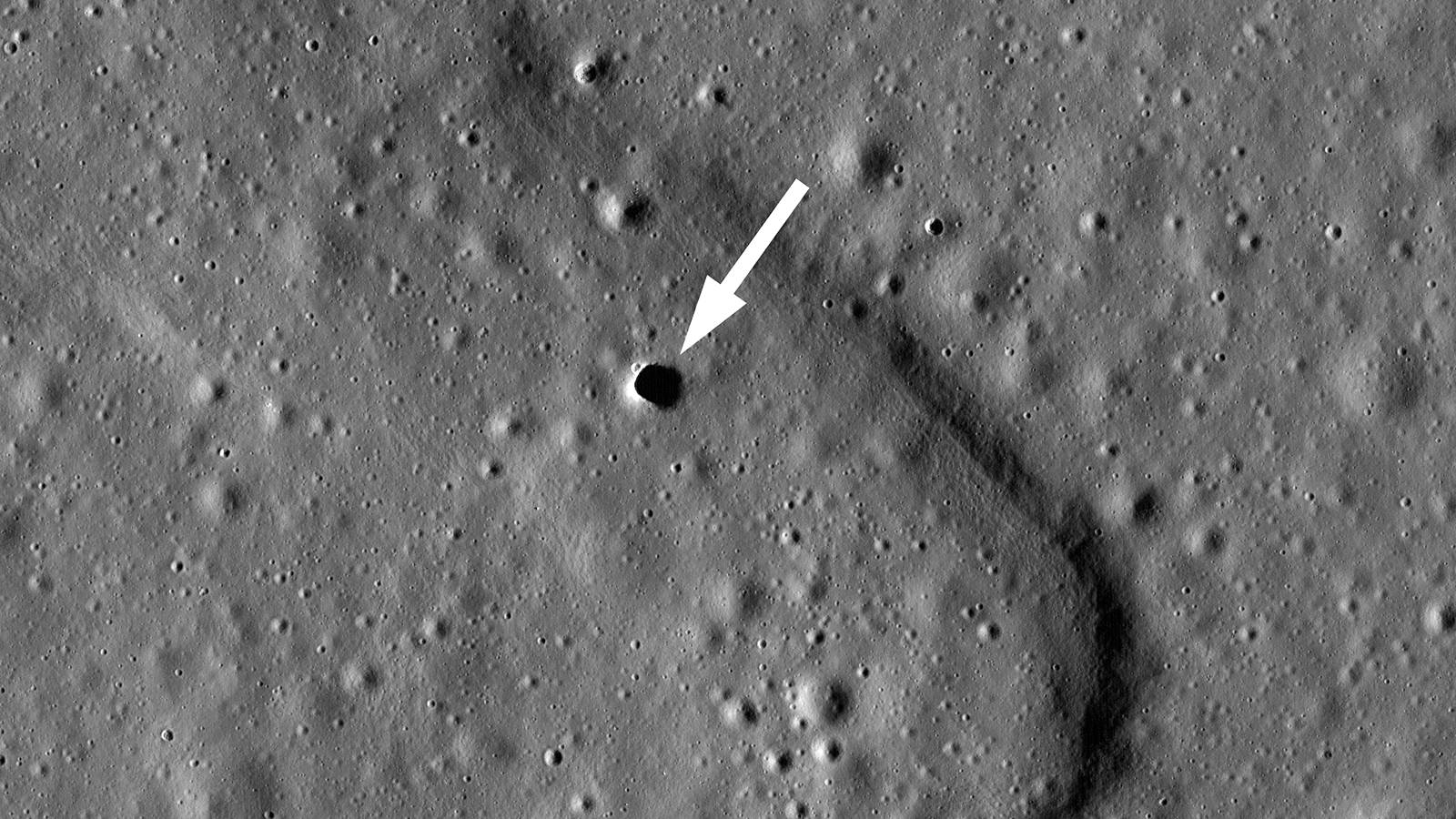
The second suite has the most eye-catching target. GIMLI, the Geophysical Investigation for Mapping Lunar Interior, will be set up at the Marius Hills Pit to hunt for lava tubes under the surface.
The pit isn't new to science. It was first spotted in images from Japan's SELENE/Kaguya spacecraft by a team led by Junichi Haruyama, and NASA's Lunar Reconnaissance Orbiter later imaged it in sharp detail. The LRO camera team, based at Arizona State University, now puts the opening at about 58 by 49 m and 40 m deep. Kaguya's cameras saw it at up to 6 m per pixel. LRO's narrow-angle camera got down to 0.5 m per pixel. After measuring later images taken with the Sun higher in the sky, the team cut its first estimate of about 65 m across down to today's figures. The pit sits in the middle of a sinuous rille, a winding channel left by ancient lava flows. That's why scientists think it's a spot where a lava tube's roof caved in.
GIMLI's job is to scan beneath the surface and find out whether the pit really does lead into a big underground tube. NASA says that if it does, these natural spaces could give future astronauts ready-made protection from extreme temperatures and harmful radiation. "Confirming these void spaces now could shift future habitat planning," the agency said, "offering natural, ready-made shelters that provide crucial thermal stability and shielding from deadly ionizing radiation and micrometeoroid bombardment."
The LRO team made the same point years ago. Caves on the Moon, like caves on Earth, keep steady temperatures, and their roofs would block cosmic rays and meteorite strikes. GIMLI should also help scientists understand the volcanic processes that shaped the Moon.
The principal investigator is Dr Nathaniel Putzig of the Planetary Science Institute.
Counting ice in the cold traps
The third suite is DISCO, the Depth Imager with Spectral and Color Optics. NASA corrected the payload's name in an update to the release on 30 September.
NASA says DISCO will make the first direct, on-the-ground measurements of ice hidden in lunar micro-cold traps. Those are small, permanently shadowed spots where ice can survive. It'll pinpoint where the ice is and how much of it there is.
It'll also study how the surface behaves, from the way rocket exhaust disturbs the ground to how stable the soil is for rovers and walking crews. NASA says that'll help it design safe surface operations and develop the technology to turn lunar ice into a usable resource for Moon Base. NASA's release doesn't spell out what that resource is. In general, though, ice is prized for space travel because it can be turned into drinking water, oxygen to breathe, and hydrogen and oxygen for rocket propellant.
The principal investigator is Dr Ariel Deutsch of NASA's Ames Research Center in California.
Where this fits in the Artemis plan
Brad Bailey, director of the Exploration Science Strategy Integration Office in NASA's Science Mission Directorate, said: "Each new PRISM selection strengthens our ability to deliver ambitious, transformative science to the lunar surface. These investigations exemplify how Artemis and Moon Base are expanding the frontier of lunar exploration, advancing innovative technologies, deepening our understanding of the Moon's environment, and paving the way for future astronaut missions."
NASA says it's stepping up the pace of lunar missions to build Moon Base. The crewed side of the programme is moving at the same time. The Artemis II crew flew around the Moon in April, and President Trump has since given them the Congressional Space Medal of Honor. At Kennedy, technicians finished installing Artemis III's four RS-25 engines on 1 September. NASA's Artemis overview says the agency's still aiming for its first crewed lunar landing in 2028.
Other countries are being asked in, too. In its Artemis Accords release on 28 September, NASA said it has invited every one of the accords' 76 signatories to take part in its return to the Moon through scientific payloads, technology demonstrations, CubeSats and other capabilities.
The robots go first. Moon Base will be built near the south pole, and NASA wants to know about the quakes, the dust, the ice and the shelter before anyone has to live with them. These three payloads are how it plans to find out.
The paper
Comments
No notes on this story yet.
Sign in to comment