
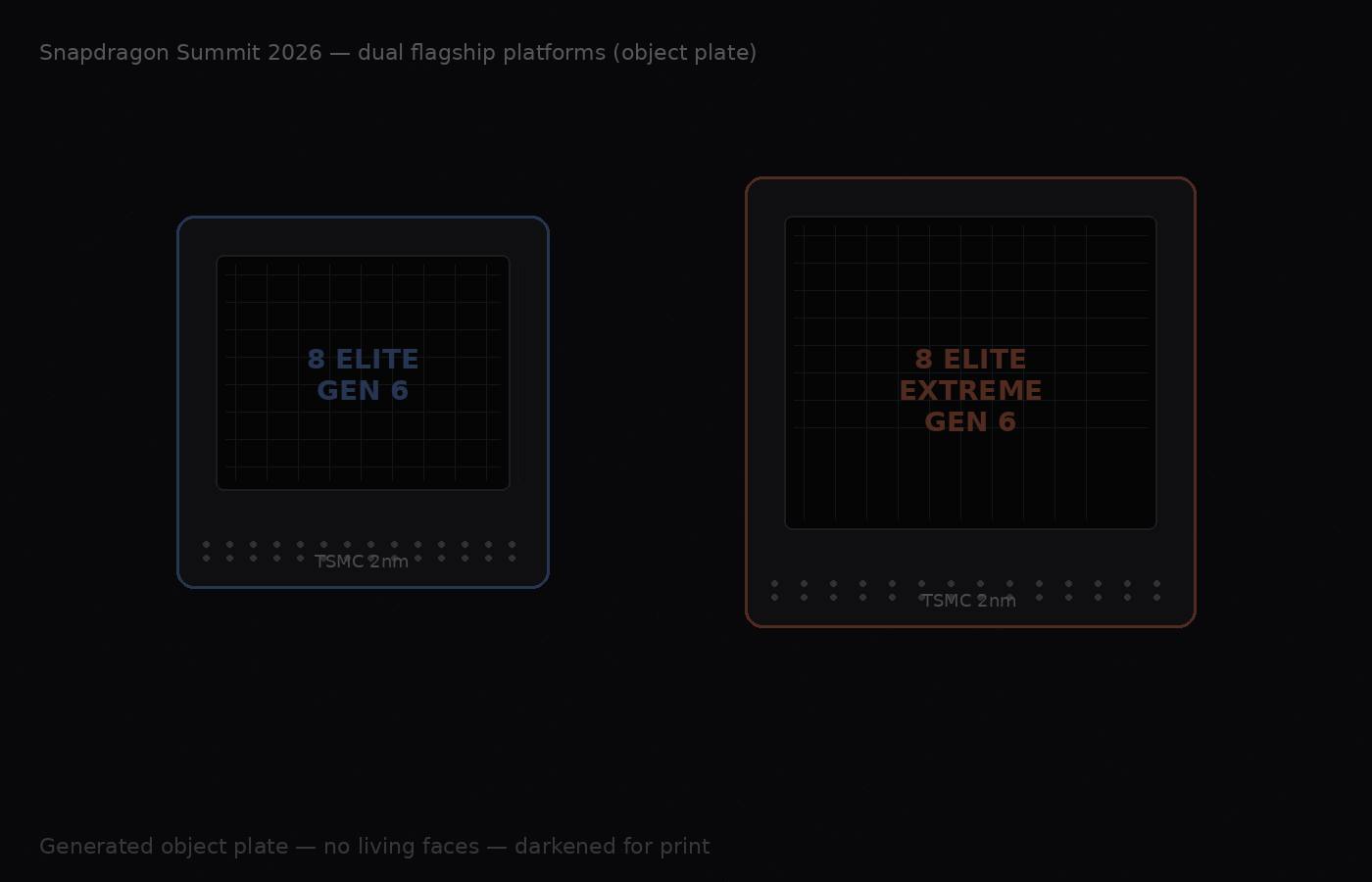
Qualcomm didn't launch one new flagship phone chip on Tuesday 22 September 2026. It launched two. At its Snapdragon Summit on Maui, it showed off the Snapdragon 8 Elite Extreme Gen 6 at the top and the Snapdragon 8 Elite Gen 6 just below it. Both are made on TSMC's 2-nanometre process, and both have the same 5.0 gigahertz Oryon prime cores.
So this year there are two top chips instead of one. The Extreme gets the extra shared memory and the gaming features. Xiaomi and Motorola have already announced phones that'll be among the first to use them. And CNBC says the smartphone market is shrinking because memory's getting so expensive.

Tuesday on Maui: two flagships, not one
Qualcomm's press release, sent out from Maui on 22 September 2026, makes the plan clear. The company unveiled the Snapdragon 8 Elite Extreme Gen 6 Mobile Platform and the Snapdragon 8 Elite Gen 6 Mobile Platform on the same day. Chris Patrick, senior vice president and general manager of mobile handsets, summed up the strategy:
"Today marks a milestone as we introduce not one, but two new flagship mobile platforms, delivering agentic AI experiences that are immediate, personal, and adaptive. As the agentic AI age evolves, our multi-flagship strategy allows us to push the boundaries of what's possible for mobile while bringing our latest AI innovations to a broader range of premium devices. By designing two innovative platforms, we're giving OEMs greater choice as we collectively shape the capabilities of the next generation of intelligent, personalized, mobile experiences."
That's Qualcomm's pitch. The Extreme is the top tier, and the Elite Gen 6 is the flagship for a wider range of phones. Both are sold as flagships, and both are made on the same 2-nanometre process. The difference is in what the Extreme keeps and the Elite Gen 6 leaves out.
What both chips share
Start with what they have in common, because that's what you'll notice on an ordinary day.
Both use a custom Qualcomm Oryon processor with two prime cores that run up to 5.0 gigahertz and six performance cores up to 4.0 gigahertz. In his keynote at the Summit, Patrick said it's the first time a phone processor has gone past 5 gigahertz. Both have a 16-megabyte Oryon Flex Cache, which lets all eight cores share one flexible pool of memory. Both have a redesigned Hexagon NPU, the part that runs AI, with a new Hexagon Element Accelerator. Both keep the Qualcomm X105 5G Modem-RF System and the FastConnect 8800 wireless chip. And both are built on TSMC's 2-nanometre process. The Verge notes they're Qualcomm's first 2nm phone chips, joining Apple's A20 Pro and MediaTek's Dimensity 9600 Pro.
Robert Triggs at Android Authority laid out what they share in a story on 23 September. It's the same process, the same top Oryon speeds, the same 16 MB Flex Cache, the same X105 modem, the same FastConnect 8800 and the same Sensing Hub design with two tiny NPUs. Ellie Fortin from Qualcomm's media team told TechRadar both chips use TSMC's 2nm process. So everyday processor speed and connectivity aren't where they differ.
Qualcomm's product sheets compare the new chips with last year's Snapdragon 8 Elite Gen 5, and results will depend on the phone maker. The Extreme claims about 13% better processor performance, 44% better graphics and 35% better AI, with efficiency gains of about 37% for the processor, 40% for graphics and 33% for AI. The Elite Gen 6 claims a smaller set: about 10% for the processor, 35% for graphics and 14% for AI, and about 37% / 40% / 20% better efficiency. Those are Qualcomm's own numbers, not independent lab tests. Buyers won't notice a percentage point from a product sheet. They'll notice whether the phone stays cool and whether AI tasks keep running smoothly.
Where the Extreme pulls ahead
Here's the difference that really matters.
On AI, the Extreme gets 50% more shared memory than last year's Elite Gen 5. Qualcomm says that bigger pool on the chip is what lets the Extreme run 30-billion-parameter Mixture-of-Experts AI models, which the regular Elite Gen 6 can't. CNBC's Tuesday story carries the same 30-billion-parameter claim for the Extreme. Android Authority puts it bluntly. The standard Elite Gen 6 has standard support for AI agents, and the Extreme is the one for models of 30 billion parameters and up.
On graphics, only the Extreme gets Adreno Matrix Cores, which are AI cores built into the graphics chip, and Adreno Neural Fusion, Qualcomm's AI tech for sharpening images and generating extra frames. Lekha Motiwala, senior director of product management, told TechRadar's Axel Metz at the Summit:
"We're introducing Adreno Matrix cores, which are exclusive to the 8 Elite Extreme Gen 6. They support the running of AI workloads within the graphics pipeline itself. Rendering becomes smarter, [you'll get] super resolution, frame generation, many of these features can now be run within the graphics pipeline rather than moving to the NPU and other [parts of the chipset]. So now you'll have much lower latency and much lower power consumption."
The Extreme also has 18 megabytes of Adreno High Performance Memory, which Qualcomm says cuts power use by 12%. Android Authority says the Elite Gen 6 doesn't get that memory this year. Games Qualcomm named for Neural Fusion include Honkai: Star Rail, Diablo Immortal, War Thunder, Mobile and others in the Summit material. Support still depends on game makers doing the work, and there's no public date for when the rest of the catalogue will get it.
For cameras and video, both chips use the Spectra image processor with Intelligent Pixel Control. Only the Extreme supports the Advanced Professional Video (APV) format, filming 8K at 60 frames per second, and 4K slow motion at 240 frames per second. The Elite Gen 6 tops out lower. Android Authority lists 8K30 / 4K120 for the Elite Gen 6 against 8K60 / 4K240 for the Extreme. The Extreme also adds hardware to play VVC (H.266) video. Streaming apps still have to support that format before you'll notice the difference.
Why two chips in a year of expensive memory
Kif Leswing at CNBC wrote about the wider market the same Tuesday. The launch comes as the smartphone industry is shrinking, because memory prices are soaring. CNBC reports that Counterpoint Research expects phone shipments to fall about 14% in 2026, and maybe another 1% in 2027. Brands are putting more of their effort into expensive phones for buyers with more money to spend, while memory costs push phone prices up.
At the Summit, Qualcomm described the chips as "AI hubs" on the phone, able to run AI models without going to the cloud for every step. Cristiano Amon, Qualcomm's president and CEO, said on Tuesday:
"We're going into this transition from what is a very phone-centric model to now an agentic-centric model for new experiences."
And later, as CNBC quotes him from the same Summit:
"AI will now require the device to do much more than just execute commands, and it's going to be less about navigating apps, and and it's going to be about completing tasks for you."
Motiwala's interview with TechRadar explains most clearly why phone makers get a choice:
"Some OEMs [Original Equipment Manufacturers] are trying to reach the pinnacle of technology, while others are trying to reach broader audiences. We want to give choice and flexibility to the OEMs. The 8 Elite Gen 6 is the next generation to the 8 Elite Gen 5. The 8 Elite Extreme Gen 6 is positioned above it as the top tier, to enable newer experiences like ultra[-level] gaming, professional video codec support, etc. On the 8 Elite Extreme Gen 6, we are going beyond what we traditionally do [with our flagship chipsets], hence the tiering this year."
Android Authority sees it as much about money as technology. The Extreme keeps the forward-looking extras. The Elite Gen 6 keeps the headline speeds but drops features most buyers might not use yet. That should let phone makers price their mainstream flagships lower in a year when memory's expensive.
The first phones announced
Qualcomm's press release lists the brands that'll launch phones with the two chips: HONOR, iQOO, Motorola, OnePlus, OPPO, REDMI, RedMagic, vivo and Xiaomi. Dominic Preston at The Verge adds Nubia and ZTE, which Qualcomm named in its briefing material. So the press release lists nine brands, and The Verge's list is longer.
These phones have actually been announced:
Xiaomi. On stage on Maui, Xiaomi's Adam Zeng said the Xiaomi 18 Pro series would launch in Beijing, with both Snapdragon flagship chips on 2 nanometres. The Xiaomi 18 Pro gets the Snapdragon 8 Elite Gen 6. The Xiaomi 18 Pro Max gets the Snapdragon 8 Elite Extreme Gen 6. According to the Day 1 transcript, Zeng said Xiaomi would be first in the world to launch them, at an event in Beijing on 23 September at 7:00 p.m. China Standard Time.
Motorola. Nicole Hagen, executive director and head of global product marketing at Motorola, introduced the Motorola Signature 27 on the Summit stage as one of the first phones powered by the Snapdragon 8 Elite Extreme Gen 6. TechRadar and The Verge both list the Signature 27 as an Extreme phone. Hagen said it's coming to markets around the world in 2026.
The Samsung Galaxy S27 Ultra and the rest of the rumoured phones in TechRadar's roundup are still just rumours. Their predecessors used the Elite Gen 5, but Qualcomm's press release doesn't confirm the new models.
Amon, Osterloh and the pitch for AI agents
The first day of the Summit wasn't only about chips. Cristiano Amon's keynote set out Qualcomm's view of the age of AI agents. Apps and agents will live side by side, and the phone isn't going anywhere. Instead of tapping through apps, you'll say what you want. Trust and ease of use will decide whether people let an agent act for them. Amon brought Google's Rick Osterloh on stage. Osterloh's numbers on Gemini, including one billion monthly users, growth at Google Cloud and a rise in usage over the year, are Google's claims made on Qualcomm's stage. They're interesting, but they aren't independent figures.
As CNBC points out, Amon's "AI hub" idea matches Apple's recent talk of "intelligent personal hubs" for AI on the device. Apple's A20 Pro is built on the same 2nm generation.
Mastercard also appeared, to talk about trust when AI agents buy things for you.
Connectivity and packaging
Qualcomm's product sheets say both chips have the X105 modem, its first 5G modem ready for the 3GPP Release 19 standard, with support for satellite connections, called NR-NTN. They also have the FastConnect 8800 chip, with a 4x4 Wi-Fi design aimed at the next-generation Wi-Fi 8. The Extreme's sheet lists top download speeds of up to 14.8 Gbps on the modem and up to 11.6 Gbps on Wi-Fi. Those are Qualcomm's maximums, and real speeds depend on the phone.
Motiwala also talked about Offset Package-on-Package at the Summit. It's a change to how the chip is packaged, rearranging the memory and silicon so heat can escape more easily. Qualcomm claims it keeps the chip at peak speed more than 2× longer under heavy loads. That's clever packaging, not a speed boost. It matters if you're wondering how a 5 GHz core survives in your pocket in summer.
The Extreme's part number, printed at the bottom of its product sheet, is SM8975.
The key points
First, on Tuesday 22 September 2026 on Maui, Qualcomm unveiled the Snapdragon 8 Elite Extreme Gen 6 and Snapdragon 8 Elite Gen 6 together.
Second, both are made on TSMC 2nm. Both use Oryon, with two prime cores up to 5.0 GHz, six performance cores up to 4.0 GHz and a 16 MB Flex Cache.
Third, the Extreme sits above the Elite Gen 6. It gets +50% NPU shared memory, support for 30B+ MoE models, Adreno Matrix Cores and Neural Fusion, 18 MB of graphics memory, and 8K60 / 4K240 / APV / VVC video.
Fourth, the Elite Gen 6 keeps the headline speeds, modem and connectivity for a wider range of flagship phones.
Fifth, the press release lists HONOR, iQOO, Motorola, OnePlus, OPPO, REDMI, RedMagic, vivo and Xiaomi as phone makers.
Sixth, the first Extreme phones named on stage are the Motorola Signature 27 and the Xiaomi 18 Pro Max. The Xiaomi 18 Pro gets the Elite Gen 6. Xiaomi's Beijing launch was given on the Summit stage as 23 Sep at 7pm CST.
Seventh, CNBC and Counterpoint say phone shipments will fall about 14% in 2026 because memory costs are rising, with brands focusing on expensive phones.
Why two chips matter more than the long names
Flagship chip names have been getting longer for years. The real change on Maui is in how the range is built. Qualcomm used to sell one top Android chip each year and let phone makers stand out with cameras, cooling and software. This year the chip itself splits in two. The Extreme keeps the extra shared memory and the AI built into the graphics. The Elite Gen 6 keeps the speeds that sell a flagship, while the extras that need developer support and lots of memory stay on the pricier chip.
That split comes in a year when memory prices are cutting phone sales. CNBC's Counterpoint numbers are the industry's weather report: fewer phones overall, and more effort spent on the expensive ones. Two flagship chips let Xiaomi put the Extreme in a Pro Max and the Elite Gen 6 in a Pro without waiting a year. They also let Motorola make the Signature 27 a statement phone with the Extreme. Whether buyers will notice Neural Fusion or 30-billion-parameter MoE models on day one depends on software, and the chip launch can't answer that. What it does settle is that phone makers now have two top Snapdragon chips to pay for instead of one.
Patrick's "greater choice" line is the company's version of that. Motiwala's point about phone makers chasing the pinnacle versus a broader audience is the product team's version. Android Authority's point about price pressure is the analyst's version. It's the same split, seen three ways.
Speeds, cache and what 5 GHz gets you
Five gigahertz on a phone's prime core is both a marketing number and an engineering one. Patrick said it makes AI agents more responsive, because the processor still runs the agent's to-do list even when the NPU does the heavy AI work. Flex Cache is the quieter claim. All eight cores share a 16 MB memory pool that can lean toward whichever core is busiest. AI agents move work around the chip a lot, and a shared pool is meant to make those hand-offs cheaper than giving each core a fixed slice.
None of that replaces good cooling. Offset PoP is Qualcomm admitting the chip has to get rid of heat differently if it's going to hold its top speeds. The cooling inside each phone will still decide whether 5 GHz is a burst you can feel or just a line on a slide.
Memory on the chip versus memory in the phone
There are two different memory stories this week, and they're easy to mix up.
The first is the price of the memory and storage chips inside finished phones. That's the shortage CNBC and Counterpoint are talking about. It's why some new phones might come with less RAM than last year's, and why the industry is focusing on expensive phones.
The second is the shared memory built into the Hexagon NPU and the 18 MB of graphics memory on the Extreme. That's Qualcomm trying to keep AI models and graphics data close to where they're processed, so the phone doesn't have to fetch as much from its main memory. The Extreme has 50% more NPU shared memory and the 30B MoE claim. The Elite Gen 6 has a standard shared memory pool and standard support for AI agents.
If phone memory is getting pricier, putting more of the AI work on the chip itself is one way to keep AI features without giving every phone 24 gigabytes of RAM. Whether 30-billion-parameter MoE models become an everyday phone feature is still up to phone makers and AI companies. Android Authority says as much.
So on Tuesday on Maui, Qualcomm launched two Snapdragon 8 Elite Gen 6 chips, with the Extreme above the Elite. Both are on TSMC 2nm, and both run Oryon cores at 5.0 GHz prime and 4.0 GHz performance. The Extreme keeps the extra shared memory, the Matrix cores, Neural Fusion and the 8K60/APV video. Xiaomi is splitting its Pro and Pro Max between the two chips. Motorola is putting the Signature 27 on the Extreme. And CNBC's memory shortage hangs over the whole launch.
The long names will keep changing. The bigger point won't. Qualcomm gave phone makers two top chips to choose from this year instead of one, at a time when memory costs are already deciding which phones get built and what they cost. Xiaomi's Pro and Pro Max split and Motorola's Signature 27 are the first examples. Whether Neural Fusion and 30B MoE models are features buyers get on day one still depends on software and phone makers. The chip menu is set.
For more, read about the iPhone 18 Pro and the A20 Pro chip, Xiaomi's 18 Fold launch and Xiaomi's HyperOS stand at IFA.
Sources
Qualcomm / Public Technologies, Snapdragon Leads the Agentic AI Age with Two of the World's Fastest Mobile SoCs… (Maui, 22 Sep 2026), with the Chris Patrick quote, the list of phone makers and the launch of both chips.
Qualcomm, Snapdragon 8 Elite Extreme Gen 6 Product Brief (PDF), with speeds, NPU shared memory, Adreno Neural Fusion and Matrix cores, 8K60 / 4K240 / APV, X105 and FastConnect figures, SM8975, and comparisons with Gen 5.
Qualcomm, Snapdragon 8 Elite Gen 6 Product Brief (PDF), with comparisons against the Elite Gen 5.
Snapdragon, Summit 2026 Day 1: CEO Vision and Mobile Keynotes, with Amon, Patrick, Motiwala, Zeng and Hagen on stage.
Snapdragon Summit 2026 Day 1 transcript (Quartr via StockAnalysis), a transcript of the same session, covering the Xiaomi 18 Pro and Pro Max chips, the Beijing launch on 23 Sep at 7pm CST, and the Signature 27 on the Extreme.
CNBC, Kif Leswing, 22 Sep 2026, Qualcomm releases Android chip built for AI amid memory shortage, with Counterpoint's sales forecast, Amon quotes, the 30B Extreme claim, 2nm, and Motorola, Xiaomi and ZTE.
TechRadar, Axel Metz, 22 Sep 2026, with the Motiwala and Fortin interviews, the Signature 27 and Xiaomi 18 Pro Max on the Extreme, the Xiaomi 18 Pro on the Elite Gen 6, and a list of rumoured phones.
Android Authority, Robert Triggs, 23 Sep 2026, Elite Gen 6 vs Extreme differences, with what the chips share and what only the Extreme gets: Matrix cores, Neural Fusion, +50% NPU memory, 30B MoE, 8K60, APV, VVC and 18MB HPM.
The Verge, Dominic Preston, 22 Sep 2026, with the shared speeds, the Signature 27 on the Extreme, the list of phone makers including Nubia and ZTE, and the A20 Pro and Dimensity 9600 Pro on 2nm.


The paper
Comments
No notes on this story yet.
Sign in to comment