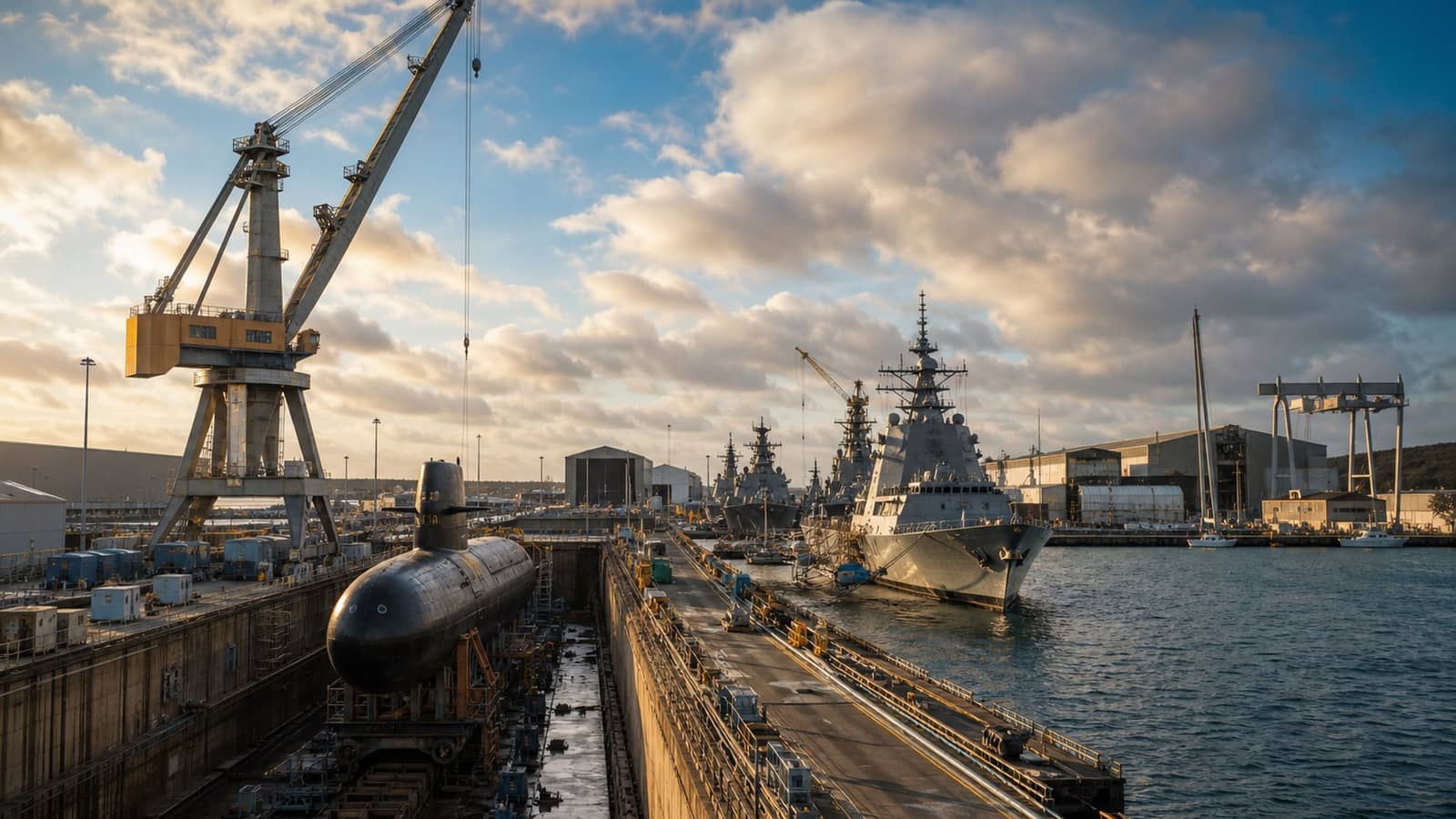

Rear Admiral Douglas J. Adams's AUKUS visit put Henderson Defence Precinct's dry-dock arithmetic on the public wire — capacity questions, not a ribbon-cutting — with US preference colour reported as three graving docks plus a floating dock.
The Nightly's reporting framed Adams's talks with Australian Submarine Agency officials around whether the Western Australian precinct, as lately mapped, can sustain the nuclear-powered boat load AUKUS and Submarine Rotation Force—West imply. Richard Marles's separate confidence line on a first Virginia-class pathway boat planned for 2032 sits in the same alliance calendar. I'm staying on Henderson and the docks.
Henderson is the sustainment geography. The Albanese and Cook governments' late-August 2026 site selection for the Henderson Defence Precinct locked a preferred layout for naval shipbuilding and sustainment, including the sustainment of Australia's future conventionally armed nuclear-powered submarines, on an initial Commonwealth funding commitment already announced in the billions. Site selection isn't dry docks poured. It's the map that lets the next design and dredging work proceed.
Adams's role on the US side is AUKUS integration and acquisition leadership — the Navy officer whose office exists to execute the trilateral submarine pathway. The Nightly revealed high-level talks in Australia focused on Henderson capacity after the precinct boundaries landed. US figures speaking to that outlet said the Pentagon's long-held view was that Henderson should eventually include three graving docks and one floating dock so Australian and US boats can share enough docking windows. That's reported preference and concern, not a signed Australian build schedule for four docks.
Floating-dock work is already a separate named thread. Commonwealth selection of a preliminary-design lead for a contingency floating dry dock earlier in the mid-2026 window sits in the public industrial reporting as a precondition language for receiving Australia's first Virginia-class boat. Henderson and HMAS Stirling are connected and not interchangeable: Stirling on Garden Island is the operating base expanding for submarines and SRF-West; Henderson at the Australian Marine Complex is the construction, sustainment, and contingency-docking precinct. Keep the nouns apart.
Submarine Rotation Force—West is the living posture peg. Rotational US submarine presence on Australia's west coast is already the arrangement later maintenance talk builds on. Adams's visit, on The Nightly's account, sits ahead of continuing US personnel arrivals for SRF-West preparations, with the admiral expected back before year's end on the same reporting. Rotation force is people and boats and base time. Dry docks are how you keep those boats available.
Marles's Virginia 2032 confidence line belongs here as calendar context, not as a second lede. In the broader Washington and alliance coverage of early September, the defence minister has kept public confidence that the first Virginia-class under the AUKUS pathway remains planned for 2032. Three second-hand Virginias across the 2030s are the related handoff language in that same ministerial register. Henderson's dock capacity is how Australia proposes to host maintenance for rotational and, later, pathway boats without sending every deep availability to a distant US yard.
This isn't the force-posture growth story. The Marles–Hegseth Washington thread is about accelerating US force posture initiatives at Australian bases and a promise of further announcements with Penny Wong. Henderson is about the precinct map, Adams's capacity talks, the three-graving-plus-floating preference as reported, SRF-West as the rotation peg, and 2032 as the Virginia confidence mark. Same alliance. Different verb: docks, not posture pressers.
Nouns and numbers. Visitor: Rear Adm. Douglas J. Adams, AUKUS integration and acquisition leadership. Precinct: Henderson Defence Precinct, Western Australia. Reported US preference: three graving docks and one floating dock. Posture peg: Submarine Rotation Force—West. Ministerial timing confidence: Virginia pathway first boat planned 2032. Site selection: Albanese–Cook announcement late August 2026. Sources: The Nightly on the Adams visit; ABC and allied coverage on Marles timing; Commonwealth precinct materials.
Graving dock versus floating dock, in plain Australian. A graving dock is a dug basin you pump dry. A floating dock is a movable lift you sink and raise. Three of one and one of the other is a capacity portfolio for overlapping availabilities — the kind of portfolio a Pentagon sustainment planner asks for when two navies will share a west-coast maintenance load. Australia may stage floating capability earlier as contingency while graving capacity is still a planning fight inside the precinct footprint. Report the preference. Don't invent a concrete pour date.
Capacity questions are how alliances stay honest. The Nightly's sources said US military figures privately questioned how many dry docks fit the nuclear-sustainment slice of the newly published precinct area. That's a footprint argument: nuclear rules, security perimeters, and heavy industry compete for metres of waterfront. Selecting a site answers where. It doesn't automatically answer how many docks of which type. Adams's talks are the US side stress-testing the answer before SRF-West and Virginia pathway dates harden into steel.
Jobs and dollars stay attributed. The Commonwealth's initial twelve-billion-class commitment to deliver the Defence Precinct, announced earlier, and the broader jobs forecasts attached to AUKUS and west-coast shipbuilding are program-scale colour. They're not a per-dock invoice. There's no invented price for three graving docks here.
What "gets the AUKUS visit" means in a headline. It means the AUKUS acquisition admiral flew in, sat with Australian Submarine Agency officials, and put Henderson capacity on the agenda while SRF-West preparations continue. It doesn't mean a treaty rewrite. It doesn't mean Australia has agreed to the Pentagon's three-plus-one dock mix. It means the visit happened and the dock question is now on the public record through The Nightly's reporting.
West Australian readers will ask about local industry sequencing — frigates, landing craft, contingency docking, nuclear sustainment halls. The August site layout names preferred locations for shipbuilding and sustainment activities inside the precinct. Sequencing those builds is the next planning phase the governments said the site decision unlocks. Adams's questions sit inside that phase, not after a finished skyline.
Sea days remain the practical measure under the dock talk. More local docking windows mean less transit dead time for boats that need availabilities. That's the same infrastructure logic that ties Henderson to alliance posture without turning every paragraph into a Washington readout. Leave unannounced dollar figures and unannounced dock counts until they're announced.
Close. Rear Admiral Douglas J. Adams's AUKUS visit centred Henderson Defence Precinct dry-dock capacity; US preference colour in The Nightly's reporting runs to three graving docks and one floating dock; Marles's public confidence still prints Virginia 2032; Submarine Rotation Force—West is the rotation peg already in motion. Site selection in late August set the map. The docks are still the argument. Sources: The Nightly; ABC and allied Marles coverage; Commonwealth precinct announcements. Henderson got the visit. The waterfront still has to answer the capacity question.
The paper
Comments
No notes on this story yet.
Sign in to comment