
Europe just put a plant-glow meter and a third Sentinel-3 into the same night sky. Vega-C flight VV30 left Europe's Spaceport in French Guiana on 15 September 2026 at 03:21 CEST — 14 September at 22:21 local time on the pad — carrying ESA's FLEX Earth Explorer and Copernicus Sentinel-3C on one stack. ESA's launch note says both satellites are up, both separated, and ESA's European Space Operations Centre in Germany has the first signals from each.
Here's the short version. FLEX is ESA's first satellite built specifically to measure photosynthetic activity from orbit by catching the faint fluorescence plants give off while they work. Sentinel-3C is the continuity bird — oceans, land, ice, atmosphere — keeping Copernicus's Sentinel-3 time series honest. One rocket. Two jobs. The official broadcast locked for this page is fmrgyh5s-is — FLEX and Sentinel-3C launch (Official broadcast) on the European Space Agency channel.
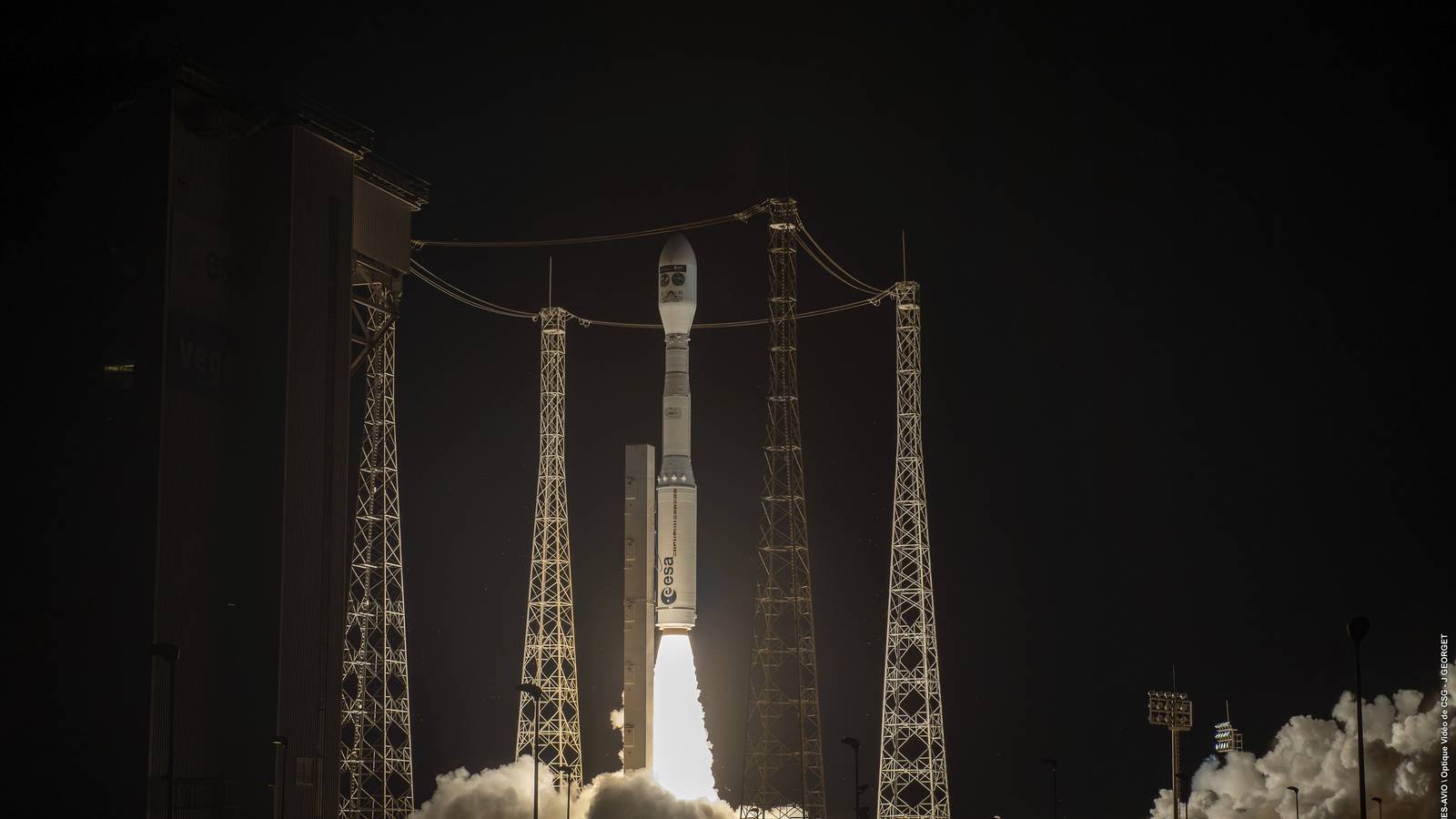
Liftoff on the Kourou clock was late Monday evening local. On the CEST programme it was early Tuesday, 15 September 2026. In Adelaide (UTC+9:30) that was about 10:51 a.m. the same day. What follows is the long public read after first-signal confirmation — the VV30 timeline, the Vespa dual-stack, what FLEX's FLORIS instrument is for, what Sentinel-3C adds to Copernicus, who builds and who operates what after commissioning, and how the tandem orbit plan is supposed to work. No invented quotes. No invented masses. Where Thales Alenia Space and ESA print different colour on the same hardware, the attributions stay on.
What left the pad
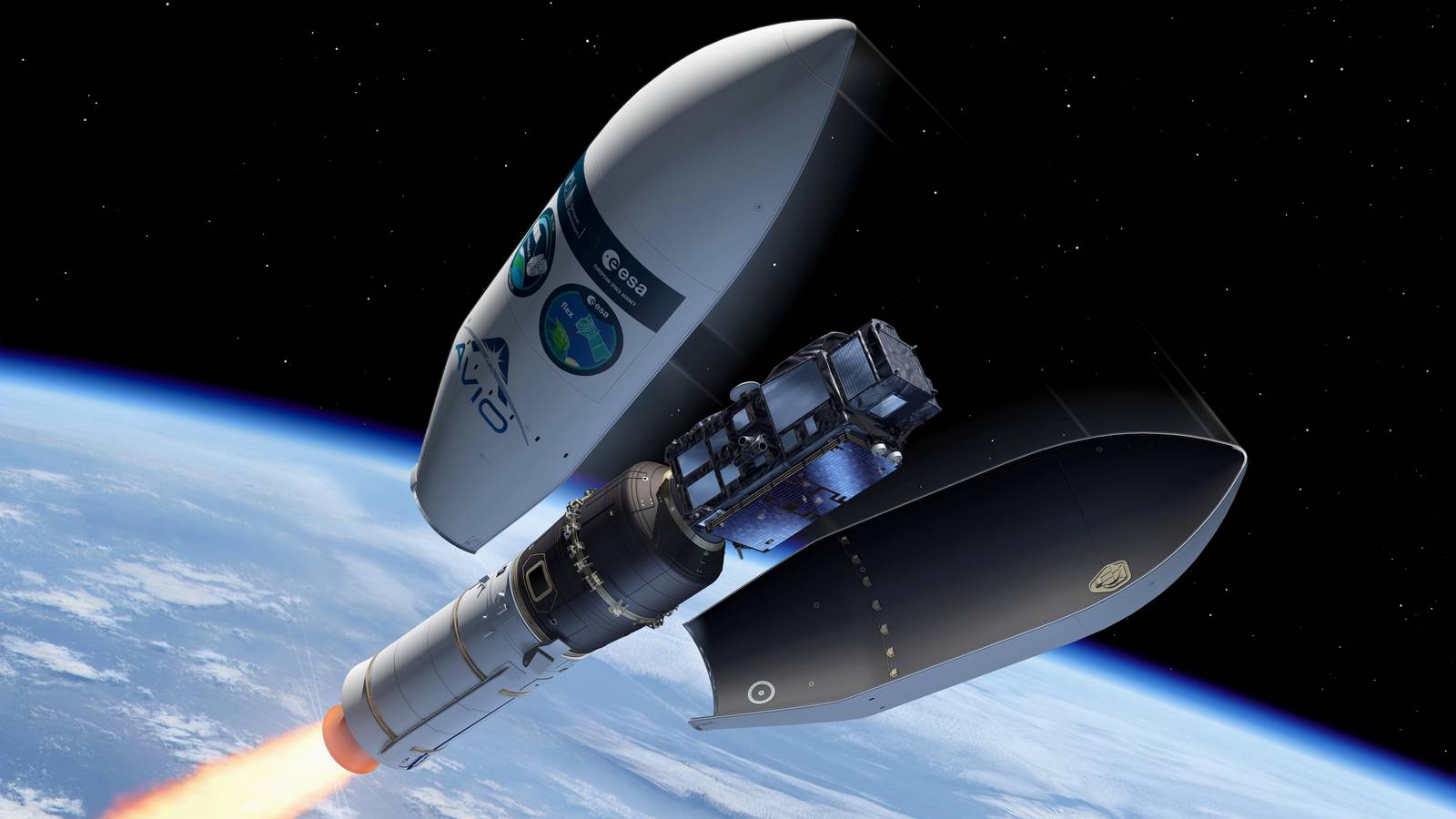
ESA's 15 September success note is blunt. Flight VV30 lifted at 03:21 on 15 September (14 September at 22:21 local). A launch adapter called Vespa stacked the two satellites inside the Vega-C fairing. Sentinel-3C sat on top and went into orbit first. FLEX followed about an hour later from inside the lower Vespa volume.
ESA's pre-launch watch page had already published the broadcast programme in CEST: coverage from 02:50, liftoff 03:21, Sentinel-3C separation around 04:21, FLEX separation around 05:17, broadcast end 05:36. Treat that card as the public show order. The success note confirms the physical order that mattered: Sentinel-3C first, FLEX about an hour later, then first signals at ESOC.
ESA's image caption for the flight calls this a first dual launch for Vega-C using Vespa. That's the launcher story under the science story. Avio is prime contractor and design authority for Vega-C under ESA's programme lead. For VV30, ESA says Avio was also the launch service operator.
Vega-C itself, in ESA's launch-day language: an evolution of the Vega family, able to put 2300 kg into low Earth orbit, about 210 tonnes on the pad, three solid stages then a liquid upper stage for precise placement. The same note puts the rocket at about 35 metres tall in the related image text. Those are ESA figures. Don't upgrade them into a different launcher brochure.
First signal, then LEOP
After the separate deployments, ESA says controllers at the European Space Operations Centre in Germany received the all-important first signal from each satellite. That's the sentence that turns a pretty ascent into a working mission start: release confirmed, contact established.
What comes next is the launch and early orbit phase — LEOP in the trade shorthand. ESA's note says mission controllers will spend the coming days checking and verifying health and performance, confirming systems behave as expected. That's commissioning language, not a claim that science maps are already on your phone.
Once fully operational, ESA says Eumetsat will assume responsibility for operating Sentinel-3C, while FLEX remains under ESA's control. Keep that split. Copernicus marine and near-realtime atmospheric delivery sits in the Eumetsat lane for Sentinel-3. ESA keeps the Earth Explorer research bird.
FLEX — why a fluorescence satellite
Simonetta Cheli, ESA's Director of Earth Observation Programmes, put the pair in one quote on the launch-day page: today's launch culminates years of scientific innovation, engineering excellence, and international cooperation. FLEX, developed inside ESA's FutureEO programme, is a research mission to advance understanding of plant health and the role of photosynthesis in the carbon and water cycles. Sentinel-3C is the third Sentinel-3, systematically measuring oceans, land, ice, and atmosphere for Copernicus Services. Preparing and launching two satellites together, she said, is no easy task — thanks to the experts who got both to orbit safely.
ESA's plain description of FLEX is the one to keep. It is ESA's first satellite designed specifically to measure photosynthetic activity from space. Its Fluorescence Imaging Spectrometer — FLORIS in the industrial notes — will detect the extremely faint fluorescence plants emit as they absorb sunlight during photosynthesis. That signal is invisible to the eye. It is a direct indication of how efficiently vegetation converts sunlight and carbon dioxide into energy. ESA says the measurements help assess plant health, ecosystem productivity, and the effects of environmental stress and climate change.
ESA's watch-page brief adds the map product you can picture: global maps of vegetation fluorescence at a resolution of 300 × 300 metres. ESA's FLEX facts-and-figures page matches that aim — monthly global maps at 300 m × 300 m — and names the goals as global fluorescence measurements that quantify photosynthetic activity and plant stress.
FLORIS spectral language from that same ESA facts page, for readers who want the instrument card: data in the 500–780 nm range, with 0.1 nm sampling in the oxygen bands O2-A (759–769 nm) and O2-B (686–697 nm); 2.0 nm in the chlorophyll absorption band (600–677 nm) and photochemical reflectance index band (500–600 nm); 0.5–0.65 nm elsewhere in the stated range. You don't need to recite nanometres at dinner. You do need to know why oxygen bands matter: they're where the faint fluorescence signal is teased out of reflected sunlight.
Thales Alenia Space's 15 September press release, filed from Kourou, adds industrial mass and life numbers for FLEX: about 400 kg; 814-kilometre orbit; tandem flight with a Sentinel-3; operational lifespan in orbit of 3.5 years. Leonardo builds the high-resolution FLORIS imaging spectrometer in that industrial note. Thales Alenia Space in France is prime for the satellite and platform, with a European consortium of almost forty companies, Beyond Gravity on structures and thermal control among others. Attribute those masses and years to Thales Alenia Space's release unless ESA prints the same figures on the success page.
Hervé Derrey, CEO of Thales Alenia Space, said in that release he was delighted with the successful launch of both satellites, which will provide unique data to scientists and policymakers to help understand climate change and preserve ecosystems, and which demonstrate Europe's leadership in Earth observation as examples of European collaboration for climate action. Corporate quote. Label it.
Sentinel-3C — continuity with teeth
Sentinel-3C isn't the romance sentence. It's the time-series sentence. ESA says it continues long-term collection of essential environmental data: oceans, land, ice, atmosphere; ocean and land-surface temperatures; ocean colour; sea and ice conditions; vegetation; inland-water levels. Near-realtime information for ocean forecasting, climate monitoring, environmental management, and research.
ESA's operations split for Sentinel-3, once past commissioning: jointly managed by ESA and Eumetsat. Eumetsat runs routine spacecraft operations and delivers marine and near-realtime atmospheric data. ESA delivers land, cryosphere, inland water, and offline atmospheric products. Together they serve users worldwide. That's the institutional machine FLEX will ride beside.
Thales Alenia Space's Kourou release puts Sentinel-3C mass at about 1,140 kg, low Earth orbit at 814 km, operational lifespan 7.5 years. It joins Sentinel-3B in orbit in that industrial framing and continues images essential to understanding ocean currents, climate phenomena, and ecosystem health. Four instruments in the Sentinel-3 suite, in Thales language: surface temperature, colour, and height of the oceans, plus land-surface work including vegetation, soil temperature, inland water quality, and fire detection. Thales Alenia Space in France is prime, also developing OLCI (imaging spectrometer) and SRAL (radar altimeter) plus the platform; Leonardo on SLSTR (imaging radiometer); Airbus Defence & Space on MWR (microwave radiometer); more than a hundred European companies in the wider consortium. Again: industrial press card, attributed.
Why they rode together — Vespa and the tandem plan
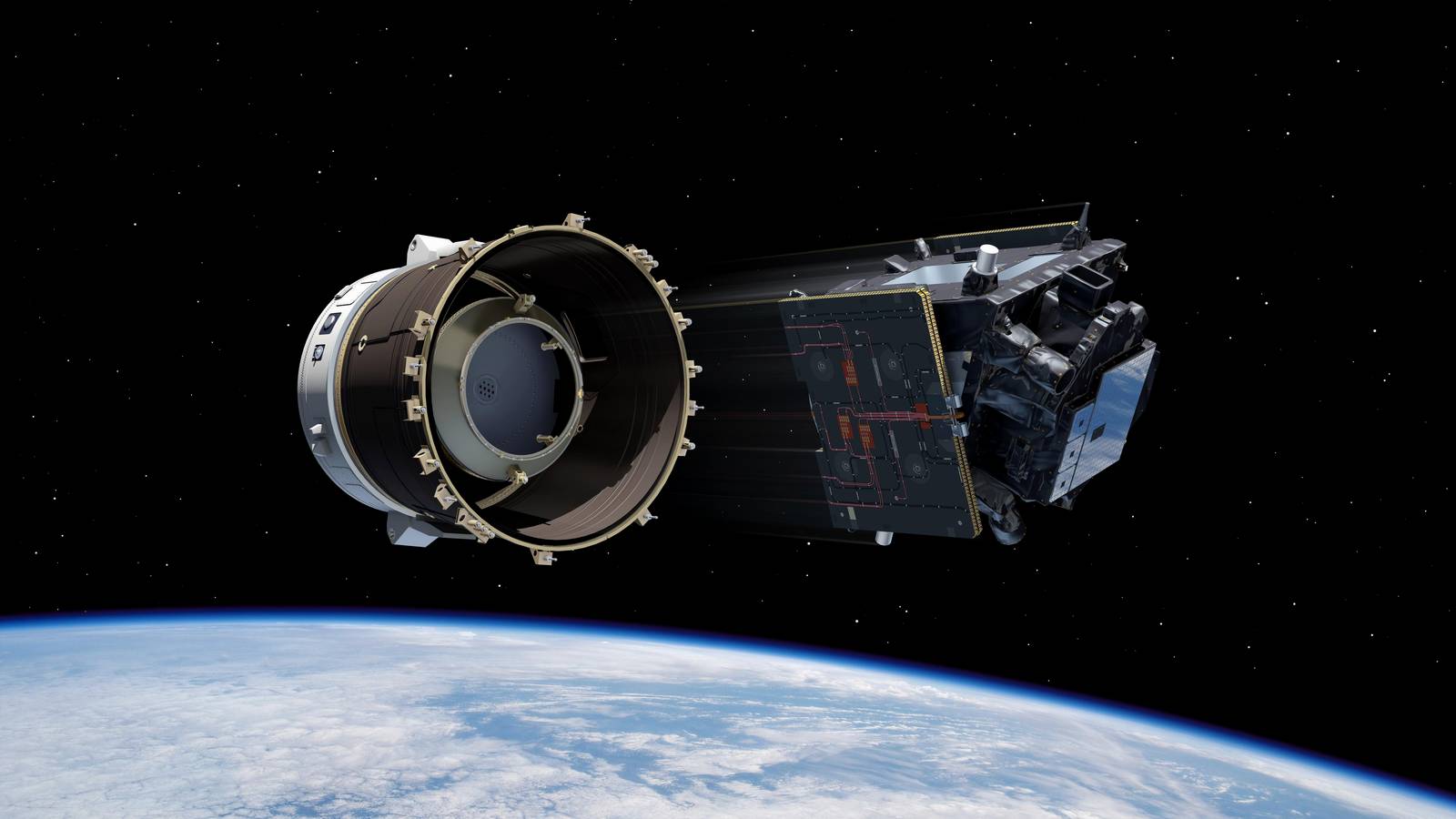
Dual launch isn't a publicity stunt. FLEX needs Sentinel-3-class context measurements almost beside it. ESA's launch note and the earlier watch page both stress the tandem arrangement: FLEX measurements of faint vegetation fluorescence combined with near-simultaneous Sentinel-3 observations of atmosphere — clouds, aerosols, water vapour — and land surface — temperature, land-cover type, additional vegetation parameters. ESA calls that package an unprecedented view of global vegetation function and status.
Orbital gymnastics, in ESA's own phrase: initially FLEX will orbit in tandem with Sentinel-3A, and later Sentinel-3C will be moved to replace Sentinel-3A in that tandem formation. Read that twice. The satellite that shared the fairing with FLEX isn't necessarily the first tandem partner FLEX flies beside. Commissioning and constellation choreography decide the dance. Don't flatten VV30's stack mates into "FLEX always flies with 3C from day one."
Thales Alenia Space's release explains the science bargain in engineer English: FLEX observations combined with Sentinel-3's imaging spectrometer to correct atmospheric bias and quantify fluorescence on the ground; Sentinel-3 optical and thermal sensors giving complementary plant-environment data; better accuracy, better temporal coverage, better interpretation of fluorescence in context.
Vespa is the hardware that made the dual ride possible. ESA's image note: Sentinel-3C on top of Vespa inside the main fairing; once deployed, the Vespa adapter opens to reveal FLEX for its injection. That's why the separation clock stretches across an hour instead of dumping both birds in one breath.
Three clocks
03:21 CEST is 01:21 UTC. Adelaide at UTC+9:30 puts liftoff around 10:51 a.m. local on Tuesday 15 September. ESOC's first-signal work lands in the European morning. This piece is the after-action long read: what flew, why fluorescence, why Copernicus needs a C-unit, who operates what, which YouTube id is official.
If a relative forwards a random reupload of the ascent, send them to ESA's own broadcast — fmrgyh5s-is on the European Space Agency channel, title locked by oembed as FLEX and Sentinel-3C launch (Official broadcast). Prefer that cut over mirror channels.
What FLEX is not
It isn't a farm drone with a bigger battery. Three-hundred-metre monthly global maps are a planetary product, not a per-paddock prescription layer you open on a ute tablet tomorrow morning. Agricultural and food-security relevance shows up in ESA's mission explainers as a societal stake — photosynthesis, stress, carbon — not as a claim that VV30 ends drought risk in the Murray-Darling.
It isn't a replacement for Sentinel-2's high-resolution optical land monitoring or for Sentinel-3's own ocean and land instruments. FLEX adds a fluorescence measurement that those missions weren't built to deliver at this precision. Sentinel-3 supplies the atmospheric and land context FLEX needs. Different photons, shared sky.
It isn't already delivering Level-2 fluorescence products today. LEOP and commissioning come first. ESA's success note is careful about days of health checks. Thales's lifespan numbers — 3.5 years for FLEX, 7.5 for Sentinel-3C — are operational design lives after the satellite is working, not a countdown that started at pad rise.
Earth Explorer eight, Copernicus machine
ESA's Earth Online mission page frames FLEX as the eighth Earth Explorer in the Living Planet / FutureEO line, selected in 2015, aimed at global fluorescence maps that can reflect photosynthetic activity and plant health and stress — with stakes for the carbon cycle, agricultural management, and food security as population demand grows. That's programme history, not launch-day hype. The launch converts a long paper mission into a spacecraft with a carrier signal.
Copernicus is the EU's Earth observation programme component, managed by the European Commission, funded by the EU and partly by ESA, in the language Thales uses and ESA's Sentinel-3 notes support. Sentinel-3C is continuity infrastructure. When a time series of ocean colour or sea-surface temperature underpins a forecast service, a third satellite is how you keep the series from going dark when an older unit ages out.
Cheli's launch-day framing puts both logics together: research innovation (FLEX) and systematic services (Sentinel-3C). Europe's Earth observation brand is that combination — explorers that invent measurements, sentinels that keep measuring.
Who built what
Prime contractor for both satellites: Thales Alenia Space, joint company Thales 67% / Leonardo 33%, per the company's own release. FLEX instrument FLORIS: Leonardo. Sentinel-3 instruments split across Thales Alenia Space, Leonardo, Airbus Defence & Space as named above. Launcher: Vega-C, ESA programme, Avio prime and, for this flight, launch service operator. Spaceport: Europe's Spaceport, French Guiana. Operations: ESOC for early orbit; then Eumetsat for Sentinel-3C routine ops; ESA retains FLEX.
That map tells you why a French Guiana countdown ends in Darmstadt telemetry and, later, in Copernicus service teams and ESA science groups. It also tells Australian readers why this isn't a SpaceX story and isn't a NASA story. Different pad, different flag, different product line — still the same human habit of putting eyes in orbit to watch a stressed biosphere.
How to watch the official broadcast
First: the dual-stack logic. Can you see why Sentinel-3C rides high and leaves first? Vespa is the answer.
Second: the science pitch inside the show. When ESA talks fluorescence, are they selling a pretty green Earth, or a faint signal that needs oxygen bands and a tandem partner to become a map? The honest sell is the second.
Third: institutional handoffs. Listen for Eumetsat, Copernicus, FutureEO, Earth Explorer. Those names are the funding and operations architecture, not garnish.
Fourth: what isn't promised. No same-week global stress map. No claim that one satellite fixes climate policy. A measurement begins.
What this story is not
This isn't Mio and Mercury. That polar-ellipse file stays where it is — different agency partnership, different planet.
This isn't Starlink waiting on Starship, Flight Fourteen, or the Nevada Semi. No SpaceX. No Starlink. No Semi.
This isn't Hanover's Tesla truck from earlier the same Adelaide calendar day. Different continent of news. Don't mash IAA and Kourou into one lede.
And this isn't a game-launch review or a trailer drop. Official film here is a launch broadcast, not a State of Play cut.
The essentials, in order
One. 15 September 2026, 03:21 CEST, Vega-C VV30, Europe's Spaceport, French Guiana. Local pad time 14 September 22:21.
Two. Payloads: FLEX (Fluorescence Explorer) and Copernicus Sentinel-3C. Vespa dual stack. Sentinel-3C separates first; FLEX about an hour later.
Three. ESOC Germany received first signals from both. LEOP health checks come next over coming days.
Four. FLEX: first ESA satellite dedicated to measuring photosynthetic activity via plant fluorescence; FLORIS spectrometer; about 300 m fluorescence maps in ESA's product language; FutureEO / Earth Explorer research mission; Thales about 400 kg, 814 km, 3.5-year life; ESA retains operations.
Five. Sentinel-3C: third Sentinel-3; oceans, land, ice, atmosphere continuity for Copernicus; after commissioning, Eumetsat operates with ESA product roles as ESA describes; Thales about 1,140 kg, 814 km, 7.5-year life.
Six. Tandem: FLEX flies with a Sentinel-3 for atmospheric and land context; initially with Sentinel-3A, later Sentinel-3C moves into that tandem role per ESA.
Seven. Launcher: Vega-C, about 2300 kg to LEO class in ESA language, Avio as prime and this flight's operator.
Eight. Embed: fmrgyh5s-is — ESA official broadcast.
Why fluorescence matters as news
Plants don't only look green. While photosystems run, a tiny fraction of absorbed energy re-emerges as fluorescence — a glow too faint for your eye at landscape scale, strong enough, with the right spectrometer and the right atmospheric correction, to become a global data product. ESA's public case is that this glow tracks how hard and how well vegetation is working, including under heat, drought, and other stress.
Carbon-cycle models, agricultural early warning, biodiversity monitoring — those are the application lanes Thales and ESA both name. Nobody here invents a bushel forecast from a launch day. The measurement ESA has been designing since the Earth Explorer selection now has a spacecraft on orbit with a confirmed carrier signal.
Sentinel-3's job beside that glow is unromantic and essential. If you can't characterise the atmosphere between the plant and the sensor, fluorescence retrievals get dirty. If you can't place the glow next to land-surface temperature and cover type, interpretation stays thin. Tandem is the architecture that tries to keep the faint signal honest.
Commissioning without fake milestones
Launch success isn't mission success. Mission success for FLEX will look like calibrated fluorescence products, validated against ground truth, flowing into science and, eventually, into services people trust. Mission success for Sentinel-3C will look like another solid unit in a series users already depend on — seamless enough that most of the public never learns its letter.
ESA's "coming days" LEOP language is the right temperature. Controllers check power, thermal, attitude, communications, then instruments. Orbit trim burns happen. Tandem phasing with Sentinel-3A is a navigation problem as much as a science problem. None of that belongs in a triumphant present tense.
When Eumetsat takes Sentinel-3C routine operations after commissioning, that handoff is how Copernicus industrialises a satellite. FLEX staying with ESA is how an Earth Explorer stays a research mission even while it flies next to an operational sentinel.
Europe's independent access, in one flight
Vega-C exists so Europe can loft scientific and Earth observation mass without borrowing another continent's medium launcher every time. ESA's launch materials lean on that independence theme: versatile access, Avio as industrial spine, Kourou as the shared European pad. VV30's dual Earth-observation load is a showcase of that policy in hardware — not a speech, a stack.
For readers who live under Southern skies, the practical takeaway is still data geography. Copernicus products and ESA Earth Explorer science don't care which café you open them in. An Adelaide climate researcher, a farm consultant, a university lab — all of them sit downstream of whether FLEX's fluorescence retrievals and Sentinel-3C's ocean and land streams stay healthy. 15 September 2026 is the day those two particular serial numbers left Earth.
Primary sources
YouTube — FLEX and Sentinel-3C launch (Official broadcast), European Space Agency (article youtubeId): https://www.youtube.com/watch?v=fmrgyh5s-is (fmrgyh5s-is). oembed confirmed: author_name European Space Agency, ESA.
ESA — FLEX and Sentinel-3C launched (15 September 2026): https://www.esa.int/Applications/Observing_the_Earth/FLEX_and_Sentinel-3C_launched (03:21 liftoff; Vespa; S-3C then FLEX; ESOC first signals; Cheli quote; FLEX fluorescence mission; Sentinel-3C role; Vega-C / Avio; Eumetsat ops handoff; tandem with 3A then 3C).
ESA — Watch: FLEX and Sentinel-3C launch on Vega-C (programme times, mission briefs, 300×300 m maps): https://www.esa.int/Applications/Observing_the_Earth/Watch_FLEX_and_Sentinel-3C_launch_on_Vega-C.
ESA — Vega-C takes FLEX and Sentinel-3C into orbit (image note; first dual launch / Vespa; 35 m / 210 t / 2300 kg class language): https://www.esa.int/ESA_Multimedia/Images/2026/09/Vega-C_takes_FLEX_and_Sentinel-3C_into_orbit.
ESA — FLEX facts and figures (300 m monthly maps; FLORIS spectral sampling): https://www.esa.int/Applications/Observing_the_Earth/FutureEO/FLEX/Facts_and_figures.
ESA Earth Online — FLEX mission overview (Earth Explorer eight; fluorescence / carbon / agriculture framing): https://earth.esa.int/eogateway/missions/flex.
Thales Alenia Space — Earth observation satellites Copernicus Sentinel-3C and Earth Explorer FLEX successfully launched (15 September 2026, Kourou): https://www.thalesaleniaspace.com/en/press-releases/earth-observation-satellites-copernicus-sentinel-3c-and-earth-explorer-flex (Derrey quote; S-3C ~1140 kg / 814 km / 7.5 y; FLEX ~400 kg / 814 km / 3.5 y; FLORIS Leonardo; consortium notes).
What flew
FLEX and Sentinel-3C flew. Vega-C VV30 put Europe's photosynthesis explorer and the next Sentinel-3 into orbit on the same ride. ESOC heard both. The official broadcast id is fmrgyh5s-is. The science bargain is a faint plant glow plus a sentinel's atmospheric and land context. The operations bargain is ESA on FLEX, Eumetsat on Sentinel-3C after commissioning, tandem choreography that starts with Sentinel-3A before 3C slides into the formation.
Carry this out the door: Europe now has a dedicated fluorescence mission on orbit beside a refreshed Sentinel-3, and the public tape of how they got there lives on ESA's own channel — not on a mirror, not on a rumour cut.
The paper
Comments
No notes on this story yet.
Sign in to comment