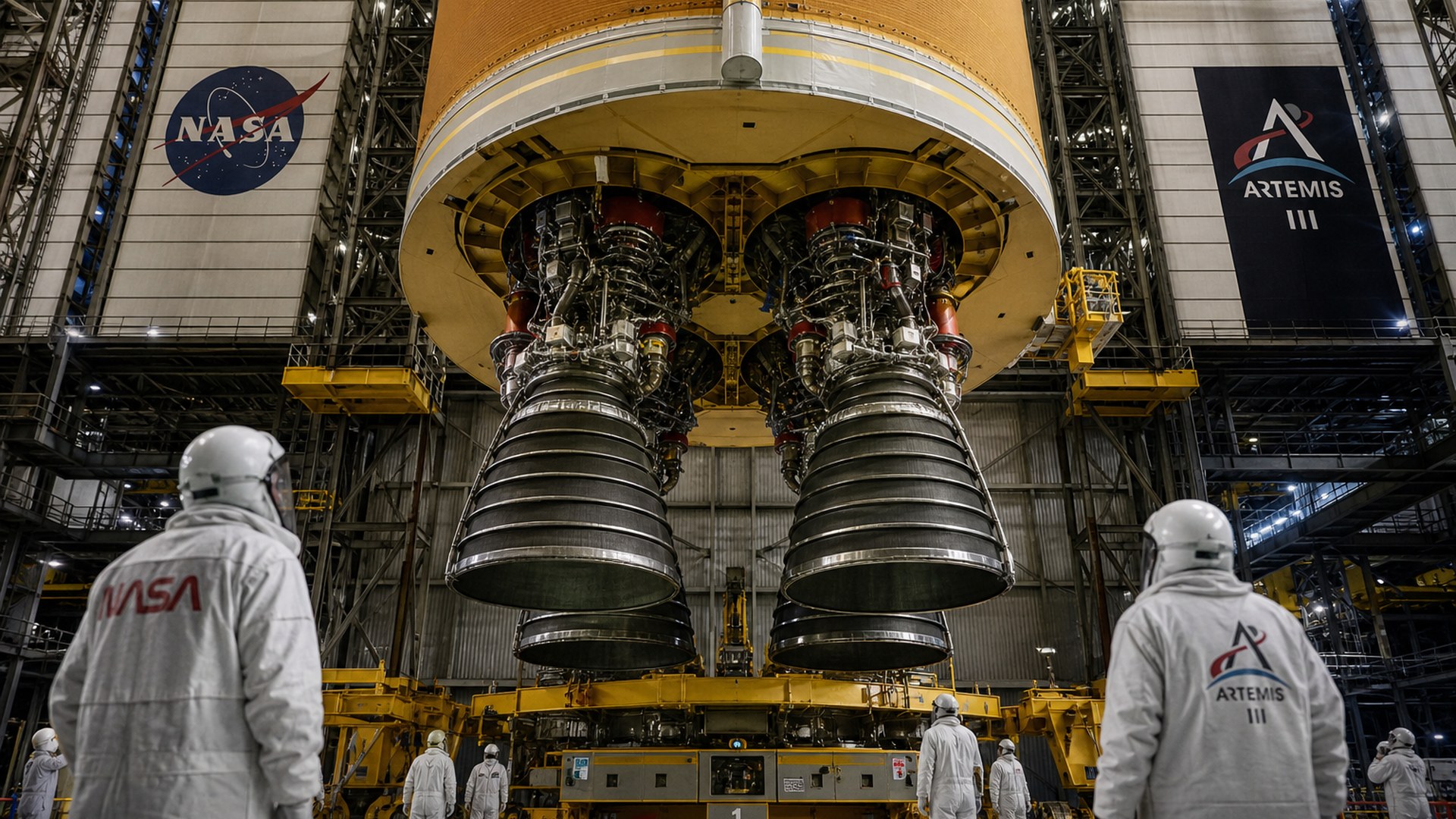

Artemis III has its four RS-25 engines on the work stand. Technicians finished the install on Tuesday, 1 September 2026, inside the Vehicle Assembly Building at NASA’s Kennedy Space Center in Florida — a hardware milestone you can photograph, not a schedule rumour.
Ars Technica’s Rocket Report carried the note on 4 September 2026, with NASA/Clayton Rougelot photo credit in the source chain. The engines are ready for integration with the Artemis III core stage. That bolt-up is the news. The rest is what it sits inside.
Four RS-25 engines. One core stage waiting. The Vehicle Assembly Building at Kennedy is where that mating work happens. On 1 September the install on the work stand was complete. You can argue about manifests and landing architecture for years. You can’t argue with four engines sitting where the integration flow needs them.
Artemis III is currently framed as a roughly two-week low Earth orbit risk-reduction flight, no earlier than summer 2027, under NASA Administrator Jared Isaacman, before later lunar landing plans. That framing matters. It isn’t “moon next summer” copy. It’s an LEO shakedown path with a not-earlier-than summer 2027 window attached, and lunar landing goals stacked after. The engine install is progress toward that flight, not a countdown clock.
Crew was announced earlier in 2026: Andre Douglas, Luca Parmitano, Randy Bresnik, and Frank Rubio. June 2026 coverage carried that slate — two NASA astronauts with deep station and shuttle-era heritage in the mix, a European Space Agency flyer in Parmitano, and the named four who’ll train against whatever Artemis III becomes as the risk-reduction plan firms up. The engines don’t care who flies. The programme does.
SLS core-stage integration is a gate, which is why the Rocket Report logged it. RS-25s are the main propulsion for the core. Until they’re on the stand and cleared into the integration flow, the stack is paperwork and prior hardware. After 1 September, the Artemis III core-stage path has a completed four-engine install to point at. Ars Technica treated it as a concrete milestone. So do I.
Kennedy’s Vehicle Assembly Building isn’t a metaphor. It’s the high bay where SLS stages and engines come together in Florida. Clayton Rougelot’s NASA photography is the visual record attached to the source notes. If you’ve seen prior Artemis core-stage engine work, you know the geometry: engines on a stand, core stage in the integration sequence, VAB as the building. This week that sequence advanced for Artemis III.
RS-25 heritage is worth one plain paragraph if you only know the acronym. These are the Space Shuttle Main Engine family, modernised for SLS. Four of them under an SLS core is the standard propulsion layout for that stage. Installing all four for Artemis III is how you move from engines in inventory to engines in the integration flow for this vehicle. The work stand is the intermediate fixture before the core-stage mate. Tuesday’s completion is that intermediate step done.
Isaacman’s framing of Artemis III as an LEO risk-reduction flight changes how you should read every hardware update. A two-week low Earth orbit mission no earlier than summer 2027 is a test-and-reduce-risk profile, not a lunar surface profile. Later lunar landing plans remain on the broader Artemis board. Which subsequent flight lands whom where isn’t settled in the sources I’m using. What is settled: the Artemis III core stage now has its four RS-25s installed on the stand for integration.
Risk reduction in LEO has engineering logic. A roughly two-week flight gives time to exercise systems, collect performance data, and retire risks that are cheaper to face in Earth orbit than on a lunar timeline. “No earlier than summer 2027” under Administrator Jared Isaacman is a floor, not a promise of a July liftoff party. Later lunar landing plans stay in the Artemis sequence after that shakedown logic. The four RS-25s on the stand are how the core stage becomes a flying article for whichever of those profiles Artemis III finally flies.
Integration next means the engines leave the work-stand phase and join the core stage in the VAB flow. That sentence is mechanical, and it’s enough. Tuesday’s completion is the prerequisite. Ars Technica’s Rocket Report on 4 September logged it because hardware gates are how you measure SLS progress between crew announcements and manifesto fights. June’s crew coverage named Douglas, Parmitano, Bresnik, and Rubio. September’s hardware coverage names four RS-25s. Together they’re a vehicle and a crew moving in the same programme year.
Kennedy Space Center. Vehicle Assembly Building. Core stage integration flow. RS-25 quartet on the work stand as of 1 September 2026. Photographers from NASA, including Clayton Rougelot in the credit line the sources note, document these steps because a public programme needs visible hardware between the manifesto debates. An engine install is visible. It’s also necessary.
Training pipelines will track the LEO risk-reduction objectives as NASA firms them. The engine milestone doesn’t change the crew slate; it changes how close the vehicle is to being a stack. Parmitano brings ESA into the capsule conversation. Bresnik and Rubio are known quantities to anyone who followed ISS expeditions and prior NASA assignments. Douglas rounds out the four. Announced earlier in 2026; June reporting is the prior beat.
No wet dress rehearsal date here, no launch window in a specific week, no lunar landing crew rotation beyond what sources state. The Ars Technica item on 4 September is about the engine installation completing on 1 September. Prior June 2026 coverage is about the crew. Isaacman’s administration frames Artemis III as LEO risk reduction before later landing plans. Hold those three together and you don’t need a lunar flag plant this week to call it progress.
Hardware moved. Four engines are on the work stand. Integration with the Artemis III core stage inside the VAB is the next mechanical chapter those engines enable. Summer 2027 as a not-earlier-than for an LEO risk-reduction flight is still the schedule language in the current framing. That’s progress without hyping the Moon.
On Tuesday, 1 September 2026, technicians finished installing all four RS-25 engines on the work stand for integration with the Artemis III core stage inside the Vehicle Assembly Building at NASA Kennedy Space Center, Florida. Artemis III is framed as a roughly two-week LEO risk-reduction flight no earlier than summer 2027 under Administrator Jared Isaacman, ahead of later lunar landing plans. Crew announced earlier in 2026: Andre Douglas, Luca Parmitano, Randy Bresnik, Frank Rubio. Ars Technica Rocket Report, 4 September 2026; prior Artemis III crew coverage, June 2026; NASA/Clayton Rougelot in the photo credit chain. The engines are on the stand.


The paper
Comments
No notes on this story yet.
Sign in to comment