A signature describes a module's interface: module type STACK = sig type 'a t val empty : 'a t val push : 'a -> 'a t -> 'a t end.
OCaml Medium · Lesson 1 · On the house
Signatures and abstract types
module type, sig ... end, hiding representations, and .mli files. Lesson 1 is free — on the house.
Lessons · OCaml Medium · Lesson 1 of 10 · On the house
Signatures and abstract types
module type, sig ... end, hiding representations, and .mli files.
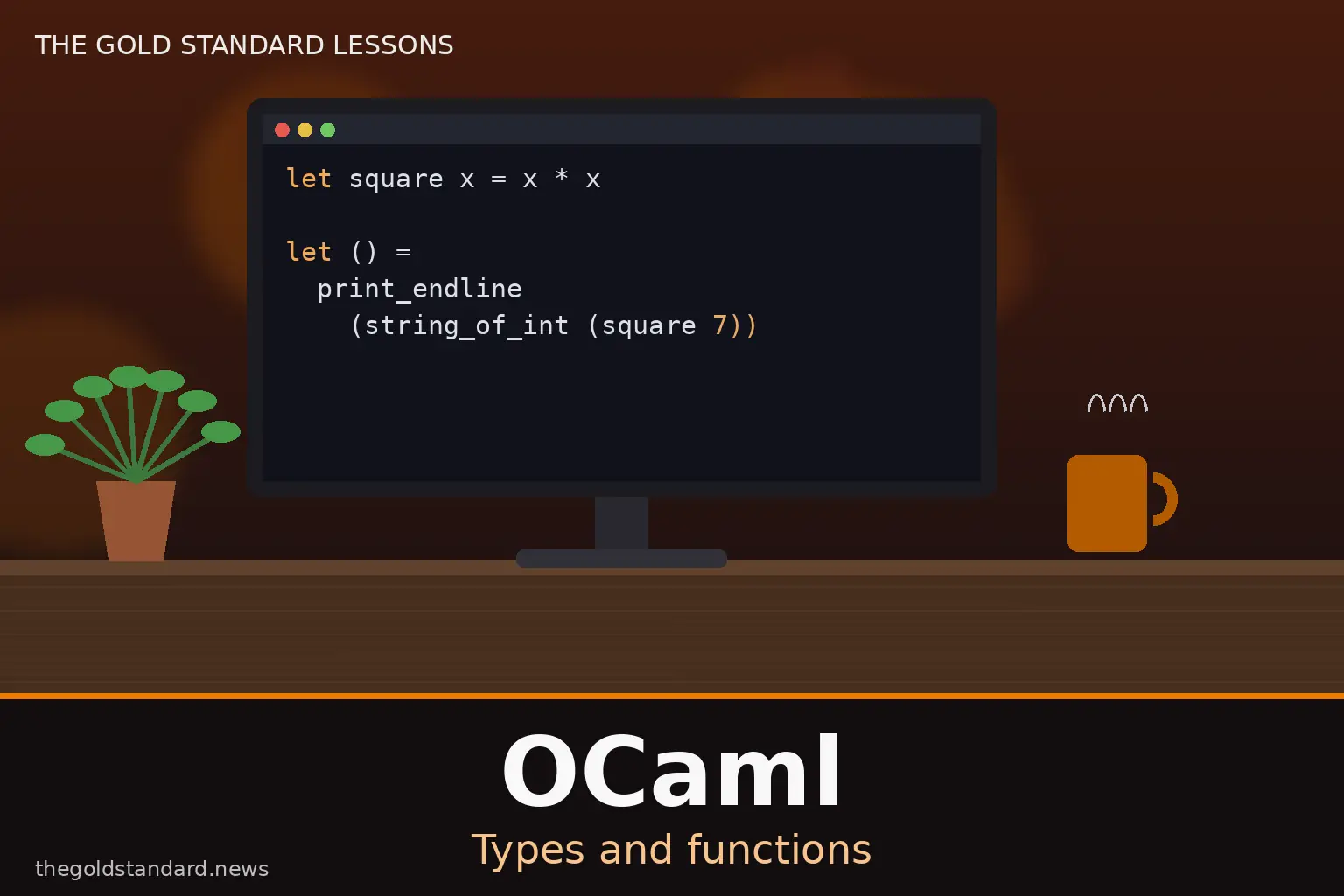
Constrain a module with it: module Stack : STACK = struct type 'a t = 'a list ... end. Outside, 'a Stack.t is abstract: nobody can see or depend on it being a list.
Abstraction enforces invariants. A Sorted_list module can guarantee sorting because only its own functions can build values of its type.
An .mli file is the signature of the matching .ml file. Write it first for library code; it doubles as documentation.
include copies a module's contents into another, which is useful for extending a module with a few functions.
abstract type
module type COUNTER = sig
  type t
  val zero : t
  val incr : t -> t
  val to_int : t -> int
end

module Counter : COUNTER = struct
  type t = int
  let zero = 0
  let incr n = n + 1
  let to_int n = n
end

let () =
  let c = Counter.(zero |> incr |> incr) in
  print_endline (string_of_int (Counter.to_int c))
Quiz
Quiz
Quiz
Quiz
Check
Match the still for: Signatures and abstract types.
Open-book: the answers are on this page. Pass every quiz and check (5) to mark the lesson done. This visit: 0/5.